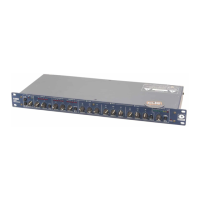
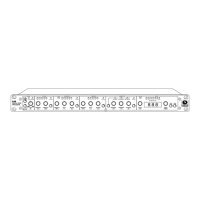
528E
13
De-essers
A de-esser is another type of dynamic range controller that’s specially designed to regulate high
frequency content. The technique was originally developed for motion picture dialogue recording,
when it was discovered that speech sounded more natural and pleasing when the accentuation of
sibilants was reduced. By sensing and limiting certain selected frequencies, the de-esser is in tend ed
to provide more specifi c control over some of the higher frequency vocal sounds that tend to be-
come overemphasized especially when the talker is close-miked.
Many sibilant vocal sounds like “s,” “sh,” and “t” are very diffi cult to reproduce electronically, be-
cause they contain a large percentage of very high frequency harmonics. But because these sounds
are essential to the intelligibility of speech, they cannot be simply removed with equal iza tion. In
fact, to help maintain articulation many sound engineers boost the higher frequencies of the vocal
spectrum (3 kHz to 8 kHz), and/or use microphones with “presence curves.” However, in certain
individuals sibilant sounds are already over-accentuated, and any kind of high frequency boost only
exacerbates the situation.
The 528E’s de-esser controls excessive sibilant and fricative vocal sounds, which can often be as
much as 12 dB louder than the rest of the spectrum. It’s activity is similar to a frequency conscious
compressor/limiter (with an equalizer boosting the high frequencies in the sidechain). Unlike a
compressor/limiter however, the de-esser operates only on the frequencies selected and above.
Unlike an equalizer, the de-esser can reduce the offending sounds without sac ri fi c ing intelligibility,
because it operates dynamically, removing only sounds that are disproportionately loud, and only
those that fall within the operator-selected control range.
De-essers usually include controls that allow the operator to determine which frequencies are con-
trolled, and how much those frequencies are actually attenuated. The 528E’s de-esser controls are
frequency, which is variable from 800 Hz to 8 kHz, and threshold, which may be set from 0 dB to
-30 dB. In other words, the 528E’s de-esser will attenuate selected frequencies between 800 Hz and
8 kHz as much as 20 dB.
Sidechain Processing
The sidechain is a patch point in the control circuit of a dynamic range processor, which provides
access to the part of the circuitry that tells the VCA what to do. The 528E’s sidechain routes through
a rear panel TRS jack that allows the control signal to be processed outside the unit (see Figure 7-6
for specifi c hookup information).
Refer to the block diagram in Figure 7-1. Notice the sidechain connections that come from the
compressor/limiter/expander section. They allow access to the audio input of the control circuit (a
fancy envelope follower by any other name) for the dynamic range processor. This control signal
is derived from, but kept totally separate from, the audio signal path. That means the control signal
can be processed outside the 528E without actually processing the signal that’s going through the
VCA (the audio signal itself). This presents some very interesting possibilities for changing or im-
proving the operation of the dynamic range processor.
The best use of the sidechain connections is to make the action of the 528E’s dynamics processor
frequency dependent, that is, to make it respond more (or less) to certain frequencies. Because the
audio signal and the control signal remain completely separate (even while the control circuit tells
the VCA whether to turn the gain up or down), you can equalize the sidechain without changing the
EQ in the main audio path.
Removing unwanted frequencies from the control signal before it actually reaches the VCA pre-
vents those frequencies from being used to create gain changes. Applications utilizing the sidechain
may be found in Chapter 8.


 To Next Page
 Loading...