528E
25
Tips and Techniques for Using the 528E
Following are some tips and techniques for using the 528E. You should consider any settings given
as starting points for developing your own settings. More general discussions of these topics may
also be found in Chapter 6 of this manual.
METERING
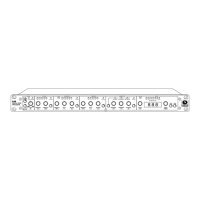
The 528E has several LED bargraphs that serve as gain reduction and output meters. The gain-re-
duction meters indicate the change, from unity gain, for their respective function and the LEDs read
(and move) from right to left. When operating as a level meter, the LEDs read (and move) from left
to right. Each meter has its own scale markings, as shown on the front panel.
GAIN SETTING
There are two places to adjust the gain of the 528E: at the mic input, before any processing, and at
the output. An understanding of this topic is essential to getting the most from your 528E. A more
basic discussion can be found under the heading, “Gain Setting,” in Chapter 7.
First, the mic input gains. You make best use of the 528Es signal-to-noise ratio by ensuring that
your mic-level input signals are adjusted to fi t within the headroom of the mic preamp. Doing so en-
sures optimum dynamic range through the mic preamp and succeeding processors. With the De-es-
ser, Expander/Compressor, and EQ sections temporarily set to BYPASS and the OUTPUT GAIN control
set to 0 dB (12:00 o’clock), set the MIC GAIN control so that the OUTPUT LEVEL display indicates
levels in the -10 to 0 VU range. The CLIP LED should never illuminate on signal peaks. Remember
to restore the settings of the various bypass switches.
Finally, the OUTPUT GAIN. After adjusting all of the other processors, set this control so that the 0
VU LED on the OUTPUT LEVEL meter illuminates. The red CLIP LED should never illuminate.
The output CLIP LED also monitors the EQ section. If the CLIP LED illuminates, reduce the OUTPUT
GAIN control setting slightly. You may need to increase the gain of some device following the 528E
to achieve the same overall level.
EQUALIZATION
Bandwidth specs, in octaves, for some popular equalizers.
Name BW (min) BW (max)
API 550 1.6 n/a
Focusrite 0.6 1.8
Neve V3 0.2 3.0
SSL G 1.4 2.8
SSL E 0.5 2.5
The 528Es parametric equalizer has three overlapping bands. Each band can operate as a peaking or
dipping equalizer. The boost and cut range for each band is ±15 dB. The bandwidth may be varied
from 0.3 to 4-octaves wide.
Since the bands overlap, it is possible to apply equalization at the same frequency in two places.
Doing so could conceivably increase the signal level by 30 dB at one frequency. You may need to
reduce the INPUT or OUTPUT GAIN to avoid distortion. Likewise, large amounts of boost in any one
band may require reducing the setting of the OUTPUT GAIN control to prevent overload. Let the OUT-
PUT CLIP LED be your guide.
Electronic considerations aside, one of the contributing factors to an equalizer’s sound is its band-
width. The table above lists the bandwidths (octaves) for several (possibly) familiar equal iz ers, as
found on their respective mixing consoles. While we make no promise that the 528E will sound the
same, these settings may be a good starting point if one of these equalizers is within your frame of
reference.


 To Next Page