RETURNS
STANDARD ROUTING WITH DIO 18
WHICH SLOT SHOULD BE USED FOR THE UNIT•Y CARD?
A UNIT•Y card using Standard Routing may be fitted into any slot.
More cards may be used simultaneously.
Signals from a UnitY card in slot 1 will appear on Tape inputs 1-8.
Signals from a UnitY card in Slot 2 will appear on Tape inputs 9-16.
Signals from a UnitY card in Slot 3 will appear on Mic inputs 1-8.
Signals from a UnitY card in Slot 4 will appear on Mic inputs 9-16.
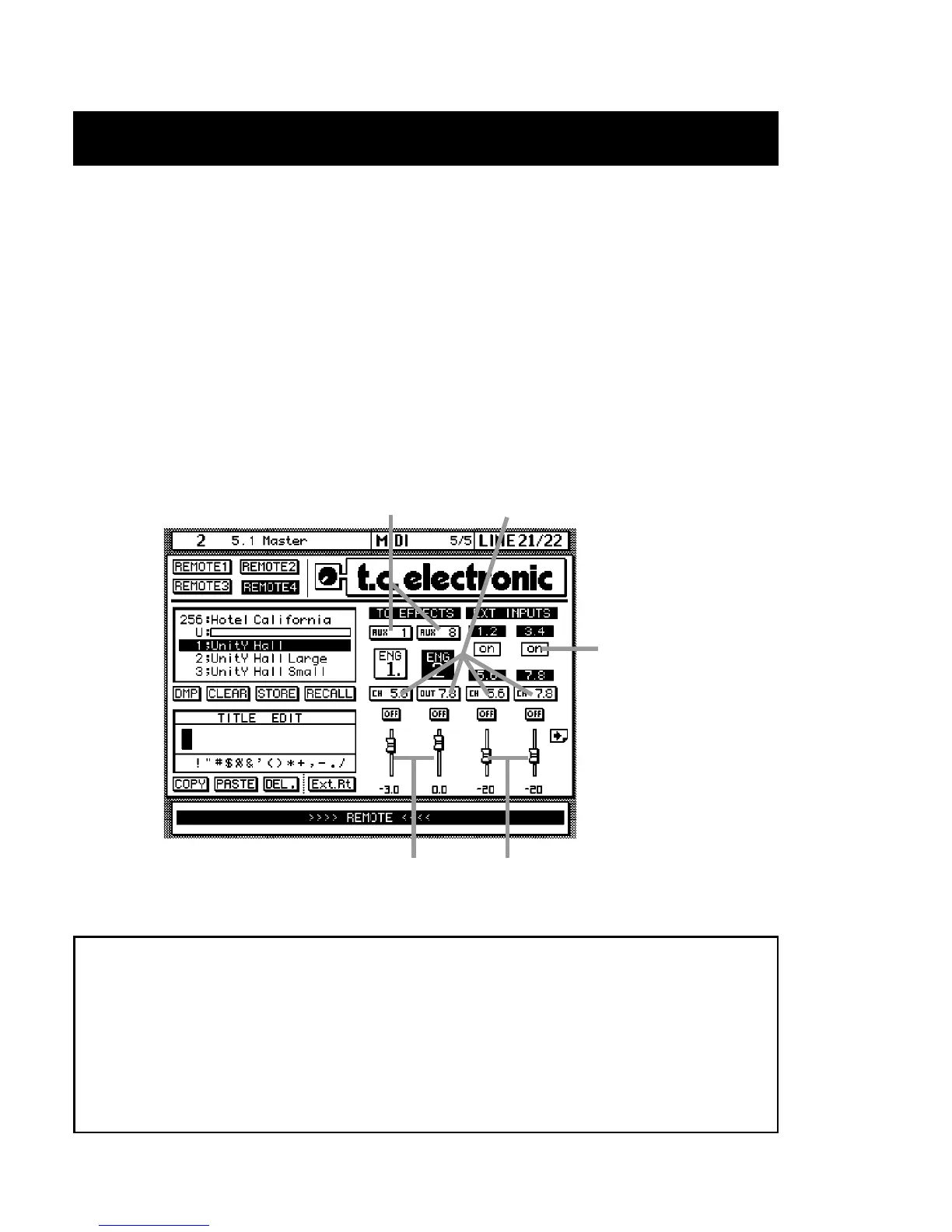
Input Select Output Select
Engine Output Faders External Input Faders
For a card positioned in slot 4, the two UNIT•Y stereo engines return on Mic inputs 13-16,
or may be directed to outputs 5-8 of the card.
External inputs return on Mic inputs 9-16 like with a normal Yamaha I/O card. External
inputs 5/6 and/or 7/8 are mixed with UNIT•Y effects at 24 bit resolution. The submix is
passed on to Mic input 13/14 and 15/16. Submix levels are automatable.
To adjust or mix the Engine return levels and external inputs 5-8, use the four stereo faders
when you are on a UNIT•Y screen.
Note: If you use the Stereo Bus Insert Return, the return signals will also be available on
channel 5/6. Be sure to turn them down to avoid phase cancellation or loops. For a card
with DIO capabilities, it will often be more desirable to output the Finalizer from the card
directly.
UNIT•Y
Main
screen
for
a
card
with
I/O
extension
fitted
These fields show “ON” to verify I/O
extension. Settings can’t be altered.



 To Next Page