1-88 System 3
RZ-UDP Communications Interface
packet = struct.pack(">%di" % len(data), *(i for i in
data))
# send the data packet to the UDP interface.
print 'sending packet', count, '...'
sock.send(header + packet)
count += 1
# slow it down for demonstration purposes
time.sleep(.2)
UDPInterfacePerformance
The UDP interface is a 10Mb Ethernet interface, but the usable bandwidth is
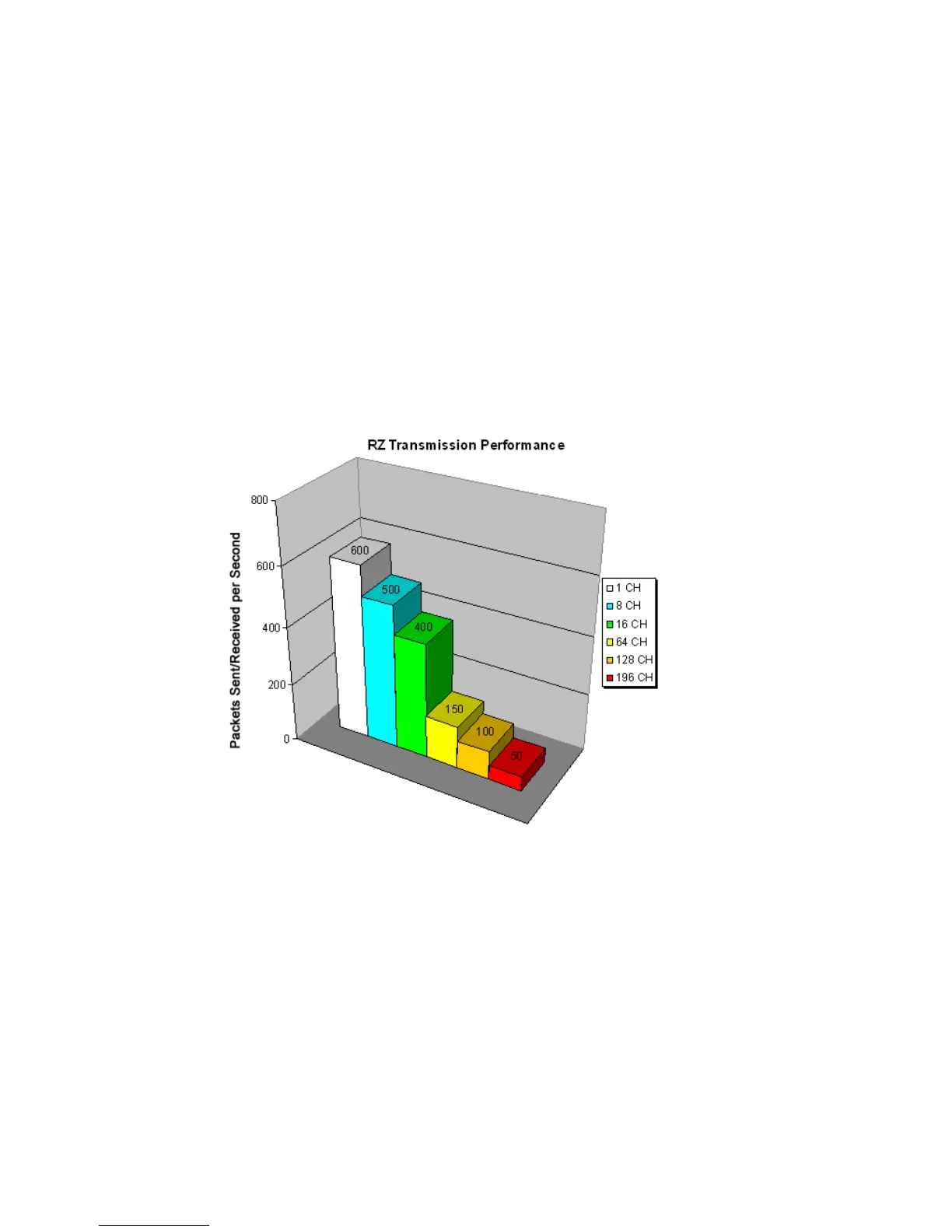
significantly lower due to limitations of the Ethernet hardware. A graph below displays
the expected throughput for different numbers of packets sent or received per second
depending on the number of channels transmitted on an RZ processor.
The bandwidth for transmitting data from an RZ through the UDP interface decreases
depending on the width (or number of channels) of packets sent or received.
Transmission of a single packet (single channel) provides a high amount of data
resolution since the packets are transmitted at a much higher rate and would respond
quickly to abrupt changes in value. Transmitting multiple packets (large number of
channels) allows more information to be sent in parallel but reduces data resolution.
RelativePerformance
A typical application might involve sending a packet size of 16 channels 100 times
per second or a packet size of 100 channels 10 times per second. As shown in the
diagram above, the UDP interface will be able to send a packet size of 16 channels
400 times per second or a packet size of 128 channels 100 times per second.
As a result, the UDP performance is relative to the size of the packet, dictated by
the number of channels transmitted.


 To Next Page