EasyManua.ls Logo

Teac A-100 - Cassette Tape

Teac A-100
9 pages
Print Icon
To Next Page IconTo Next Page
To Previous Page IconTo Previous Page
Loading...
Cassette
Tape
Fig.
E
Fig.
C
From
side
A
(1)
Back
side
B
(2|
Fig.
A
Side
B
record
tab
Fig.
F
Fig-
D
J
B-
A
Fig.
B
Fig.
G
2
HiFi
CrOa
FeCr
Monophonic
head
Before
Recording
or
Playing
Back
a
Cassette
Tape
A
tape
that
is
loose
or
slack
inside
the
cassette
case
may
become
wound
around
the
capstan
or
pinch
roller.
To
avoid
this
problem,
check
and
tighten
(if
necessary)
C-30
C-60
C-90
C-120
C-180
the
tape
by
using
a
pencil
or
other
suitable
implement
as
shown
in
fig.
E.
Cover
the
hole
with
cellophane
tape
Side
A
record
tab
Stereo
head
®
(D
(D
O
jgQoLCZj
Protection
of
Recorded
Tapes
Pre-recorded
cassettes
can
be
protected
against
accidental
erasure
or
re-recording
by
removing
the
"punch
out"
record
tab
as
shown
in
figure
F.
Each
cassette
contains
two
record
tabs,
one
for
each
side
of
the
tape.
With
Side
A
(or
1)
of
the
cassette
facing
up
as
shown,
the
record
tab
for
Side
A
is
on
the
right
end
of
the
cassette
case
and
the
record
tab
for
Side
B
is
on
the
left
end.
When
this
tab
is
removed
and
the
cassette
inserted
into
a
tape
deck
the
deck
cannot
go
into
a
record
mode
because
the
deck
has
a
special
sensing
arm
which
checks
for
the
presence
of
this
tab.
If
the
tab
is
removed,
the
record
and
erase
functions
are
inhibited
and
the
tape
cannot
be
re-recorded.
If
the
tab
is
removed,
(using
a
screwdriver
as
shown)
and
later
the
recordist
decides
to
re-record
the
cassette,
a
piece
of
tape
can
be
placed
over
the
tab
hole
to
allow
recording
(Fig.
F,
G).
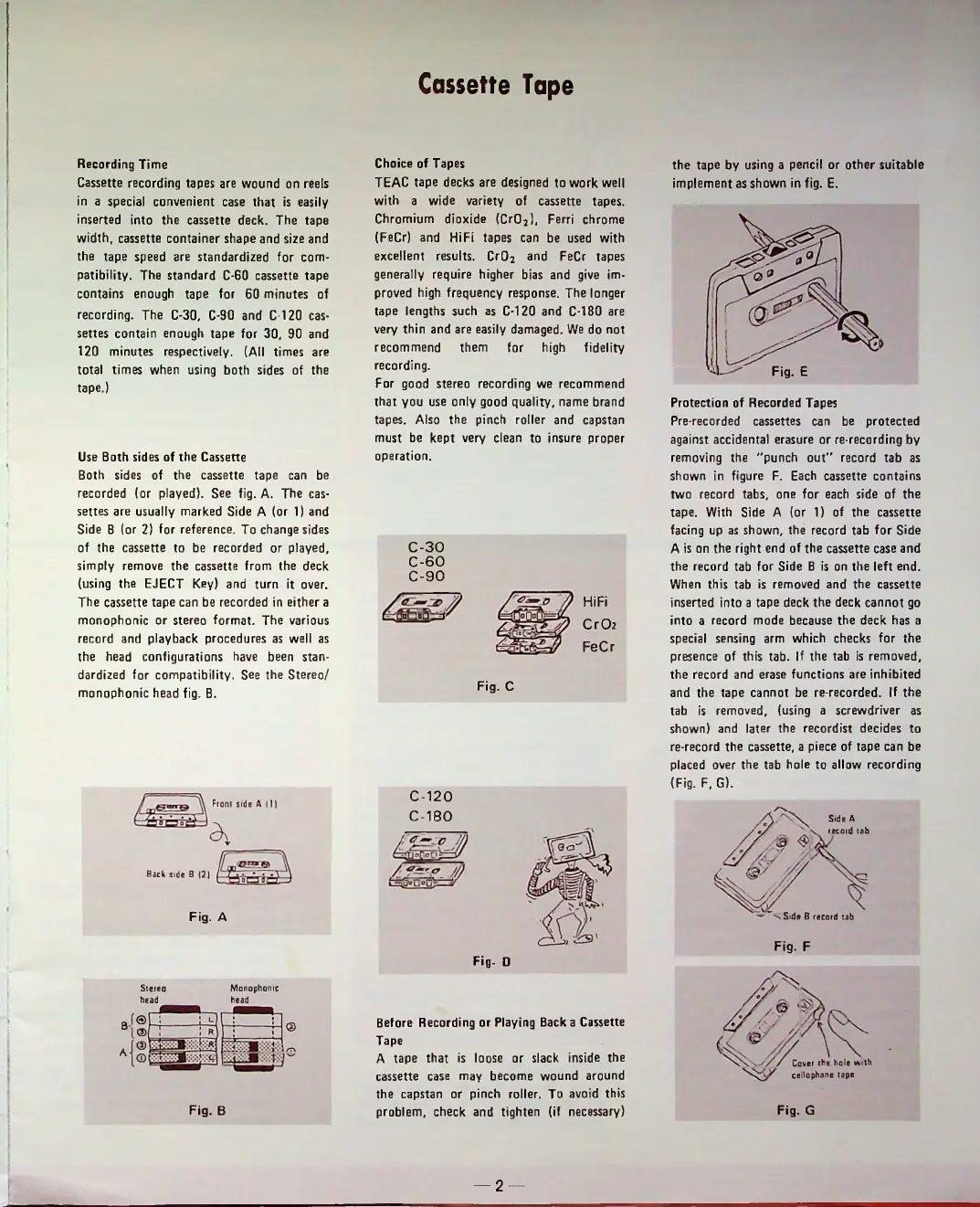
Use
Both
sides
of
the
Cassette
Both
sides
of
the
cassette
tape
can
be
recorded
(or
played).
See
fig.
A.
The
cas
settes
are
usually
marked
Side
A
(or
1)
and
Side
B
(or
2)
for
reference.
To
change
sides
of
the
cassette
to
be
recorded
or
played,
simply
remove
the
cassette
from
the
deck
(using
the
EJECT
Key)
and
turn
it
over.
The
cassette
tape
can
be
recorded
in
either
a
monophonic
or
stereo
format.
The
various
record
and
playback
procedures
as
well
as
the
head
configurations
have
been
stan
dardized
for
compatibility.
See
the
Stereo/
monophonic
head
fig.
B.
Recording
Time
Cassette
recording
tapes
are
wound
on
reels
in
a
special
convenient
case
that
is
easily
inserted
into
the
cassette
deck.
The
tape
width,
cassette
container
shape
and
size
and
the
tape
speed
are
standardized
for
com
patibility.
The
standard
C-60
cassette
tape
contains
enough
tape
for
60
minutes
of
recording.
The
C-30,
C-90
and
C-120
cas
settes
contain
enough
tape
for
30,
90
and
120
minutes
respectively.
(All
times
are
total
times
when
using
both
sides
of
the
tape.)
Choice
of
Tapes
TEAC
tape
decks
are
designed
to
work
well
with
a
wide
variety
of
cassette
tapes.
Chromium
dioxide
(CrO
2
),
Ferri
chrome
(FeCr)
and
HiFi
tapes
can
be
used
with
excellent
results.
Cr0
2
and
FeCr
tapes
generally
require
higher
bias
and
give
im
proved
high
frequency
response.
The
longer
tape
lengths
such
as
C-120
and
C-180
are
very
thin
and
are
easily
damaged.
We
do
not
recommend
them
for
high
fidelity
recording.
For
good
stereo
recording
we
recommend
that
you
use
only
good
quality,
name
brand
tapes.
Also
the
pinch
roller
and
capstan
must
be
kept
very
clean
to
insure
proper
operation.

Related product manuals