EasyManua.ls Logo

Teac A-1250 - Expert Recording & Pause Use; Record Bias Settings; Pause Functionality

Teac A-1250
24 pages
Print Icon
To Next Page IconTo Next Page
To Previous Page IconTo Previous Page
Loading...
Splicing
the
Tape
Expert
Use
of
Rec.
Bias and
Pause
\2
/-7-'-7----l
REC.
BIAS
Generally,
for
recording
on
regular
tapes
(Scotch
150;
BASF
LP-35;
Agfa
PE-31;
SONY
S-100;
etc.), the
REC
BIAS
should
be
set
to
NORMAL.
When
recording
high
performance
tapes
(Scotch
203;
BASF-
LP-35LH;
Agla
PB-36;
SONY
SLH-550;
etc')
which
require
a larger
bias
tlian
regular
types,
always
set the
REC'
BIIS
switch
to
HIGH.
This
will
allow
taking
complete
advantage
of all
the merits
of a
high
perfomance
tape
at
recording
wide
range,
high SN
ratio,
large
output,
low
distortion
and
witie
dynamic
range
NOTE:
Not
only
will
the
l'righ
notes
be exaggerated
and
sound
balance
destroyed
when a
recording
is made
on a
high
performance
tape at
the
NOR\IAL
setting
of the
switch
but distortion
will increase
and tire
sound
will
be unnatural.
Also,
in
the opposite
situation--if
a regular
tape is
recorded
with
the
switch
remaining
in
the
HIGH
position,
balance
will be
destroyed
with lack
of
high
notes,
and
moreover,
the
recording
level
rvill
be low
and
sound
unnatural'
EXPERT
MONITORING
AT
RECORDTNG
ON
LOW
NOISE
TAPE
Although
therc
will be no
difference
in sound
level,
when
recording
on regular
tape,
if the
tape
MONITOR
switch
is
set
to either
SOURCE
or TAPE,
there
will be
difference
in
sound
volume
(including
meter
level difl'erence)
between
the
source
ancl
tape
wl.ren using
low noise
tape
(sound volume
will
be lower
on the
TAPE
position
but
this
is due
to
difference
in tape
sensitivity).
If
you wish
to compare
sound
between
the
source
and
tape
at
the same
sound
1evel,
advance
the OUTPUT
knob
to match
sound
level with
that
from
the source
while
the
Tape
Monitor Switch
is
in the
'I'APE
position
or, use
the
tape monitor
switch
on
your
amplifier
to
which
this
tape
deck
is connected'
When using
this
switch,
set
the
tape
deck
MONITOR
switch
to TAPE
and
match
the sound
volume
with
the OUTPUT
knob.
PAUSE
In
conventional
tape
decks,
recording
is started
by
depressing
the
recording
button
and
then
the
'play'
button
bui
the
Model
A-1250
features
a
unique
recording
system
permitting
the
use
of
"PAUSE" during
recording
a
"com-
mercial
killer."
During
recording,
the
tape
can
be
stopped
by
setting the
Tape
Mode Lever
to "PAUSE"
to start
again
when
the Lever
is set
to
"PLAY"
thus
permitting
one-touch
start of the
tape.
Also,
if
you should
wish
to
switch
to
the
recording
mode
during
playback,
the
Lever
is
set to
PAUSE,
and
by
depressing
the-RECORD
button
and
then
the
:
'-button,
the
taie
deck
will
be
placed
in
the
recording
mode,
ready
to
begin
recording
as
soon
as
the
lever
is
set
to
PLAY'
Furthermore,
if
you
wish
to
record
or erase
the
tape
during
playback
without
stopping
it, the
tape
deck-can
be
put in
ihe
recording
mode
by simultaneously
depressing
the
RECORD and t,>
button.
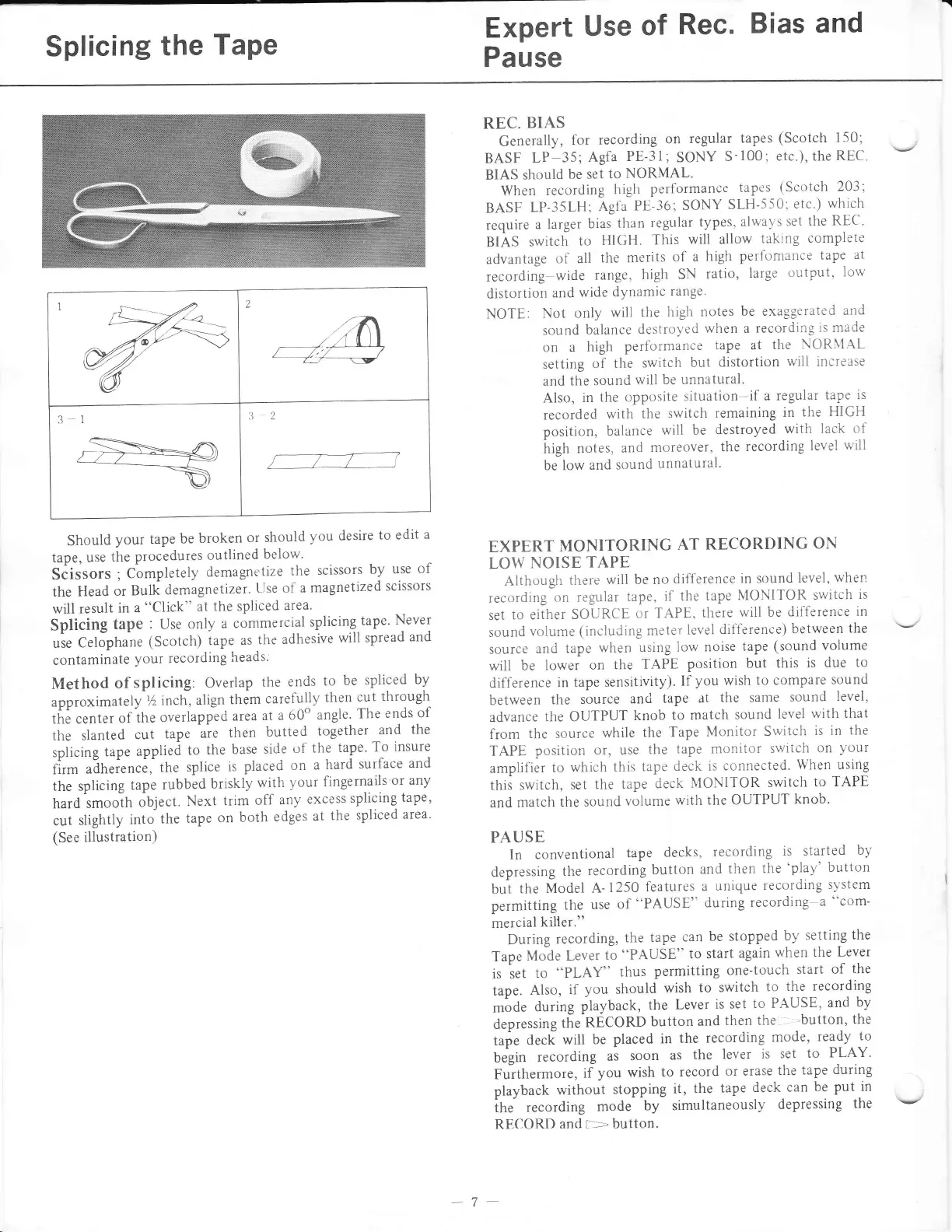
Should
your tape
be
broken
or should
you
desire
to edit
a
tape, use
the
procedures
outlined
below'
Scissors
;
Ctmpletely
demagnetize
the
scissors
by
use
of
the
tlead
or
Bulk
demagnetizer.
LIse
of
a magnetized
scissors
wi-ll
result
in a
"Click"
at
the spliced
area'
Splicing
tape
:
Use
only
a
commercial
splicing
tape'
Never
use
CelJphane
(Scotch)
iup.
ut
the
adhesive
will spread
and
contaminate
your
recording
heads.
Method
of
splicing:
Overlap
the ends
to
be
spliced
by
approximately
''Linci,align
them
carefully
then
cut
through
the center
ofihe
overlapp.d.rea
at a
60"
angle'
The
ends
of
the
slanted
cut
tape
aie
then
butted
together
and
the
splicing
tape
applied
to
the
base
side
t-rf the
tape'
T-o
insure
firm
.f,f,.i.n..,
tttt
splice
is
placed
on
a
hard
surface
and
the
splicing
tape
rubbid
briskly
wilh
your
fingernails
or any
hard
smooih
obiect.
Next
trim
off
any
excess
splicing
tape'
cut
slightly
into
the
tape
on
both
edges
at
the
spliced
area'
(See
illustration)

Related product manuals