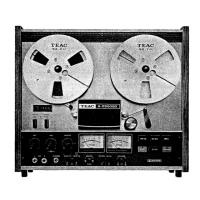
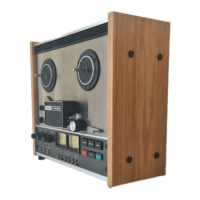
Need help?
Do you have a question about the Teac A-1250 and is the answer not in the manual?
Defines "Track" and explains 2-track vs. 4-track recording methods.
Tracks 1&3 recorded, then 2&4; provides best stereophonic reproduction.
Illustrates connections for microphones and headphones on the front panel.
Dual concentric knobs for adjusting input/output levels for left/right channels.
Controls tape movement: PLAY, reverse, FAST, STOP, PAUSE.
Turns the unit on/off; illuminates indicator lamp.
Initiates the recording process.
Thread tape through guides, heads, capstan, and pinch roller.
How automatic reverse works with sensing foil.
Using PAUSE for recording, editing, or commercial skipping.
Balance noise reduction with distortion by setting optimal recording levels.
Recording sequence for stereo, including automatic reverse setup.
Connecting mics, setting levels, and avoiding feedback.
Connecting external sources via LINE IN jacks and adjusting levels.
Recording with a single microphone into the left channel MIC jack.
Connecting mono sources to LINE IN, using only left channel controls.
Steps for setting speed, monitor, REC. MODE, BIAS, and controls for mono recording.
Recording a mono track, then mixing it with a new signal on another track.
Detailed steps for setting up and performing sound-on-sound recordings.
Erasing entire tapes using stereo mode or a tape eraser.
Why demagnetization is needed to prevent frequency loss and noise.
Step-by-step guide for using the TEAC E-1 Head Demagnetizer.
Importance of clean heads/guides; use TEAC TZ-261 kit.
How to change the unit's voltage setting using the selector plug.
Repositioning the motor pulley belt and switching frequency selector.
Solutions for no movement, capstan, pinch roller, or counter problems.
Diagnosing and fixing issues with pinch roller, tape path, or tape quality.
Troubleshooting no sound, low sound, poor sound, and no automatic reverse.
Diagnosing issues with no recording, low sound, or poor sound during recording.


 To Next Page
 General