EasyManua.ls Logo

Teac A-1250S - Page 13

Teac A-1250S
24 pages
Print Icon
To Next Page IconTo Next Page
To Previous Page IconTo Previous Page
Loading...
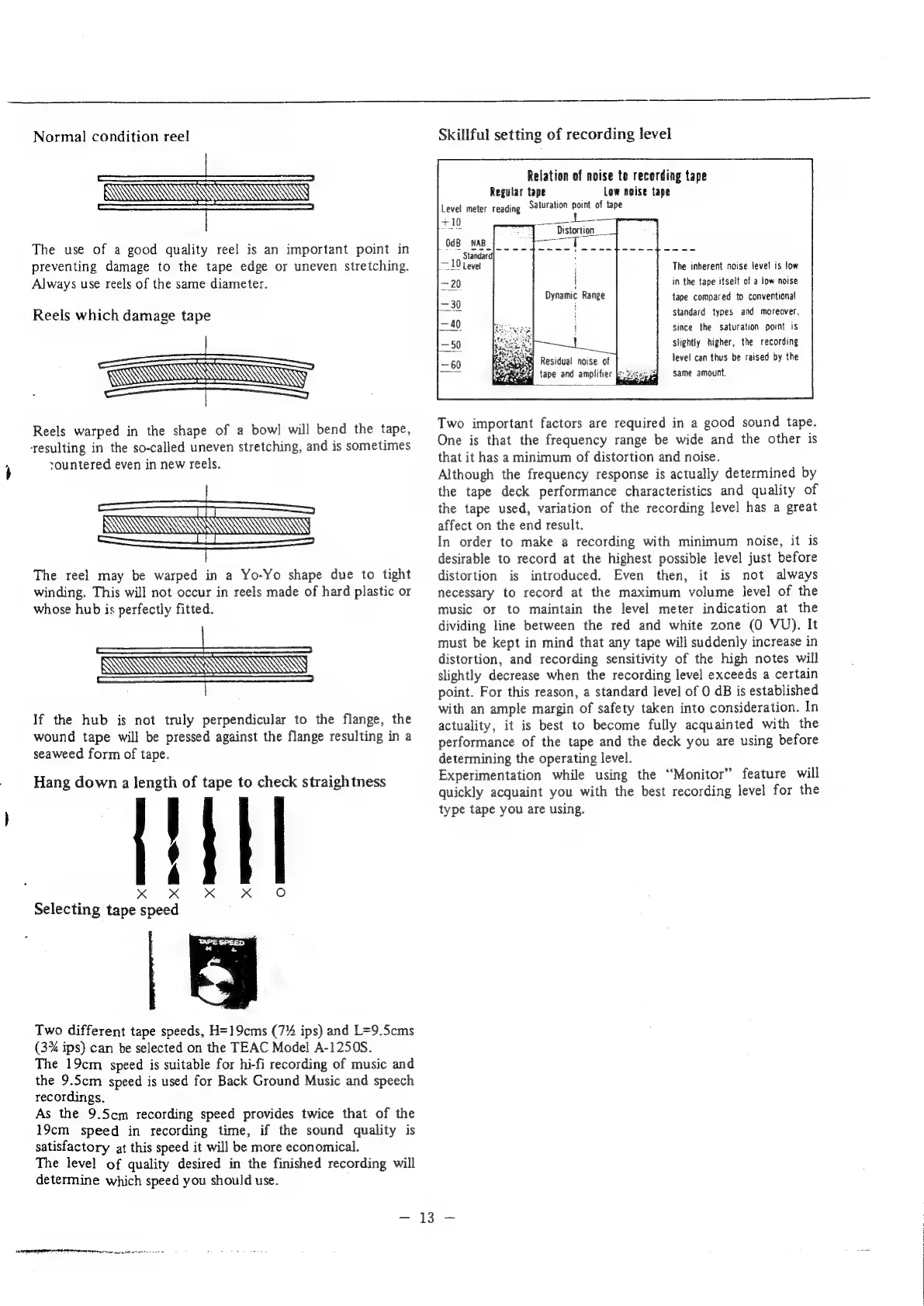
Normal
condition
reel
The
use
of
a
good
quality
reel
is
an
important
point
in
preventing
damage
to
the
tape
edge
or
uneven
stretching.
Always
use
reels
of
the
same
diameter.
Reels
which
damage
tape
Reels
warped
in
the
shape
of
a
bowl]
will
bend
the
tape,
resulting
in
the
so-called
uneven
stretching,
and
is
sometimes
rountered
even
in
new
reels.
The
reel
may
be
warped
in
a
Yo-Yo
shape
due
to
tight
winding.
This
will
not
occur
in
reels
made
of
hard
plastic
or
whose
hub
is
perfectly
fitted.
If
the
hub
is
not
truly
perpendicular
to
the
flange,
the
wound
tape
will
be
pressed
against
the
flange
resulting
in
a
seaweed
form
of
tape.
Hang
down
a
length
of
tape
to
check
straightness
aul
Selecting
tape
speed
Two
different
tape
speeds,
H=19cms
(7%
ips)
and
L=9.5cms
(3%
ips)
can
be
selected
on
the
TEAC
Model
A-1250S.
The
19cm
speed
is
suitable
for
hi-fi
recording
of
music
and
the
9.5cm
speed
is
used
for
Back
Ground
Music
and
speech
recordings.
As
the
9.5cm
recording
speed
provides
twice
that
of
the
19cm
speed
in
recording
time,
if
the
sound
quality
is
satisfactory
at
this
speed
it
will
be
more
economical.
The
level
of
quality
desired
in
the
finished
recording
will
determine
which
speed
you
should
use.
Skillful
setting
of
recording
level
Relation
of
noise
to
recording
tape
Regular
tape
Low
noise
tape
Level
meter
reading
Saturation
point
of
tape
+10
___1l-——-¢
<
fe
4
Distortion
__
OdB
NAB
"|
Standard
—1¥
Levet
The
inherent
noise
level
is
low
—20
|
in
the
tape
itself
of
a
low
noise
en
tape
compared
to
conventional
standard
types
and
moreover,
since
the
saturation
point
is
slightly
higher,
the
recording
level
can
thus
be
raised
by
the
same
amount.
=
30
Two
important
factors
are
required
in
a
good
sound
tape.
One
is
that
the
frequency
range
be
wide
and
the
other
is
that
it
has
a
minimum
of
distortion
and
noise.
Although
the
frequency
response
is
actually
determined
by
the
tape
deck
performance
characteristics
and
quality
of
the
tape
used,
variation
of
the
recording
level
has
a
great
affect
on
the
end
result.
In
order
to
make
a
recording
with
minimum
noise,
it
is
desirable
to
record
at
the
highest
possible
level
just
before
distortion
is
introduced.
Even
then,
it
is
not
always
necessary
to
record
at
the
maximum
volume
level
of
the
music
or
to
maintain
the
level
meter
indication
at
the
dividing
line
between
the red
and
white
zone
(0
VU).
It
must
be
kept
in
mind
that
any
tape
will
suddenly
increase
in
distortion,
and
recording
sensitivity
of
the
high
notes
will
slightly
decrease
when
the
recording
level
exceeds
a
certain
point.
For
this
reason,
a
standard
level
of
0
dB
is
established
with
an
ample
margin
of
safety
taken
into
consideration.
In
actuality,
it is
best
to
become
fully
acquainted
with
the
performance
of
the
tape
and
the
deck
you
are
using
before
determining
the
operating
level.
Experimentation
while
using
the
“Monitor”
feature
will
quickly
acquaint
you
with
the
best
recording
level
for
the
type
tape
you
are
using.
ee

Related product manuals