EasyManua.ls Logo

Teac A-2300SD - Frequency Response-Playback-; Phone Output Check; Monitor Level Setting; Specified Input Level Setting

Teac A-2300SD
50 pages
Print Icon
To Next Page IconTo Next Page
To Previous Page IconTo Previous Page
Loading...
9-7
FREQUENCY
RESPONSE-PLAYBACK-
1.
Place
Tape
SPEED
SW
in
7-1/2
ips
(HIGH)
position.
2.
Thread
a
TEAC
Test
Tape
YTT-1003
on
the
unit.
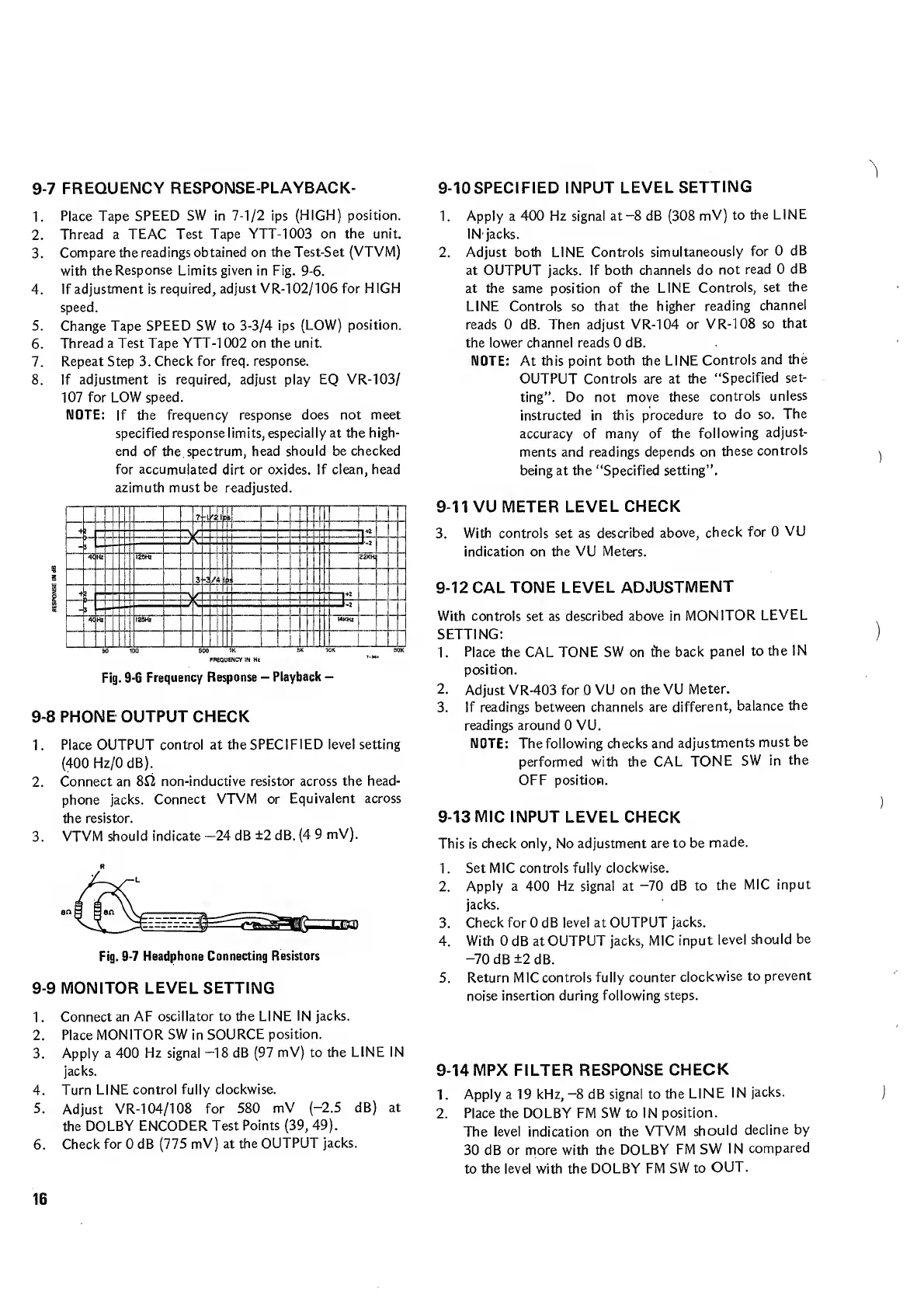
3.
Compare
the
readings
obtained
on
the
Test-Set
(VTVM)
with
the
Response
Limits
given
in
Fig.
9-6.
4.
if
adjustment
is
required,
adjust
VR-102/106
for
HIGH
speed.
5.
Change
Tape
SPEED
SW
to
3-3/4
ips
(LOW)
position.
6.
Thread
aTestTape
YTT-1002
on
the
unit.
7.
Repeat
Step
3.
Check
for
freq.
response.
8.
If
adjustment
is
required,
adjust
play
EQ
VR-103/
107
for
LOW
speed.
NOTE:
If
the
frequency
response
does
not
meet
specified
response
limits,
especially
at
the
high-
end
of
the
spectrum,
head
should
be
checked
for
accumulated
dirt
or
oxides.
If
clean,
head
azimuth
must
be
readjusted.
7
-1
a
-
J
K.
4(
Hz
ISSHz
22Ka
3
3
/
•f
/"
-
i
U-J-2
40
HZ
125Hz
I4KHZ
n
j
"so
100
SCO
IK
5K
10K
-
80K
FR6QU6NCY
IN
Ht
’'***
Fig.
9-6
Frequency
Response
-
Playback
-
9-8
PHONE
OUTPUT
CHECK
1.
Place
OUTPUT
control
at
the
SPECIFIED
level
setting
(400
Hz/0
dB).
2.
Connect
an
8S2
non-inductive
resistor
across
the
head¬
phone
jacks.
Connect
VTVM
or
Equivalent
across
the
resistor.
3.
VTVM
should
indicate
—24
dB
±2
dB.
(4
9
mV).
9-10SPECIFIED
INPUT
LEVEL
SETTING
1.
Apply
a
400
Hz
signal
at-8
dB
(308
mV)
to
the
LINE
IN
jacks.
2.
Adjust
both
LINE
Controls
simultaneously
for
0
dB
at
OUTPUT
jacks.
If
both
channels
do
not
read
0
dB
at
the
same
position
of
the
LINE
Controls,
set
the
LINE
Controls
so
that
the
higher
reading
channel
reads
0
dB.
Then
adjust
VR-104
or
VR-108
so
that
the
lower
channel
reads
0
dB.
NOTE:
At
this
point
both
the
LINE
Controls
and
the
OUTPUT
Controls
are
at
the
“Specified
set¬
ting”.
Do
not
move
these
controls
unless
instructed
in
this
procedure
to
do
so.
The
accuracy
of
many
of
the
following
adjust¬
ments
and
readings
depends
on
these
controls
being
at
the
“Specified
setting”.
9-11
VU
METER
LEVEL
CHECK
3.
With
controls
set
as
described
above,
check
for
0
VU
indication
on
the
VU
Meters.
9-12
CAL
TONE
LEVEL
ADJUSTMENT
With
controls
set
as
described
above
in
MONITOR
LEVEL
SETTING:
1.
Place
the
CAL
TONE
SW
on
fhe
back
panel
to
the
IN
position.
2.
Adjust
VR-403
for
0
VU
on
the
VU
Meter.
3.
If
readings
between
channels
are
different,
balance
the
readings
around
0
VU.
NOTE:
The
following
checks
and
adjustments
must
be
performed
with
the
CAL
TONE
SW
in
the
OFF
position.
9-13
MIC
INPUT
LEVEL
CHECK
This
is
check
only.
No
adjustment
are
to
be
made.
9-9
MONITOR
LEVEL
SETTING
1.
Connect
an
AF
oscillator
to
the
LINE
IN
jacks.
2.
Place
MONITOR
SW
in
SOURCE
position.
3.
Apply
a
400
Hz
signal
—18
dB
(97
mV)
to
the
LINE
IN
jacks.
4.
Turn
LINE
control
fully
clockwise.
5.
Adjust
VR-104/108
for
580
mV
(-2.5
dB)
at
the
DOLBY
ENCODER
Test
Points
(39,
49).
6.
Check
for
0
dB
(775
mV)
at
the
OUTPUT
jacks.
1.
Set
MIC
controls
fully
clockwise.
2.
Apply
a
400
Hz
signal
at
-70
dB
to
the
MIC
input
jacks.
3.
Check
for
0
dB
level
at
OUTPUT
jacks.
4.
With
0
dB
at
OUTPUT
jacks,
MIC
input
level
should
be
-70
dB
±2
dB.
5.
Return
MIC
controls
fully
counter
clockwise
to
prevent
noise
insertion
during
following
steps.
9-14
MPX
FILTER
RESPONSE
CHECK
1.
Apply
a
19
kHz,
-8
dB
signal
to
the
LINE
IN
jacks.
2.
Place
the
DOLBY
FM
SW
to
IN
position.
The
level
indication
on
the
VTVM
should
decline
by
30
dB
or
more
with
the
DOLBY
FM
SW
IN
compared
to
the
level
with
the
DOLBY
FM
SW
to
OUT.

Related product manuals