EasyManua.ls Logo

Teac A-7300RX - Page 14

Teac A-7300RX
65 pages
Print Icon
To Next Page IconTo Next Page
To Previous Page IconTo Previous Page
Loading...
8-7
PINCH
ROLLER
PRESSURE
NOTE:
Pinch
roller
pressure
is
supplied
by
the
pinch
roller
solenoid
arm
and
it
is
most
important
that
the
solenoid
plungers
be
fully
bottomed
before
taking
pressure
measurement.
.
Load
tape
or
block
the
shut-off
arm
in
the
“ON”
posi-
tion.
Remove
the
Pinch
Roller
Cap.
2.
Attach
a
suitable
spring
scale
to
a
screw
inserted
in
the
pinch
roller
shaft.
3.
Place
the
unit
in
the
PLAY
mode,
and
holding
the
spring
scale
as
illustrated,
slowly
draw
it
away
from
the
pinch
roller.
(Do
not
allow
the
string
to
rub
against
the
pinch
roller.)
4.
Note
the
reading
on
the
spring
scale
at
the
instant
the
pinch
roller
stops
rotating.
.
The
scale
should
indicate
2
kg
+0.2
kg
(4.4
Ibs
+0.4
Ibs)
_
If
adjustment
is
necessary,
loosen
the
3
mounting
screws
on
the
capstan
solenoid
and
position
the
solenoid
for
optimum
pressure.
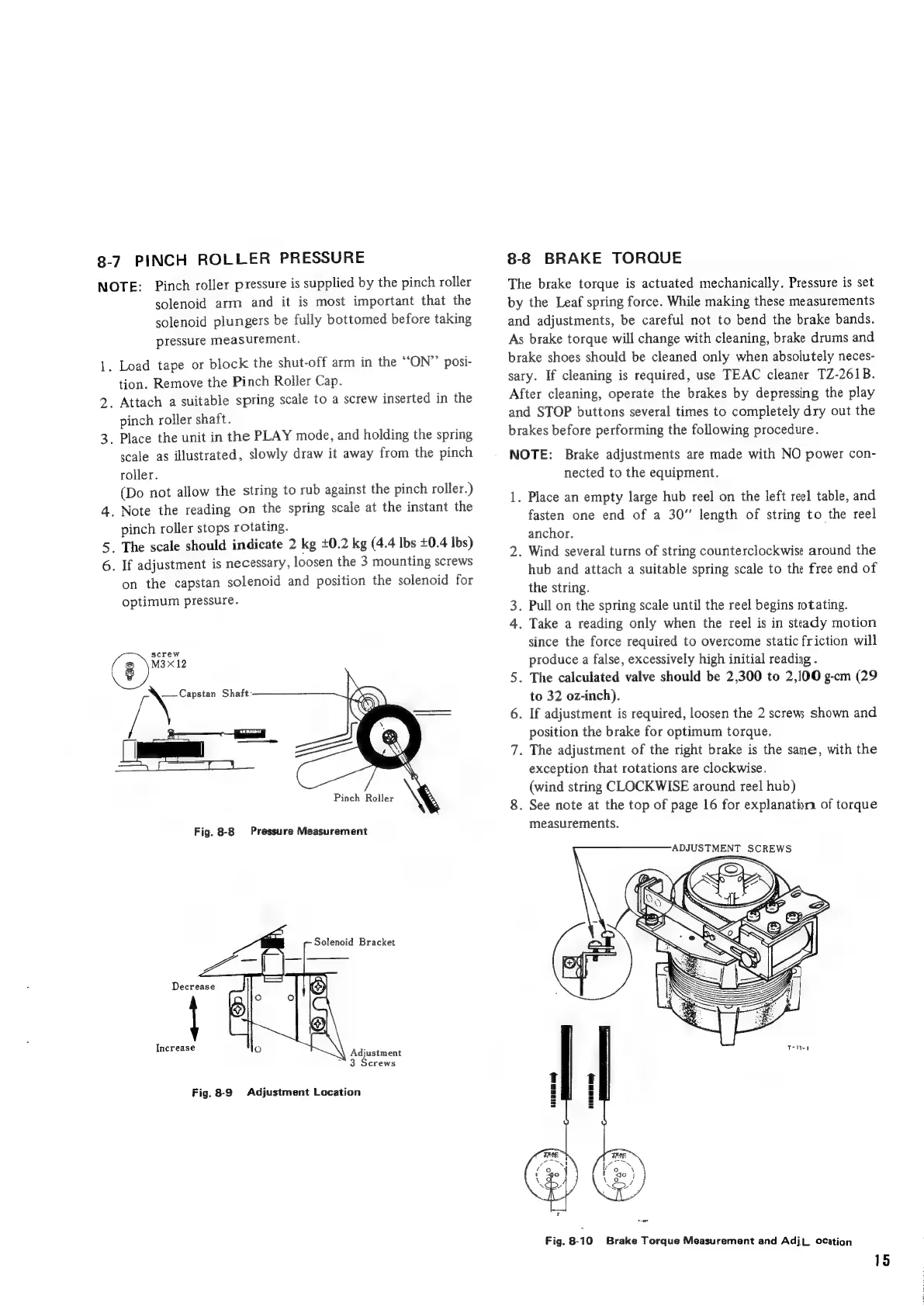
screw
M312
ai
Shaft
Fig.
8-8
Pressure
Measurement
nw”
Decrease
2
Increas
Adjustment
3
Screws
Fig.
8-9
Adjustment
Location
8-8
BRAKE
TORQUE
The
brake
torque
is
actuated
mechanically.
Pressure
is
set
by
the
Leaf
spring
force.
While
making
these
measurements
and
adjustments,
be
careful
not
to
bend
the
brake
bands.
As
brake
torque
will
change
with
cleaning,
brake
drums
and
brake
shoes
should
be
cleaned
only
when
absolutely
neces-
sary.
If
cleaning
is
required,
use
TEAC
cleaner
TZ-261B.
After
cleaning,
operate
the
brakes
by
depressing
the
play
and
STOP
buttons
several
times
to
completely
dry
out
the
brakes
before
performing
the
following
procedure.
NOTE:
Brake
adjustments
are
made
with
NO
power
con-
nected
to
the
equipment.
1.
Place
an
empty
large
hub
reel
on
the
left
reel
table,
and
fasten
one
end
of
a
30”
length
of
string
to
the
reel
anchor.
2.
Wind
several
turns
of
string
counterclockwise
around
the
hub
and
attach
a
suitable
spring
scale
to
the
free
end
of
the
string.
.
Pull
on
the
spring
scale
until
the
reel
begins
rotating.
.
Take
a
reading
only
when
the
reel
is
in
steady
motion
since
the
force
required
to
overcome
static
friction
will
produce
a
false,
excessively
high
initial
reading
.
5.
The
calculated
valve
should
be
2,300
to
2,100
g-cm
(29
to
32
oz-inch).
.
If
adjustment
is
required,
loosen
the
2
screws
shown
and
position
the
brake
for
optimum
torque.
7.
The
adjustment
of
the
right
brake
is
the
same,
with
the
exception
that
rotations
are
clockwise.
(wind
string
CLOCKWISE
around
reel
hub)
8.
See
note
at
the
top
of
page
16
for
explanation
of
torque
measurements.
pW
lox
ADJUSTMENT
SCREWS
Fig.
8-10
Brake
Torque
Measurement
and
AdjL
ocation
15

Related product manuals