EasyManua.ls Logo

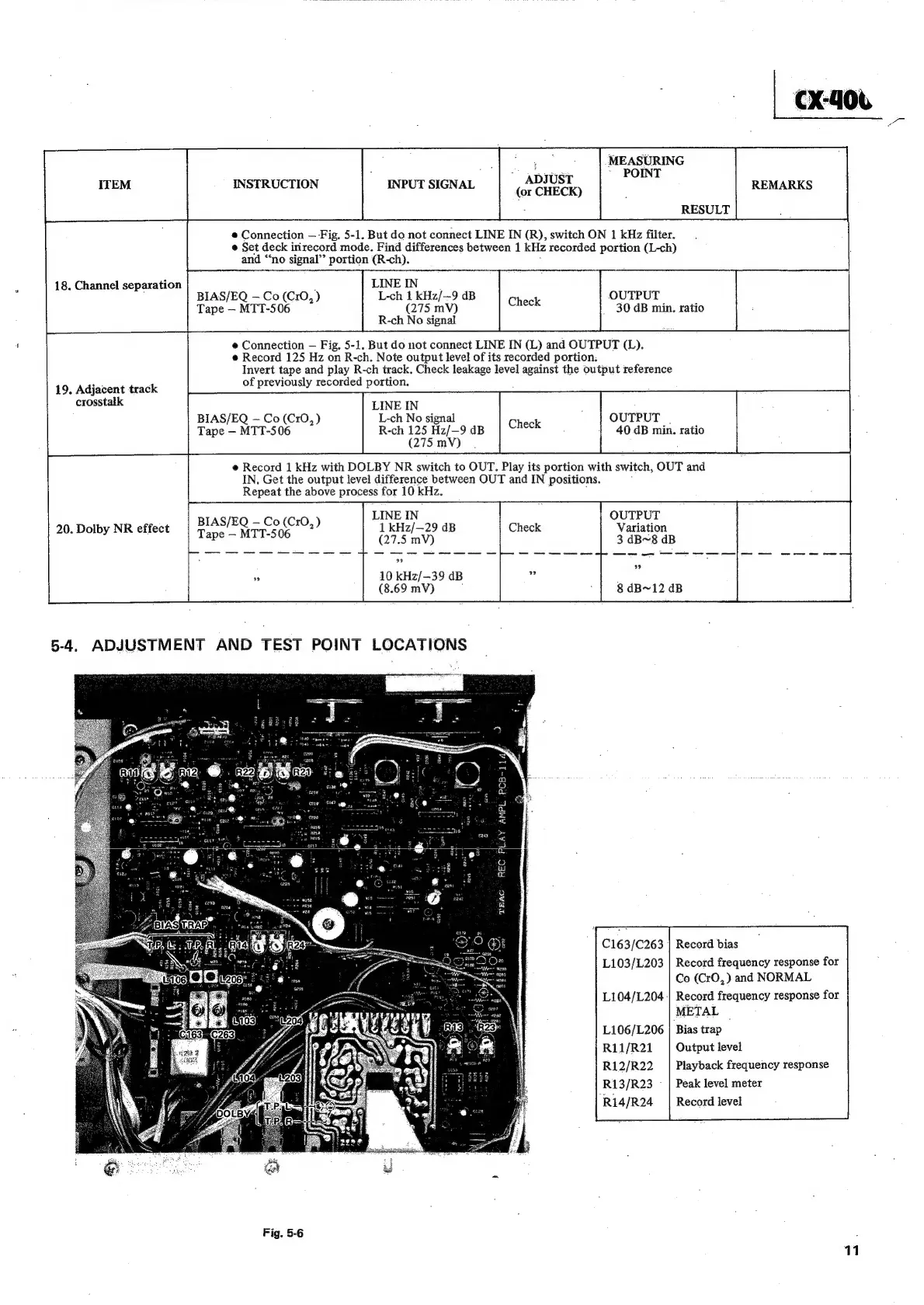
Teac CX-400 - CHANNEL SEPARATION; ADJACENT TRACK CROSSTALK; DOLBY NR EFFECT

Teac CX-400
25 pages
Print Icon
To Next Page IconTo Next Page
To Previous Page IconTo Previous Page
Loading...
MEASURING
cael
cae
POINT
ADJUST
INSTRUCTION
INPUT
SIGNAL
(or
CHECK)
|
REMARKS
RESULT
e
Connection
Fig,
5-1.
But
do
not
connect
LINE
IN
(R),
switch
ON
1
kHz
filter.
e
Set
deck
irirecord
mode.
Find
differences
between
1
kHz
recorded
portion
(L-ch)
and
“no
signal’’
portion
(R-ch).
18.
Channel
separation
LINE
IN
;
BIAS/EQ
Co
(C10,
)
L-ch
1
kHz/—9
dB
OUTPUT
Tape
MTT-506
(275
mV)
_
30
dB
min.
ratio
R-ch
No
signal
e@
Connection
Fig,
5-1,
But
do
not
connect
LINE
IN
(L)
and
OUTPUT
(L).
e
Record
125
Hz
on
R-ch.
Note
output
level
of
its
recorded
portion.
Invert
tape
and
play
R-ch
track.
Check
leakage
level
against
the
output
reference
19.
Adjacent
track
of
previously
recorded
portion,
;
crosstalk
LINE
IN
BIAS/EQ
Co
(Cr0,)
L-ch
No
signal
OUTPUT
.
Tape
MTT-506
R-ch
125
Hz/—9
dB
40
dB
min.
ratio
(275
mV)
:
@
Record
1
kHz
with
DOLBY
NR
switch
to
OUT.
Play
its
portion
with
switch,
OUT
and
IN.
Get
the
output
level
difference
between
OUT
and
IN
positions.
Repeat
the
above
process
for
10
kHz.
LINE
IN
OUTPUT
20.
Dolby
NR
effect
ee
Mere
2)
1
kHz/—29
dB
Variation
(27.5
mV)
3
dB~8
dB
10
kHz/—39
dB
(8.69
mV)
;
TEAC
REC
PLAY
C163/C263
|
Record
bias
L103/L203
|
Record
frequency
response
for
Co
(CrO,)
and
NORMAL
L104/L204,)
Record
frequency
response
for
METAL
L106/L206
|
Bias
trap
R11/R21
Output
level
R12/R22
Playback
frequency
response
R13/R23
|
Peak
level
meter
‘R14/R24
Record
level
Fig.
5-6
11

Related product manuals