Need help?
Do you have a question about the Teac P-70 and is the answer not in the manual?
Describes the VRDS system for disc stabilization and vibration reduction.
Enables synchronization with master clock from D/A converter to eliminate jitter.
Separates power supply from mechanical/digital systems for interference rejection.
Offers multiple digital outputs including high-speed multiplied signals.
Features a robust chassis design for vibration damping and sonic performance.
Instructions to release the transport clamp before initial operation and secure for transport.
Guidance on optimal placement for performance, stability, and avoiding condensation.
Guidelines on playable discs, cleaning, storing, and handling to ensure playback.
Adjusts filter for master clock synchronization modes.
Input for word clock synchronization signals from other units.
Outputs 44.1kHz digital audio via optical and coaxial connectors.
Outputs 44.1/88.2kHz digital audio via optical and coaxial connectors.
Outputs 44.1/88.2kHz digital audio via balanced XLR connectors.
Terminals for ground connection and power supply connection details.
Diagram showing connections to D/A converters and digital recording equipment.
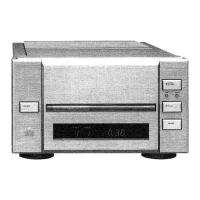
Identifies and describes the buttons, indicators, and display on the front panel.
Lists and describes the functions of the remote control buttons.
Step-by-step guide on how to insert batteries into the remote control.
Guidelines for optimal operation and troubleshooting remote control issues.
Configuration for using a central word synchronization source.
Settings for sampling frequency multiplication (2x, 4x).
Steps to power on the unit and load a disc.
How to start playing a disc and pause playback.
How to navigate and play specific index markers within a track.
How to play a single track and stop automatically afterwards.
How to enable repeat function for all tracks on a disc.
How to select and repeatedly play a specific segment of a disc.
How to program up to 30 tracks for playback in a desired order.
How to initiate playback of a created program.
How to select tracks to exclude from programmed playback.
How to play back the disc with selected tracks deleted.
How to change display type and turn off the display to reduce noise.
Adds a four-second silence between tracks for recording purposes.
How to connect and set up for automatic playback at a scheduled time.
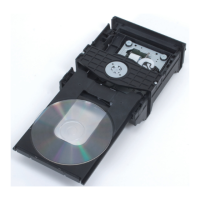
Detailed explanation of the VRDS system's design and benefits for disc stability.
Exploded view and labelled components of the VRDS drive system.
Common problems like no power or no sound and their solutions.
Troubleshooting for remote control problems and disc playback errors.
Detailed technical data including output formats, power, and dimensions.
Details about the remote control unit's type, battery, and dimensions.
 General
| Digital outputs | Coaxial, Optical |
|---|---|
| Disc formats | CD, CD-R |
| Frequency response | 20 Hz to 20 kHz |
| Line output | 2.0 V |
| Signal to Noise Ratio | 100 dB |

 To Next Page