GB
3
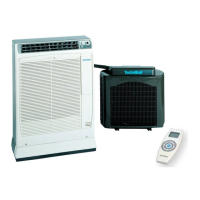
7. OPERATION lamp: This lamp lights up during
operation.
It blinks once to announce that the remote controlsignal
has been received and stored. It blinks continuously
during the protection modes (defrosting, etc.).
9. TIMER lamp: This lamp lights up when the system is
being controlled by the timer.
10. Air intake latch, on two sides.
11. Air filter.
12. Suspension brackets.
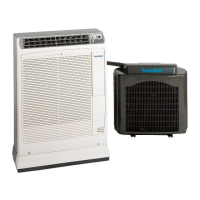
13. Refrigerant couplings.
14. Condensate drain connection.
15. Sensor: Detects the room temperature around the
unit; when the remote control unit is not active the air
conditioner will be set by the detected temperature.
1. Remote control unit.
2. Remote control sensor: Detects the room temperature
around the remote control unit, the air conditioner is
controlled accordingly.
3. Air outlet: Conditioned air is blown out of the air
conditioner through the air outlet.
4.
Air intake: Air from the room is drawn into this section
and passes through air filter which removes dust.
5. Remote control receiver: This section picks up infrared
signals from the remote control unit (Transmitter).
6. Operation selector (without remote control): Push
the button to walk through the OFF, COOL and HEAT
operation modes.
8. STANDBY lamp: This lamp lights up when the air
conditioner is connected to the power and ready to
receive the remote control command.
The OFF position does not disconnect the power. Use
the main power switch to turn off power completely.
WARNING
NAME OF PARTS AND OPERATION SELECTOR SWITCH
NOTE
The blinking of OPERATION, TIMER and STANDBY
lamps, indicates that the operating mode selected
is not compatible with the unit. If this happen the air
conditioner does not operate until the correct mode
is selected.
5
7 9 8
OPER
TIMER STBY
5
6
7 9 8
3
12
14
5
13
2
1
15
6
10
11
4
INFORMATION FOR CORRECT DISPOSAL OF THE PRODUCT IN ACCORDANCE WITH THE EUROPEAN DIRECTIVE
2012/19/EU
At the end of its working life this equipment must not be disposed of as an household waste.
It must be taken to special local community waste collection centres or to a dealer providing this service.
Disposing of an electrical and electronic equipment separately avoids possible negative effects on the environment
and human health deriving from an inappropriate disposal and enables its components to be recovered and recycled
to obtain significant savings in energy and resources.
In order to underline the duty to dispose of this equipment separately, the product is marked with a crossed-out dustbin.
INFORMATION FOR CORRECT DISPOSAL OF THE BATTERY IN ACCORDANCE WITH THE EUROPEAN DIRECTIVE
2006/66/EC
Please replace battery when its electricity charge is used up: please do not eliminate this battery together with normal household
waste. It must be taken to special local community waste collection centres or to a dealer providing this service. Disposing of a
battery separately avoids possible negative effects on the environment and human health deriving from an inappropriate disposal
and enables its components to be recovered and recycled to obtain significant savings in energy and resources. In order to underline
the duty to dispose of this equipment separately, the battery is marked with a crossed-out dustbin.



 To Next Page
 Loading...