
 Need help?
Do you have a question about the Technics QUARTZ ST-K50 and is the answer not in the manual?
Detailed specifications for the FM tuner performance.
Detailed specifications for the AM tuner performance.
General unit specifications including output, power, and dimensions.
Step-by-step guide for connecting a coaxial antenna cable.
Guidance for installing the included AM loop antenna.
Placement recommendations for the AM loop antenna.
Describes physical buttons, indicators, and displays on the front panel.
Details operation for tape decks, tuners, CD players, and amplifiers.
Details the process of removing various unit components.
Procedures for tuning, distortion, and VCO adjustments.
Description of the Front Panel (FL) display.
Technical pinout details for the front panel display.
Visual layout of components and connections on PCBs.
Identification of key semiconductor pins and functions.
List of external chassis components and their identification.
List of included add-on items and their part numbers.
Identification of materials used for shipping and packaging.
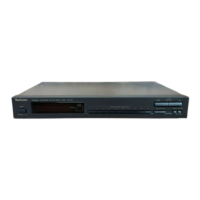
This document outlines the service and operational aspects of the Technics ST-K50 Quartz Synthesizer AM/FM Stereo Tuner. It provides comprehensive information for both technicians and users, covering everything from basic connections and control functions to detailed disassembly instructions and circuit diagrams.
The Technics ST-K50 is a high-fidelity AM/FM stereo tuner designed to receive broadcast radio signals with precision and clarity. At its core, it features a Quartz Synthesizer, which ensures stable and accurate tuning to desired frequencies. The tuner is capable of receiving both FM and AM broadcasts, offering a wide range of listening options.
For FM reception, the unit automatically switches to stereo mode when a strong enough FM stereo broadcast is detected, enhancing the listening experience with spatial audio. Users also have the option to manually select monaural mode, which can be useful for improving reception quality in areas with weak stereo signals. The tuner boasts a sophisticated FM front-end pack that includes components like an FM OSC (oscillator) and FM IF AMP (intermediate frequency amplifier) to process and amplify the incoming signals.
The AM section is equally robust, designed to capture AM broadcasts effectively. The unit incorporates an AM loop antenna for optimal reception, which can be positioned for the best signal. Both FM and AM sections are supported by a microcomputer (IC901: LC6512A3997) that manages various functions, including frequency synthesis, display control, and user input processing.
A key feature of the ST-K50 is its preset tuning capability, allowing users to store up to 24 FM and AM broadcast frequencies in memory. This enables quick recall of favorite stations with the touch of a button. The tuner also includes a "memory set" switch for programming these presets. Tuning can be done manually using dedicated "tuning" buttons, which adjust the frequency in precise steps (0.05 MHz for FM and 9 kHz or 10 kHz for AM).
The unit's display section provides essential information to the user. An "FM stereo indicator" illuminates when an FM stereo broadcast is being received, confirming the stereo mode. A "digital frequency display" shows the currently tuned frequency, while a "channel display" indicates the selected preset channel number. The "memory indicator" lights up when the memory button is pressed, signifying that a station is being programmed or recalled from memory. Finally, a "quartz-lock indicator" confirms that the unit is precisely tuned to a broadcast station, ensuring optimal reception.
Power management is handled by a "power standby/on" switch. When set to "standby," the secondary circuit power is off, but the primary circuit remains "live" as long as the power cord is connected. A "standby indicator" illuminates in this state, alerting the user to the constant supply voltage to the internal circuitry.
The tuner also integrates with other audio components through its "AC OUTLET" (SWITCHED) feature. This outlet provides power that is controlled by the tuner's power switch, allowing for convenient power management of other audio equipment. However, users are advised not to exceed the indicated power rating when connecting devices to this outlet.
The Technics ST-K50 is designed for intuitive operation, whether directly from the unit or via its remote-control transmitter.
Basic Connections: To set up the tuner, users first connect the included stereo connection cable to an amplifier. L-type cables (not included) are used for connecting to other audio components. The AC power supply cord is then connected, with specific cord types provided for different geographical areas (e.g., (GN) area only, (GC), (PX) areas).
Antenna Connections: For FM reception, an FM indoor antenna is included and can be attached to a wall for best reception. For improved sound quality or in areas with poor reception (mountainous regions, reinforced-concrete buildings), an FM outdoor antenna (not included) is recommended. The manual provides detailed instructions on how to connect a 75-ohms coaxial cable to the unit, involving stripping the outer vinyl insulator and twisting the shield braid.
For AM reception, an AM loop antenna is included and connects to the AM antenna terminals. It should be attached to a column, rack, or the unit itself, positioned to face the direction of best reception. Important notes for AM antenna placement include avoiding horizontal attachment, proximity to power cords, speaker wires, metal surfaces, or tape decks to prevent noise and impaired reception. An AM outdoor antenna (not included) can also be used, typically a vinyl-covered wire placed horizontally at a window.
Control Section: The front panel features a clear layout of controls. The "power standby/on" switch manages the unit's power state. "Band selectors" (FM/AM) allow users to switch between radio bands. Pressing the AM button for about 4 seconds changes the AM frequency step between 9 kHz and 10 kHz, catering to different regional broadcast standards. "Tuning buttons" enable manual frequency adjustment. The "FM mode selector" toggles between stereo and monaural FM reception. The "memory button" is used in conjunction with the "preset-tuning buttons" (1-0) to store and recall up to 24 favorite stations.
Remote Control Operation: The ST-K50 comes with a remote-control transmitter (specific models for (GN) and (GC), (PX) areas). This transmitter can control not only the tuner but also other Technics components like amplifiers, cassette tape decks, turntables, compact disc players, and graphic equalizers, provided they have a control terminal. This allows for a unified control experience for an entire audio system. The remote includes dedicated keys for tuner functions (power, preset channel selection, muting, volume adjustment) and also for controlling other components (e.g., play, stop, rewind, fast forward for cassette decks; play, stop, skip for CD players). This multi-component control simplifies the user experience, allowing operation of the entire system without needing to interact directly with each unit.
The service manual provides detailed instructions for technicians, ensuring proper maintenance, repair, and adjustment of the ST-K50 tuner.
Disassembly Instructions: The manual outlines a step-by-step procedure for disassembling the unit, starting with the removal of the cabinet, followed by the front panel, operation switch P.C.B. (Printed Circuit Board), remote sensor P.C.B., main P.C.B., and FL drive P.C.B. Each step includes clear instructions and diagrams, indicating which screws to remove and how to detach components safely. A "Caution! ATTENTION SERVICER" note warns about sharp edges and the need for careful handling during disassembly and servicing.
Measurements and Adjustments: Critical adjustments for optimal performance are detailed, particularly for the FM tuner section. These include:
The manual explicitly states that Z201 (AM ANT and OSC coil) and Z202 (AM-IFT) are supplied as pre-adjusted parts, and their cores should not be turned. This simplifies AM circuit maintenance.
Schematic Diagrams and Component Information: Comprehensive schematic diagrams are provided, illustrating the internal circuitry and signal paths. These diagrams include notes on power source switch positions, preset tuning switches, band selector switches, memory set switch, FM mode selector switch, and tuning switches. Voltage selector switch settings for different regions are also noted.
Important safety notices highlight components identified with a "Δ" mark, indicating special characteristics important for safety. When replacing these, only manufacturer-specified parts should be used.
Terminal Guides and Parts Lists: A "Terminal Guide of IC's, Transistors and Diodes" provides pinout information and descriptions for key semiconductor components, aiding in troubleshooting and component replacement. A "Replacement Parts List" enumerates all replaceable components, including integrated circuits, transistors, diodes, variable resistors, component combinations, coils, transformers, filters, oscillators, display tubes, and switches. This list also specifies regional applicability for certain parts (e.g., (GC), (PX), (GN) areas), ensuring correct part selection.
ESD Precautions: A "Caution!" section emphasizes the sensitivity of ICs and LSIs to static electricity. Technicians are advised to take precautions during repair, such as covering plastic parts boxes with aluminum foil, grounding the soldering iron, using a conductive mat on the work table, and avoiding direct finger contact with IC/LSI legs.
Exploded View: An exploded view diagram illustrates the physical arrangement of all parts, making it easier to identify and locate components during assembly and disassembly. This visual aid is invaluable for technicians performing repairs or replacements.
Overall, the Technics ST-K50 service manual is a thorough guide designed to support the longevity and optimal performance of the tuner through detailed operational instructions and comprehensive technical maintenance information.
 General
| Tuning Bands | FM, AM |
|---|---|
| Signal to Noise Ratio (AM) | 50 dB |
| Distortion (FM) | 0.15% (Mono), 0.3% (Stereo) |
| Type | Quartz Synthesizer Tuner |
| FM Tuning Range | 87.5 MHz - 108.0 MHz |
| AM Tuning Range | 530 - 1605 kHz |
| FM Sensitivity | 1.0 µV (IHF) |
| Frequency Response (FM) | 20Hz to 15kHz |
| Signal to Noise Ratio (FM) | 70 dB |
| Dimensions | 430 x 150 x 330 mm |


 To Next Page