Need help?
Do you have a question about the Technics SB-M500 and is the answer not in the manual?
Step-by-step guide for removing the speaker net assembly.
Procedure for detaching the speaker midrange unit from the enclosure.
Instructions for safely removing the speaker tweeter component.
Detailed steps for removing the front panel of the speaker system.
Steps for detaching the front woofer speaker unit.
Procedure to remove the internal network assembly unit.
Instructions for removing the rear woofer speaker component.
Procedure to detach the speaker terminal block assembly.
Illustrates the internal section view of the speaker system components.
List of speaker drivers, passive radiators, and related parts.
Details on inductors and capacitors used in the crossover network.
Information on resistors and poly switch protection devices.
List of cabinet parts, mounting hardware, and accessories.
Components related to product packaging and shipping.
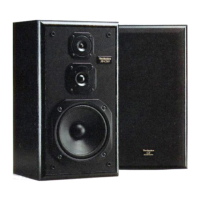
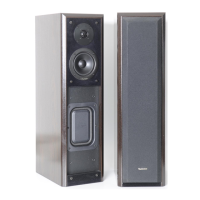
The Technics SB-M500 is a sophisticated Hi-Fi speaker system designed to deliver high-quality audio reproduction. This speaker system is a 3-way, 4-speaker configuration, meticulously engineered to provide a rich and immersive sound experience. Its design emphasizes both acoustic performance and user-friendly maintenance, making it a versatile addition to any audio setup.
The core function of the SB-M500 is to convert electrical audio signals into sound waves, reproducing music and other audio content with fidelity. The 3-way, 4-speaker system architecture means that different frequency ranges are handled by dedicated speaker units, optimizing sound clarity and detail across the entire audio spectrum.
The system incorporates a "Dual Dynamic Drive System" for the woofers, which is a key feature for robust bass reproduction. This system includes an 18 cm passive radiator alongside a 14 cm cone-type active driver unit. The passive radiator enhances the bass response without requiring additional power, by utilizing the air pressure generated by the active woofer. This results in deeper, more controlled, and impactful low frequencies.
For the midrange frequencies, the SB-M500 employs a 14 cm cone-type driver. This dedicated midrange unit is crucial for reproducing vocals and instruments with naturalness and presence, ensuring that the most critical part of the audio spectrum is handled with precision.
High frequencies are managed by a 2.5 cm dome-type tweeter. Dome tweeters are known for their wide dispersion characteristics and ability to reproduce crisp, detailed highs, contributing to the overall spaciousness and clarity of the soundstage.
The speaker system is designed to handle a substantial amount of power, with a music input power of 160 W and a DIN input power of 80 W. This robust power handling capability ensures that the speakers can perform well with a variety of amplifiers and can deliver high sound pressure levels without distortion.
A crossover network is integrated into the system, which is responsible for directing the correct frequency ranges to their respective speaker units. The crossover frequencies are set at 90 Hz and 2.5 kHz, ensuring a smooth transition between the woofer, midrange, and tweeter, and preventing interference between the drivers. This precise frequency division is vital for maintaining tonal balance and preventing phase issues.
The SB-M500 is available in two color options: black (K) and brown (M), allowing users to choose a finish that best suits their aesthetic preferences and home decor.
The SB-M500 is designed for straightforward integration into a home audio system. Users simply connect the speaker terminals to their amplifier or receiver. The terminal block is clearly marked, ensuring correct polarity for optimal sound performance.
The speaker's robust construction and carefully selected components are intended to provide long-term reliability and consistent audio quality. The system's dimensions and weight suggest a substantial build, which typically contributes to better acoustic performance by minimizing cabinet resonances.
The speaker net, which protects the drivers, is designed for easy removal, allowing users to access the speaker units for cleaning or inspection. This feature also caters to audiophiles who prefer to listen with the speaker grilles off, as some believe it can slightly improve sound clarity by removing an obstruction in the sound path.
The internal wiring and component layout are thoughtfully arranged, as shown in the schematic diagram and exploded view. This attention to detail in the internal design contributes to the overall performance and longevity of the speaker system. The use of non-polar capacitors and poly switches in the crossover network indicates a commitment to quality and protection of the speaker components.
The service manual provides comprehensive disassembly instructions, which are invaluable for experienced repair technicians. These instructions detail how to access and remove various components, facilitating maintenance and repair.
The detailed instructions for each component removal, including the type and number of screws, specific tools (like hexagonal wrenches), and wire colors for terminals, make it possible for qualified technicians to perform precise repairs. The manual also includes warnings, such as being careful not to break the net holder, and specific instructions for reassembly, like ensuring the "UP" mark on the passive radiator is correctly oriented.
The inclusion of an exploded view and a schematic diagram further aids in maintenance and troubleshooting. The exploded view provides a visual representation of all components and their assembly order, while the schematic diagram illustrates the electrical connections and component values within the crossover network. This level of detail is essential for diagnosing electrical issues and replacing faulty components.
The replacement parts list, with part numbers and descriptions, is a critical resource for obtaining genuine replacement parts, ensuring that any repairs maintain the original performance characteristics of the speaker system. The list distinguishes between parts supplied by PAES and AD. M.E.I., indicating the sourcing of components.
Overall, the Technics SB-M500 is a well-engineered speaker system that combines advanced acoustic design with practical maintenance considerations, ensuring both high-fidelity sound reproduction and long-term serviceability.
 General
| Impedance | 6 Ohms |
|---|---|
| Power Handling | 100 W |
| Crossover Frequencies | 3 kHz |
| Enclosure | Bass reflex |
| System | 2-way |

 To Next Page