EasyManua.ls Logo

Technics ST-9600 - Page 6

Technics ST-9600
16 pages
Print Icon
To Next Page IconTo Next Page
To Previous Page IconTo Previous Page
Loading...
The
DC
component
is
taken
from
the
discrete
output
taken
from
terminal
©
of
1C303,
and
the
response
is
made
flat
by
the
filter
circuitry.
Then,
after
the
signal
is
amplified
to
an
appropriate
level,
it
passes
through
the
selector
switch,
and
then
to
the
tape
input
terminals
and
the
output
terminals
of
this
unit.
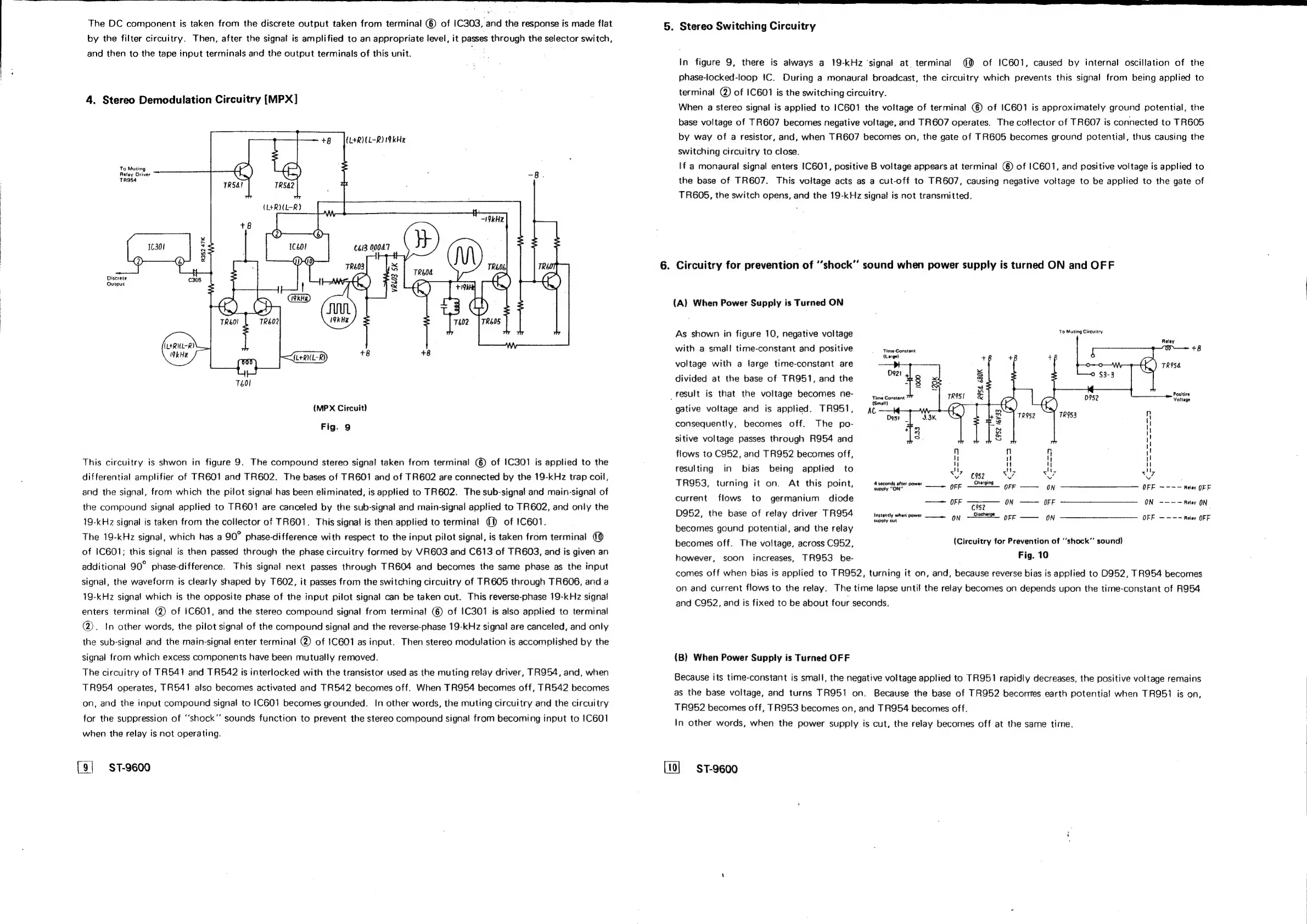
4.
Stereo
Demodulation
Circuitry
[MPX]
+B
[(L+R)(L-R)IVKHZ
To
Muting
-)
zl
Retay
Driver
Naas
-8.
ai
TRSAI
TR5A2
7
(L4RML-RY
|
oe
2)
©
1Cé0!
4/3
00047
Da,
:
(2)
©
R352
47K
R
x
ens
H
ee
ye
|
TREod
=
Lim)
#8
Lea
=
Ss
T6402
(LtRML-R)
mee
<i
.
Té0!
(MP
X
Circuit)
Fig.
9
This
circuitry
is
shwon
in
figure
9.
The
compound
stereo
signal
taken
from
terminal
@)
of
1C301
is
applied
to
the
differential
amplifier
of
TR601
and
TR602.
The
bases
of
TR601
and
of
TR602
are
connected
by
the
19-kHz
trap
coil,
and
the
signal,
from
which
the
pilot
signal
has
been
eliminated,
is
applied
to
TR602.
The
sub-signal
and
main-signal
of
the
compound
signal
applied
to
TR601
are
canceled
by
the
sub-signal
and
main-signal
applied
to
TR602,
and
only
the
19-kHz
signal
is
taken
from
the
collector
of
TR601.
This
signal
is
then
applied
to
terminal
(@
of
1C601.
The
19-kHz
signal,
which
has
a
90°
phase-difference
with
respect
to
the
input
pilot
signal,
is
taken
from
terminal
(@
of
|1C601;
this
signal
is
then
passed
through
the
phase
circuitry
formed
by
VR603
and
C613
of
TR603,
and
is
given
an
additional
90°
phase-difference.
This
signal
next
passes
through
TR6O4
and
becomes
the
same
phase
as
the
input
signal,
the
waveform
is
clearly
shaped
by
T602,
it
passes
from
the
switching
circuitry
of
TR605
through
TR606,
and
a
19-kHz
signal
which
is
the
opposite
phase
of
the
input
pilot
signal
can
be
taken
out.
This
reverse-phase
19-kHz
signal
enters
terminal
(2)
of
1C601,
and
the
stereo
compound
signal
from
terminal
@
of
1C301
is
also
applied
to
terminal
(2.
In
other
words,
the
pilot
signa!
of
the
compound
signal
and
the
reverse-phase
19-kHz
signal
are
canceled,
and
only
the
sub-signal
and
the
main-signal
enter
terminal
@
of
1C601
as
input.
Then
stereo
modulation
is
accomplished
by
the
signal
from
which
excess
components
have
been
mutually
removed.
The
circuitry
of
TR541
and
TR542
is
interlocked
with
the
transistor
used
as
the
muting
relay
driver,
TR954,
and,
when
TR954
operates,
TR541
also
becomes
activated
and
TR542
becomes
off.
When
TR954
becomes
off,
TR542
becomes
on,
and
the
input
compound
signa!
to
1C601
becomes
grounded.
In
other
words,
the
muting
circuitry
and
the
circuitry
for
the
suppression
of
‘shock’
sounds
function
to
prevent
the
stereo
compound
signal
from
becoming
input
to
IC601
when
the
relay
is
not
operating.
[9|
S$T-9600
_result
is
that
the
voltage
becomes
ne-
5.
Stereo
Switching
Circuitry
In
figure
9,
there
is
always
a
19-kHz
‘signal
at.
terminal
(0
of
IC601,
caused
by
internal
oscillation
of
the
phase-locked-loop
1C.
During
a
monaural
broadcast,
the
circuitry
which
prevents
this
signal
from
being
applied
to
terminal
@)
of
IC601
is
the
switching
circuitry.
When
a
stereo
signal
is
applied
to
IC601
the
voltage
of
terminal
@
of
IC601
is
approximately
ground
potential,
the
base
voltage
of
TR607
becomes
negative
voltage,
and
TR607
operates.
The
collector
of
TR607
is
connected
to
TR605
by
way
of
a
resistor,
and,
when
TR6O7
becomes
on,
the
gate
of
TR6O5
becomes
ground
potential,
thus
causing
the
switching
circuitry
to
close.
If
a
monaural
signal
enters
1C601,
positive
B
voltage
appears
at
terminal
@
of
1C601,
and
positive
voltage
is
applied
to
the
base
of
TR607.
This
voltage
acts
as
a
cut-off
to
TR607,
causing
negative
voltage
to
be
applied
to
the
gate
of
TR605,
the
switch
opens,
and
the
19-kHz
signal
is
not
transmitted.
6.
Circuitry
for
prevention
of
‘“shock’’
sound
when
power
supply
is
turned
ON
and
OFF
(A)
When
Power
Supply
is
Turned
ON
As
shown
in
figure
10,
negative
voltage
To
Muni
Chrewiey
with
a
small
time-constant
and
positive
Tin
Conaieat
+B
(Large)
+
voltage
with
a
large
time-constant
are
divided
at
the
base
of
TR951,
and
the
.
Positire
Time
Constant
Vottage
(Smalt}
gative
voltage
and
is
applied.
TR951,
ac
Ay
R953
q
consequently,
becomes
off.
The
po-
a
1
sitive
voltage
passes
through
R954
and
s
i
flows
to
C952,
and
TR952
becomes
off,
n
IH
fi
iH
resulting
in
bias
being
applied
to
dl,
aes
dH,
ity
oy
TR953,
turning
it
on.
At
this
point,
Ascondratesomr
pep
_Orsing
ope
gy
OFF
~-~~
ree
OEE
current
flows
to
germanium
diode
——~
OFF
>
oN
——
oF
———
ON
~
~~~
ray
ON
D952,
the
base
of
relay
driver
TRO54
Instantly
when
power
a
py
—-Dilsharet
ype
yy
ee
aay
OFF
becomes
gound
potential,
and
the
relay
becomes
off.
The
voltage,
across
C952,
(Circuitry
for
Prevention
of
‘shock’
sound)
however,
soon
increases,
TR953_
be-
Fig.
10
comes
off
when
bias
is
applied
to
TR952,
turning
it
on,
and,
because
reverse
bias
is
applied
to
D952,
TR954
becomes
on
and
current
flows
to
the
relay.
The
time
lapse
unti!
the
relay
becomes
on
depends
upon
the
time-constant
of
R954
and
C952,
and
is
fixed
to
be
about
four
seconds.
(B)
When
Power
Supply
is
Turned
OFF
Because
its
time-constant
is
small,
the
negative
voltage
applied
to
TRQ51
rapidly
decreases,
the
positive
voltage
remains
as
the
base
voltage,
and
turns
TR951
on.
Because
the
base
of
TRQ952
becomes
earth
potential
when
TRQ51
is
on,
TR952
becomes
off,
TR953
becomes
on,
and
TR954
becomes
off.
In
other
words,
when
the
power
supply
is
cut,
the
relay
becomes
off
at
the
same
time.
[to]
sT-9600

Related product manuals