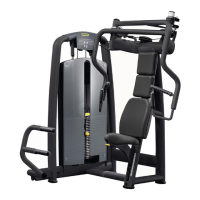
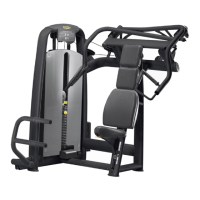
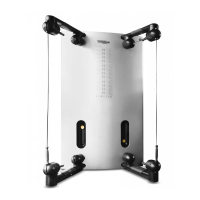
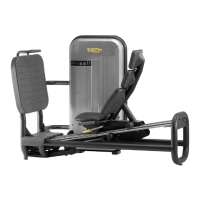
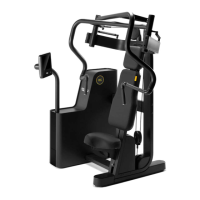
The Biostrength™ device is a commercial fitness machine designed for indoor use in both residential and professional settings. It is classified as a Class SC device according to ISO EN 20957-1, indicating its suitability for commercial environments where access and supervision are controlled by the owner. The product line includes various machines such as Chest Press, Leg Curl, Leg Extension, Leg Press, Low Row, Lower Back, Shoulder Press, Total Abdominal, and Vertical Traction, each designed to target specific muscle groups.
Function Description:
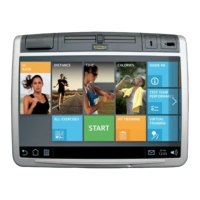
The Biostrength™ machines are designed to provide a controlled and effective strength training experience. Users interact with a display to adjust settings such as seat height, roller positions, and workload. The motorized actions of the equipment allow for precise control over the exercise movement and resistance. Emergency stop buttons are integrated into several machines (Leg Curl, Leg Extension, Lower Back, Leg Press) to immediately release the workload and stop automatic movements in case of an emergency. The equipment emphasizes proper form and controlled movements, with instructions for maintaining alignment and speed during exercises. Some machines offer variations in grip or foot placement to target different muscle trajectories or activate specific muscle groups (e.g., obliques in the Total Abdominal).
Important Technical Specifications:
- Power Supply: 200-240 Vac 50/60 Hz
- Motor Peak Power: 2 kW (6 kW in Leg Press)
- Maximum User Weight: 180 kg (397 lb)
- Noise Level: Less than 70 dB
- Protection Rating: IP 20
- Operating Temperature: From +5°C to +30°C (from +41°F to +86°F)
- Maximum Capacity of Holder: 2 kg (4 lb)
- Dimensions and Weight (examples):
- Chest Press: 1270 mm (50") length, 1450 mm (57") width, 1712 mm (67") height; 237 kg (522 lb)
- Leg Curl: 1480 mm (58") length, 1106 mm (44") width, 1257 mm (49") height; 227 kg (500 lb)
- Leg Extension: 1435 mm (56") length, 1111 mm (44") width, 1257 mm (49") height; 242 kg (534 lb)
- Leg Press: 2082 mm (82") length, 1239 mm (49") width, 1316 mm (52") height; 372 kg (820 lb)
- Low Row: 1351 mm (53") length, 1314 mm (52") width, 1340 mm (53") height; 237 kg (522 lb)
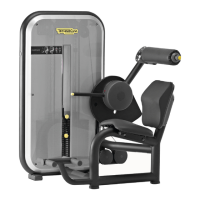
- Lower Back: 1371 mm (54") length, 1108 mm (44") width, 1218 mm (48") height; 229 kg (505 lb)
- Shoulder Press: 1153 mm (45") length, 1431 mm (56") width, 1780 mm (70") height; 232 kg (511 lb)
- Total Abdominal: 1375 mm (54") length, 1038 mm (41") width, 1391 mm (55") height; 215 kg (474 lb)
- Vertical Traction: 1154 mm (45") length, 1345 mm (53") width, 1892 mm (74") height; 219 kg (483 lb)
Usage Features:
- User Interface: The equipment features a display with buttons for adjusting seat position, roller positions, and workload.
- Safety Precautions: Users are advised to consult a medical professional before starting an exercise program. The manual emphasizes proper form, controlled speed, and stopping exercise if pain or abnormal symptoms occur. Loose clothing, long hair, and children/pets near the equipment are prohibited.
- Adjustments: Seat height and roller positions can be adjusted using display buttons to ensure proper alignment and comfort for different users. Workload is also selected via the display, with a tolerance of ±3% compared to the actual value.
- Emergency Stop: Red emergency buttons are present on specific machines to immediately release workload and stop automatic movements.
- Power Control: A main switch turns the product on and off. A circuit breaker protects electrical components from power surges. The power supply switch should be in the OFF (0) position when plugging in or unplugging the device.
- Placement: The equipment requires a flat, stable, and vibration-free surface capable of bearing its weight plus the user. A minimum free space of 60 cm around the entire perimeter is recommended. Environmental conditions should be between +10°C and +25°C with 20-90% humidity. Direct sunlight and high humidity areas (e.g., near pools) should be avoided.
Maintenance Features:
- Routine Inspection: The product's safety is ensured by careful inspection every two weeks for signs of damage or wear. Defective or worn components must be replaced immediately, or the product removed from service.
- Cleaning: The equipment should be kept clean and dust-free. Padded parts can be cleaned with neutral soap and a damp cloth or sponge. The exterior should be cleaned weekly with a damp sponge. Chemical products or solvents are not to be used.
- Lubrication: The seat guides should be lubricated monthly or if squeaking occurs. This involves sliding the seat to one end, cleaning the guides with a soft cloth to remove dust and oil, applying a thin layer of synthetic oil with PTFE (not supplied) using a slightly moistened cloth, and repeating the process for the other end of the guides.
- Padded Parts Replacement: Worn padded parts, especially for hygiene reasons, should be replaced completely. Instructions are provided for replacing seat padding and rollers on various machines (Total Abdominal, Leg Curl, Leg Extension, Lower Back).
- Electrical Connection: Instructions are provided for safely connecting the power cable, including removing spacers and screws, running the cable through clips, and securing it. The power supply socket must be grounded.
- Levelling: The product must be level for proper operation. This is achieved by adjusting the feet using a locknut and screw mechanism until the frame is stable.
- Moving the Product: When moving, a pallet truck or forklift should be used on the motor side, with padded material between the frame and lifting equipment. Levers and seats should be tied to prevent uncontrolled movement. The product is heavy and should be lifted by more than one person. Pressure should not be exerted against protective panels or display support arms/levers during movement to avoid damage or instability.
- Storage: For long periods of non-use, the equipment should be stored in a clean, dry place with a dust cover, at a room temperature between -10°C and 70°C, and 20-90% relative humidity, preferably using original packing materials.
- Disposal: The product is made from recyclable materials (steel, aluminum, plastic) and must be disposed of according to urban refuse collection regulations. Electrical and electronic equipment waste requires specific processing, recovery, and recycling systems. Users in the European Union should take used equipment to authorized collection centers; commercial users should contact Technogym Customer Service. For countries outside the EU, local authorities should be contacted. The average life of the product is 10 years.
- Technical Service: Technogym Technical Support Service provides telephone assistance, information on warranty coverage, on-site assistance, and original spare parts. When contacting, users should provide the product model, date of purchase, serial number, and a precise description of the problem. Operations by unauthorized personnel will invalidate the warranty.

 Need help?
 General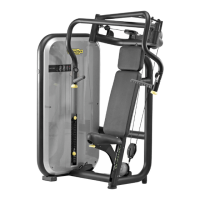

 To Next Page