
 Need help?
Do you have a question about the Technogym Element+ and is the answer not in the manual?
Instructions for cleaning the padded parts of the equipment using a moist cloth or sponge and mild soap.
Procedure for lubricating the weight stack guides with a soft cloth and supplied oil.
This document provides a comprehensive user manual for the Technogym Element+ Lat Machine, an essential strength training equipment designed for latissimus dorsi exercises. The manual covers various aspects of the machine, from its basic description and usage to detailed maintenance procedures and safety guidelines.
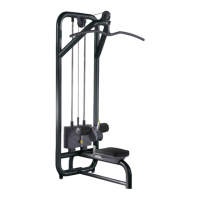
The Lat Machine is designed to allow users to perform exercises targeting the back muscles, specifically the latissimus dorsi. It features a seat where the user sits to perform the exercise, and a bar that is moved by the user. The machine incorporates rollers, which are adjustable in depth via a lever and button mechanism, to accommodate different user body weights and exercise preferences. The core of the resistance system is a weight stack, where the user selects the desired load using a pin, thereby adjusting the exercise effort level. The bar, operated by the user, moves the weights along two guides via a cable system.
For safe and effective use, the manual emphasizes several usage features. Users are instructed to sit down and position their legs underneath the roller pads. The height of these pads can be adjusted by releasing the rollers lever and operating the button. The desired workload is selected using a pin on the weight stack. Once seated and the workload is set, the user grasps the bar evenly and pulls it down, ensuring that the spine does not bend during the exercise. It is crucial to maintain a smooth, controlled speed throughout the movement, staying in control of the weight. At the end of the exercise, the weight stack should be returned to its starting position. The manual also highlights the importance of proper installation, recommending a temperature range of +10°C to +25°C, sufficient ventilation (20-90% humidity), adequate lighting, and sufficient clearance around the equipment for safety. The floor surface must be flat, stable, vibration-free, and capable of supporting the equipment's weight. For installations in public recreational areas, compliance with all relevant regulations is required, and access and supervision must be controlled by the owner.
Maintenance is a critical aspect covered extensively in the manual to ensure the equipment's safety and longevity. Routine maintenance is recommended every two weeks, involving a careful inspection for signs of damage or wear. Any defective or worn components must be replaced immediately, or the equipment should be removed from service. General hygiene practices dictate that the equipment should always be kept clean and dust-free, especially in multi-user environments. Padded parts can be cleaned with a moist cloth or sponge and mild soap, while outer parts should be cleaned weekly with a damp sponge. A specific warning is issued against rubbing drawings and instructions on labels with excessive force. Lubrication of the weight stack guides is also detailed: a soft cloth should be used to remove dust and oil residues, then slightly moistened with the supplied oil, and a very thin layer applied to the guides, avoiding excess. For maintenance actions not described, users are advised to contact Technogym Technical Service.
The manual provides detailed instructions for replacing specific components. If padded components show signs of wear, they should be replaced completely for hygiene reasons. To replace the seat, screws on the opposite side of the padding need to be loosened. For roller pads, the cover (A) is removed, screw (B) unscrewed, and washer (C) removed before replacing the pads. Cable replacement is a multi-step process: first, the bar is dismantled, the rubber gaiter (A) raised, screws (B) unscrewed, and the cable extracted from attachment (C). Then, the lock nut (D) is backed off, adjuster (E) unscrewed, and the cable extracted from the adjuster side. When inserting the new cable, the original path must be followed, starting from the adjuster side. A thickness of approximately 10 mm (1/2") should be inserted under the first weight of the stack. The adjuster (E) is then put in, the rubber gaiter (A) and attachment (C) inserted, and screws (B) tightened. The rubber gaiter (A) is lowered, cable tension adjusted, and lock nut (D) tightened. Finally, the 10 mm thickness is removed from the weight stack. A crucial warning states that only cables supplied directly by Technogym should be used, and cables must be replaced at the first sign of wear, even if only the outer rubber protection is affected. Monthly inspection of cable conditions is also mandated.
Adjusting cable tension is another maintenance feature. Slack in the weight stack cable can be taken up using the adjuster (E) after loosening the lock nut (D). When tightening screws (A) after cable replacement, inserting a 10 mm (1/2") thickness under the first weight in the stack can be helpful to pull the cable taut.
Replacing the spring hook is also covered. Monthly inspection of the spring hook's condition is required. Spring hooks must be replaced immediately upon noticing any signs of wear, deformity, difficulty in closing, or anything that compromises its robustness. Only spring hooks supplied directly by Technogym should be used. If an original part is unavailable, a spring hook meeting specific minimum requirements must be used: AISI 316 stainless steel materials and a maximum capacity of 800 kg (1764 lb) on the main axis. A warning explicitly states not to alter the spring hooks in any way.
The manual also includes information on storage and disposal. For prolonged periods of non-use, the equipment should be stored in a clean, dry place, covered with a cloth, at a temperature between +10°C and +25°C, and a humidity between 20% and 90%. Original packing materials should be used for correct storage. For disposal, it is important to ensure the equipment does not pose a hazard, especially to children. The equipment should not be disposed of in the environment or public/private areas. Being made of recyclable materials like steel, aluminum, and plastic, it must be disposed of according to urban refuse collection regulations by specialist environmental firms.
Finally, the Technogym Technical Support Service provides assistance for telephone inquiries, defining warranty coverage, on-site assistance, and sending original spare parts. When contacting the service, users should provide the equipment model, date of purchase, serial number, and a precise description of the problem. A warning states that any operations performed by unauthorized personnel will invalidate the warranty.
 General
| Usage | Commercial |
|---|---|
| Resistance System | Weight Stack |
| Dimensions | Varies depending on the specific Element+ model. See individual product specifications for detailed dimensions. |
| Weight | Varies by equipment type |
| Max User Weight | Varies by equipment type |
| Display | N/A (Typically no display on standard Element+ models. Some models may have optional displays.) |


 To Next Page