Installation (Continued)
2. When the pump is set away from the
points of water use, the discharge
pipe size should be increased to
reduce pressure losses caused by
friction.
• Up to 100 ft run: Same size as
pump discharge port.
• 100 ft. to 300 ft run: Increase one
pipe size.
• 300 ft. to 600 ft run: Increase two
pipe sizes.
PRESSURE TANK INSTALLATION
The Pressure Tank provides a reservoir
of water under pressure and maintains
a cushion of air pressure to prevent
pipe hammering and possible damage
to plumbing components. When water
is drawn off through house fixtures, the
pressure in the tank is lowered and the
pressure switch starts the pump.
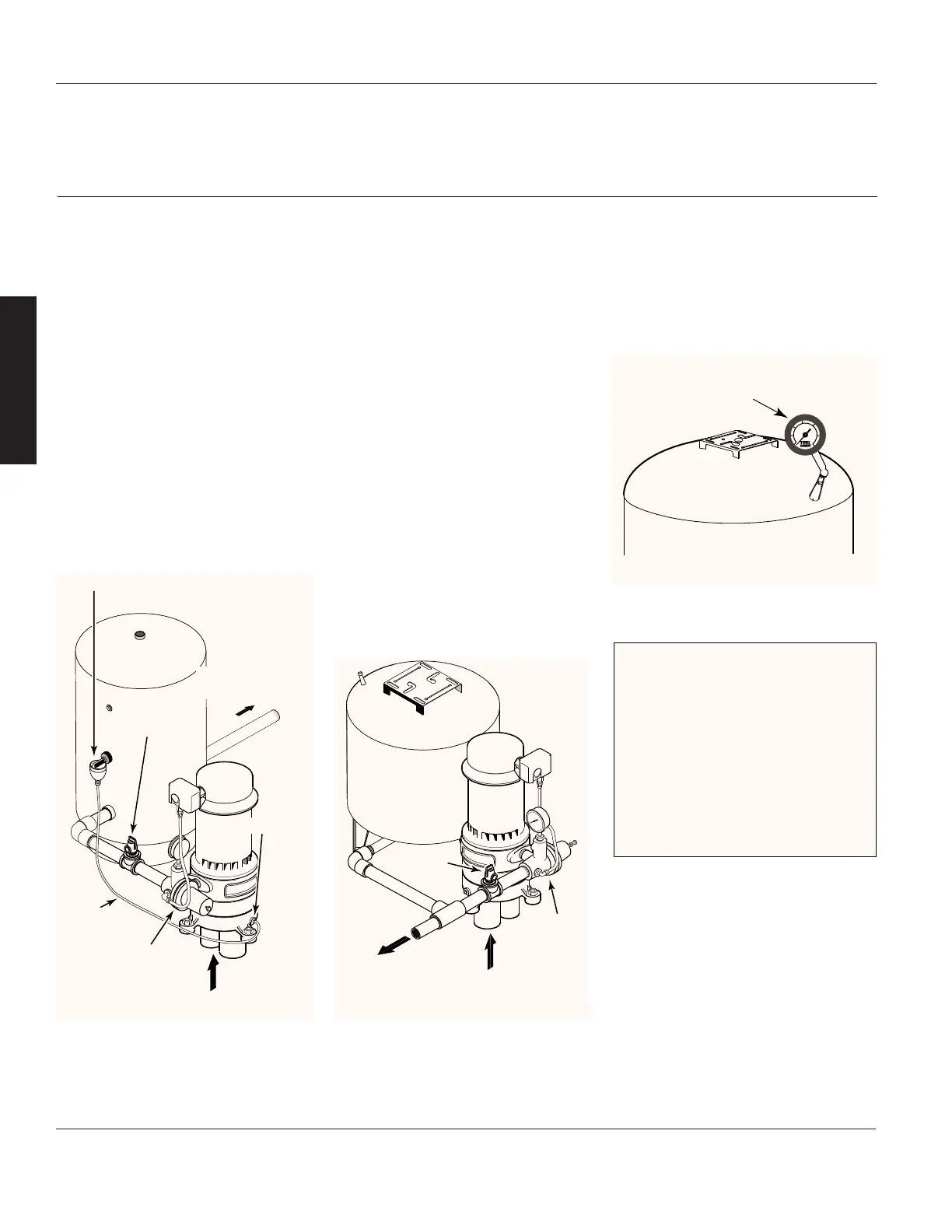
STANDARD TANK CONNECTION
When a standard tank is used, an air
volume control (AVC) adds air to the
tank when it is needed. See Figure 3
for typical standard tank installation. To
connect AVC to pump, thread a 1/4”
compression fitting into tapped hole on
the front of the pump. Cut tubing to
length to reach AVC; assemble to fitting
on pump and to AVC on tank. See
installation instructions provided with
tank and AVC for details.
PRECHARGED TANK CONNECTION
When a precharged tank is used, no
AVC is necessary. See Figure 4 for
typical precharged tank installation. A
precharged tank contains a factory
provided air charge.
IMPORTANT: Your pump pressure
switch is set for a 30-50 psi range and
requires a tank pre-charge of 28 psi for
proper operation (See Figure 5 below
and Tank Owner’s Manual). An annual
check on tank air charge is
recommended.
8
Teel Operating Instructions and Parts Manual
3P740A, 4P037, 4P038, 4P039 and 4RJ96A
Teel One, Two, and Three Stage
Vertical Jet Pumps
®
E
N
G
L
I
S
H
SEALING PIPE JOINTS
Use teflon tape or a teflon-
based pipe joint compound to
seal the joints in the suction
pipe. Make sure that all pipe
joints in the suction pipe are air-
tight as well as water tight.
If the suction pipe can suck air,
the pump will not be able to
pull water from the well.


 To Next Page
 Loading...