- 3 -
As soon as the outdoor temperature is below the high temperature limit (within the range of the "high and low
temperature limit"), the slab temperature measured by the sensor at input 1 is kept at the level of the setpoint
value (with an hysteresis of 1K). Additionally the moisture is measured regularly. If moisture is detected, the
heating will be switched on. If there is no moisture, the slab temperature will be kept at the setpoint value for as
long as the outdoor temperature is below the temperature limit.
Emergency operation (not in the "Slab idle temperature" mode)
If two sensors are connected (moisture and temperature), the controller will switch to emergency operation in
case one of the two temperature or moisture measurement circuits is impaired and the corresponding function is
activated for both sensors in the "Sensor status". In this case the evaluations will only be made with one
measurement circuit. The LED indicating the operating mode will flash red/green in order to indicate the error.
Moisture value and setting of the moisture limit
The sensors determine the moisture value as a number (without measurement unit). It lies in the range from 1 to
99. The moisture value is determined by the sensor type, the present moisture and the installation situation. By
all means the optimum moisture limit should therefore be determined during installation. In doing so, the user's
preferences need to be taken into account, i. e. if the slab heating should already be switched on in case of very
little moisture or only if a certain amount of moisture has developed. The factory default setting of 50 can be
used as an indicator. If the moisture limit is set to 50, all measured moisture values above 50 lead to the result
"moisture detected" and trigger the heating unit.
Counter for operating hours
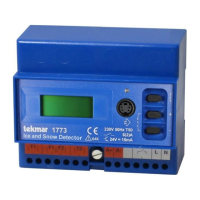
The ice and snow detector has a counter for operating hours with two display levels. The first level "Time Mtr 1"
can be reset to zero. In this way it can be monitored for how many hours the heating was switched on since the
last reset (e. g. during one heating period). The second level shows the operating time of the heating unit since
the controller has been taken into use. This level cannot be reset.
Invertible alarm output
In case of an error there is a voltage of 24V between the terminals of alarm output A+ and A-. In this way the
alarm may, for example, be detected by a central control centre via the type 1798 coupling relay.
The state of the alarm output may be inverted using the menu, i. e. in the normal state (no error) the alarm
output is supplied with 24V or in case of an error 0V. Like this the control centre may detect a power failure of
the system.
PC interface
The controller has an interface for connection to a PC. The optional connection cable and software are available
as accessories and allow for a display of all settings and measured values. Please contact us for more
information.
2. Sensor mounting in open areas (sensor type 3352, 3353, 3355 or 3356)
The sensors designed for use in open areas used by vehicles and pedestrians are cast in a body in brass G-
Ms63. The sensors have a fixed supply line. For type 3352 it is fed into the sensor body from the bottom and for
type 3353 from the side. For types 3355 und 3356 the supply line can be variably fed into the body.
The sensors type 3352, 3355 and 3356 may be installed in a ground socket. When the open area is built, this
ground socket is placed into the surface without the sensor in such a way that there will be an even surface after
installation of the sensor. Refer to the mounting example below for detailled information.
Especially in case of surfaces which need a high processing temperature, such as poured asphalt (> 75 °C), the
fitting of a ground socket should be well provided for. In order to avoid that the ground socket sinks into a soft
surface later (e. g. in a sand bed for stone paving), it is recommended to create a firm footing for the socket (e.
g. by putting a concrete slab underneath it).
Note: A protective tube needs to be used for the sensor supply line. This is beneficial both during a new
installation and in case of a necessary replacement. Depending on the weight and material of the surface either
a plastic pipe or an armoured steel tube DN20 can be used. Make sure that the openings of the empty conduit
and the ground socket are securely closed during the construction of the open area to keep out building
material.


 To Next Page
 Loading...