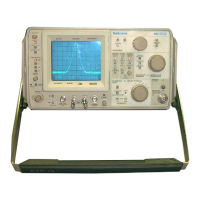
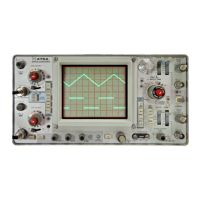
Fig. 6-19. Test equipment setup to adjust and check dispersion accuracy.
Type 491
INTENSITY
FOCUS and ASTIGMATISM
INTENSIFIER
SCALE ILLUM
POSITION (Horizontal and
Vertical)
TIME/DIV
VARIABLE
TRIGGER
SLOPE
LEVEL
SOURCE
DISPERSION RANGE
DISPERSION-COUPLED
RESOLUTION
DISPERSION CAL
DISPERSION BAL
IF ATTENUATOR dB
IF CENTER FREQ
VIDEO FILTER
VERTICAL DISPLAY
GAIN
POWER
MIXER PEAKING
Display of nominal
brightness
Adjusted for optimum
display definition
OFF
As desired
Adjusted for a
horizontally centered
sweep on the graticule
baseline
20 ms
CAL
+
Triggered sweep
LINE
MHz/DIV
10 MHz/div
Midrange
Midrange
All switches in off position
Midrange (000)
OFF
LIN
Midrange
ON
SEARCH
FINE RF CENTER FREQ
Centered
PHASE LOCK Controls
INT REF FREQ
OFF
Test Oscilloscope
Time/Cm
1 ms
Volts/Cm
.5
Input Coupling
AC
21. Adjust MHz/DIV Dispersion and
o
Linearity
NOTE
Dispersion accuracy is a measure of the frequency
dispersion error within 8 divisions of a 10 division
display. It is measured by positioning the 1st fre-
quency marker on the 1st graticule line, then not-
ing the dispersion error as the distance the 9th
marker is displaced from the 9th graticule line.
See Fig. 6-20.
Linearity error is the measured distance any mark-
er is displaced from its respective graticule line
when compared over an 8 major division display.
See Fig. 6-21.
Dispersion accuracy and the display linearity are
affected by the RF output amplitude, circuit con-
stants, etc. DISPERSION CAL adjustment R208 pri-
marily affects the dispersion accuracy and C358
the linearity. If these two adjustments will not
6-20



 To Next Page
