
 Need help?
Do you have a question about the Tektronix A622 and is the answer not in the manual?
Essential safety precautions for product operation and to prevent injury or damage.
Safety precautions to prevent fire or personal injury, including terminal ratings and tactile barrier.
Safety precautions for performing service procedures on the product, including power disconnection.
Information about the probe's 9V battery, indicator, and gain errors.
Step-by-step guide for installing the battery in the probe.
Lists items shipped with the probe and recommended accessories.
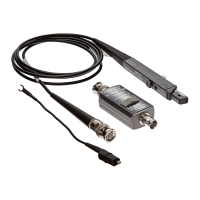
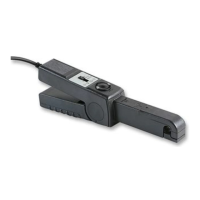
The Tektronix A622 is a 100 Amp AC/DC Current Probe designed to enable general-purpose oscilloscopes to display AC and DC current signals. It can measure currents up to 100 amps Peak (70 A RMS). Additionally, the A622 can be used with a multimeter for AC and DC measurements when paired with a BNC-to-banana plug adapter, which is available as a recommended accessory.
The A622 current probe operates by clamping around a conductor to measure the current flowing through it. It provides an output signal proportional to the measured current, which can then be displayed and analyzed by a connected oscilloscope or multimeter. The probe is equipped with an OFF/Range switch that allows the user to select between two sensitivity ranges: 10 mV/A and 100 mV/A. This flexibility enables accurate measurements across a wide range of current levels.
A key feature of the A622 is its ability to measure both AC and DC currents. For DC measurements, a Zero adjustment knob is provided to null the probe output when no current is present, or to offset a DC signal component. This zeroing is generally not required for AC measurements unless the connected instrument cannot isolate a DC component. The probe also includes a current flow symbol, an arrow indicating the polarity convention for measuring current from positive to negative, which helps ensure correct readings.
The probe is designed for use by trained personnel and emphasizes safety precautions. Users are advised to observe all terminal ratings, including Measurement Category (CAT) ratings and voltage/current ratings, to prevent fire or shock hazards. It is crucial not to exceed the maximum ratings of any terminal and to avoid using the probe beyond its tactile barrier. The probe is not intended for detecting hazardous voltages, and personal protective equipment should be used when exposed to hazardous live conductors.
To begin using the A622, batteries must first be installed. The probe connects to an oscilloscope via its BNC connector. For initial setup, the oscilloscope channel's vertical coupling should be set to DC volts and the vertical deflection to 0.1 V/div. Once connected, the OFF/Range switch is moved to either the 10 mV/A or 100 mV/A position to power on the probe. A green LED serves as a power/battery indicator; if it doesn't light up, the battery needs replacement.
The Zero adjustment is then used to zero or offset the probe output before clamping it onto the conductor. It's important to connect the probe to the measurement instrument before clamping it onto the circuit under test and to unclamp it from the conductor before disconnecting it from the instrument. Users are warned against clamping the probe onto circuits with voltages greater than 600 VAC, as this can cause personal injury or damage.
When clamping, care should be taken to clamp around only one conductor to avoid a zero reading, which can happen if both "hot" and neutral wires are clamped simultaneously. After clamping, the probe and oscilloscope channel can be adjusted to obtain a clear view of the signal. Setting the channel to DC volts allows observation of both AC and DC currents, while setting it to AC shows only the AC current.
The A622 also features an overload indicator, a red LED that lights up if the measured signal exceeds the selected range capacity. In such cases, the user should switch to the 10 mV/A range if possible, or remove the probe from the circuit.
For increased measurement sensitivity, users can loop additional turns of the wire under test through the probe's jaws. The probe's sensitivity is multiplied by the number of loops. For example, with a 10 mV/A range and four turns, the effective sensitivity becomes 40 mV/A. However, a caution is issued against forcing the jaw closed; if it cannot close around the conductors, either reduce the number of conductors or measure on a smaller conductor to prevent damage to the probe.
Proper maintenance of the A622 AC/DC Current Probe ensures its continued operation. For cleaning the probe body, a soft cloth dampened with a solution of mild detergent and water is recommended. To clean the core, the jaw should be opened, and exposed core surfaces wiped with a cotton swab dampened with isopropyl alcohol (isopropanol). After cleaning, the jaw mating surfaces should be lubricated with a light oil. Solvents or abrasives should not be used, and the probe should never be immersed in liquid.
The A622 operates on a single 9 V battery. Battery notes indicate that significant gain errors can occur as the battery drains, even though the green LED power indicator may continue to light until the battery voltage drops to 6.5 V. If gain errors are detected, the battery should be replaced with a fresh one.
Battery installation is a straightforward process. First, the probe must be removed from any circuit. The battery compartment is accessed by loosening a captive screw and sliding off the cover. The new battery is then attached to the connector, observing polarity. Finally, the cover is replaced, and the screw is lightly tightened to secure it.
The A622 does not contain any user-repairable assemblies. If any issues arise with the probe, users are advised to contact their local Tektronix Service Center or representative for assistance. The probe is shipped with instructions and a 9V battery. A BNC-to-banana plug adapter is a recommended accessory for use with digital multimeters (DMMs).
 General
| Type | AC/DC Current Probe |
|---|---|
| Connector | BNC |
| Operating Temperature | 0 °C to 50 °C |
| Bandwidth | 100 MHz |
| Sensitivity | 100 mV/A, 10 mV/A, 1 mV/A |
| Power | 9 V battery or external power supply |
| Output Sensitivity | 100 mV/A, 10 mV/A, 1 mV/A |
| Power Supply | 9 V battery or external power supply |


 To Next Page