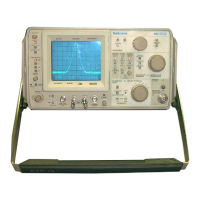
Section 2—492/492P Service Vol. I (SN B030000 & up)
INSTALLATION AND REPACKAGING
introduction
This section describes unpacking, installation, power re
quirements, and repackaging information for the 492/492P
Spectrum Analyzer. Refer to Rackmount Benchtop section
for information on these versions of the instrument.
Unpackaging and Initial Inspection
Before unpacking the 492/492P from its shipping con
tainer or carton, inspect for signs of external damage. If the
carton is damaged, notify the carrier as well as Tektronix,
Inc. The shipping carton contains the basic instrument and
its standard accessories. Optional accessories are shipped
in separate containers. Refer to the Accessories page fol
lowing the Replacable Mechanical Parts list in the 492/492P
Service Volume 2 manual for a complete listing.
If the contents of the shipping container are incomplete, if
there is mechanical damage or defect, or if the instrument
does not meet operational check requirements, contact your
local Tektronix Field Office or representative.
The instrument was inspected both mechanically and
electrically before shipment. If should be free of mechanical
damage and meet or exceed all electrical specifications.
Procedures to check functional or operational performance
are in the Calibration section. The functional check proce
dure verifies proper instrument operation and should satisfy
the requirements for most receiving or incoming inspections.
The electrical performance check follows the functional
check.
Preparation for Use
The 492/492P can be installed in any position that allows
air flow in the bottom and out the rear of the instrument.
Feet on the four corners allow ample clearance even if the
instrument is stacked with other instruments. A fan draws
air in through the bottom and expels air out the back. Avoid
locating the 492/492P where paper, plastic, or like material
might block the air intake.
The front panel cover for the 492/492P provides a dust-
tight seal. Use the cover to protect the front panel when
storing or transporting the instrument. The cover is also
used to store accessories and external waveguide mixers.
The cover is removed by first pulling up and in on the two
release latches then pulling up on the cover. The accesso
ries door is unlatched by pressing the latch to the side and
lifting the cover.
The handle of the 492/492P can be positioned at several
angles to serve as a tilt stand, or it can be positioned at the
top rear of the instrument between the feet and the rear
panel so that 492/492P instruments can be stacked. To po
sition the handle, press in at both pivot points and rotate the
handle to the desired position.
Removing or replacing the cabinet on the instrument
can be hazardous. The cabinet should only be re
moved by qualified service personnel. See Removing
the Cabinet at the beginning of the Calibration Proce
dure section.
Power Source and Power Requirements
The 492/492P is designed to operate from a single-phase
power source that has one of its current-carrying conduc
tors (neutral) at ground (earth) potential. Operating from
power sources where both current-carrying conductors are
isolated or above ground potential (such as phase-to-phase
on a multi-phase system or across the legs of a 110-220 V
single-phase, three-wire system) is not recommended, since
only the line conductor has over-current (fuse) protection
within the unit. Refer to the Safety Summary at the front of
this manual.
The ac power connector is a three-wire polarized plug
with the ground (earth) lead connected directly to the instru
ment frame to provide electrical shock protection. If the unit
is connectd to any other power source, the unit frame must
be connected to an earth ground.
Power and voltage requirements are printed on a back
panel plate mounted below the power input jack. The
492/492P can be operated from either 115 Vac or 230 Vac
nominal line voltage with a range of 90 to 132 on 180 to
250 Vac, at 48 to 440 Hz. A multipin (harmonica) type con
nector on the power supply etched circuit board can be po
sitioned to accommodate either voltage range. When the
power supply circuitry is changed to accommodate a differ
ent power source, the information plate on the back panel
must also be changed to reflect the new power require
ments. Refer to Changing Power Input Range in Section 1.
REV AUG 1981 2-1


 To Next Page
 Loading...