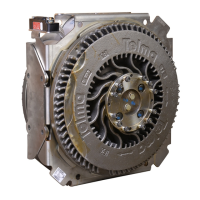
This document describes the maintenance and replacement procedures for the hub of Telma AF5 and LVRS600 retarders. Telma retarders are electromagnetic braking systems designed to provide friction-free efficiency, typically used in heavy vehicles to supplement the conventional braking system, reducing wear on service brakes and enhancing safety.
Function Description:
The Telma retarder is an auxiliary braking system that uses electromagnetic forces to slow down a vehicle without friction. This process involves rotors attached to the vehicle's drivetrain and a stator with coils that generate a magnetic field when energized. As the rotors pass through this magnetic field, eddy currents are induced, creating a braking torque that slows the vehicle. The hub is a critical component that connects the retarder to the vehicle's driveline, ensuring proper alignment and power transmission. The manual focuses on the replacement of this hub, which is essential for the retarder's structural integrity and operational efficiency.
Important Technical Specifications:
While the manual does not provide a comprehensive list of the retarder's overall technical specifications, it highlights several critical parameters and tools necessary for the hub replacement and subsequent reassembly:
- Torque Values:
- End shaft screws: 30 Nm (+/- 20%) (22 lb-ft ± 20%)
- 3 screws of the hub (AF5 retarder): 25 Nm (+/- 20%) (18 lb-ft ± 20%)
- Nut securing the connecting block to the stator (AF5 retarder): 5 Nm (+/- 20%) (44 lb-in ± 20%)
- Air Gap Measurement:
- AF50-60 and LVRS600: 0.80 mm (0 / -0.15 mm) (0.026"-0.031")
- AF50-55: 1.00 mm (0 / -0.15mm) (0.033"-0.039")
- Stator Run-out:
- Maximum allowed value: 0.40 mm
- Rotor Run-out:
- Maximum allowed value: 0.28 mm
- Abrasive Cloth: 120 grade, used for cleaning contact surfaces.
- Tools:
- Protective glasses and gloves
- Handling safety tools for retarder
- Flat screwdriver
- Torx® TX40 wrench
- Click-type wrench
- 10 mm long socket and 17 mm socket
- Tab washer driver
- Hammer
- A feeler gauge
- Magnetic dial gauge and its sensor
- Ink marker
- Abrasive cloth (120 grade)
Usage Features:
The Telma retarder, by its nature, offers several operational advantages:
- Enhanced Braking: Provides continuous, smooth braking power, especially beneficial on long descents, reducing the need for frequent use of service brakes.
- Reduced Brake Wear: Significantly extends the life of conventional brake components by taking over a substantial portion of the braking effort.
- Increased Safety: Helps maintain vehicle speed control, preventing brake fade and improving overall safety, particularly for heavy-duty vehicles.
- Friction-Free Operation: As indicated by "Friction Free Efficiency" in the logo, the electromagnetic principle ensures no mechanical wear in the retarder itself during operation, contributing to its longevity and reliability.
Maintenance Features:
The manual outlines detailed steps for the hub replacement, emphasizing precision and safety. Key maintenance features include:
- Systematic Replacement: The manual specifies "PARTS TO BE REPLACED SYSTEMATICALLY," indicating that certain components, such as end shaft screws, washers, shims, lock tabs, and screws used to secure the hub and pole shoes plate, should be replaced as a matter of course during this procedure.
- Detailed Dismantling and Reassembly Instructions: Step-by-step guidance with accompanying images ensures that technicians can accurately perform the replacement. This includes:
- Identification Marks: Instructions to draw marks on rotors to ensure correct re-alignment during reassembly (1-C, 1-D).
- Lock Tab Removal and Installation: Specific procedures for removing and installing lock tabs to secure screws (1-E, 1-F, 6-K, 6-L).
- Stator Opening: Procedures for opening the retarder stator, including removing covers and securing the retarder on wood bars for stability (2-A to 2-F).
- Defective Hub Removal: Instructions for carefully removing the old hub, with warnings about protecting coils and wiring (3-A to 3-D).
- Cleaning: Emphasizing the importance of cleaning poles and contact surfaces with abrasive cloth (120 grade) to ensure proper fit and electrical contact (3-E, 3-F).
- New Hub Installation: Detailed steps for installing the new hub, ensuring correct orientation, wire routing, and securing screws (4-A to 4-H).
- Pole Shoes Plate Installation: Instructions for carefully installing the pole shoes plate, ensuring spring washers are correctly positioned and screws are tightened to specified torques (4-I to 4-O).
- Rotor Installation: Procedures for re-installing rotors, including placing dust shields, aligning marks, and tightening end shaft screws (6-A to 6-F).
- Quality Control Checks:
- Stator Run-out Check: Using a magnetic dial gauge and sensor to measure stator run-out, with a maximum allowed value of 0.40 mm (4-U). This is crucial for preventing vibrations and ensuring smooth operation.
- Rotor Run-out Check: Similar to stator run-out, checking rotor run-out with a magnetic dial gauge and sensor, with a maximum allowed value of 0.28 mm (6-G).
- Air Gap Measurement: Critical for optimal performance, measuring the air gap between the rotor and each pole shoe using a feeler gauge, with specific target values for different models (6-H). This ensures efficient electromagnetic field generation and braking.
- Safety Precautions: The manual includes a dedicated section on safety, highlighting the importance of understanding warnings and using appropriate safety equipment. It also provides specific warnings about the weight of components (e.g., a complete retarder weighs 101 kg, a rotor weighs 14 kg) and the need for proper handling tools.
- Spare Parts Information: Directs users to the "SPARE PART CATALOG FOR AF / LVRS TELMA RETARDERS » OC443040" for ordering genuine Telma spare parts, emphasizing the need to specify the retarder's part number, serial number, and model. This ensures compatibility and reliability.
- Technical Support: Advises contacting the Telma technical department or dealer for any issues, especially if measurements like run-out exceed specified limits.
Overall, the manual provides a comprehensive guide for the hub replacement, ensuring that the maintenance is performed safely, accurately, and to Telma's specifications, thereby preserving the retarder's "Friction Free Efficiency" and extending its operational life.

 Need help?
 General

 To Next Page