EasyManua.ls Logo

Ten-Tec PARAGON - Page 19

Ten-Tec PARAGON
36 pages
Print Icon
To Next Page IconTo Next Page
To Previous Page IconTo Previous Page
Loading...
34
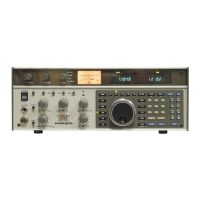
FRONT
PANEL
FUNCTIONS
Тһе
following
sections
describe
the
front
panel
displays
and
the
controls
which
are
not
located
on
the
keypad.
Refer
to
FIGURE
3-3
to
help
locate
each
control,
3-4.1
DISPLAY
AREA
As
shown
in
FIG-
URE
3-1,
the
vacuum
fluorescent
display
shows
the
frequency,
Rx/Tx
Offset,
memory
status,
the
date,
time,
or
tag,
and
other
micro-
processor
controlled
functions.
The
eight
an-
nunciators
above
show
the
VFO
selection,
OFFset
or
MEMory
selection,
and
the
DATE,
TIME,
or
TAG
selection.
3-4.2
AF
GAIN/TONE
The
AFGAIN
con-
trol
varies
the
audio
output
of
the
transceiver.
The
TONE
control
is
a
low
pass
type
with
a
rolloff
of
approximately
15
dB
at
5
kHz.
3-43
METER
Є
SWITCH
In
receive
mode
the
meter
will
automatically
read
5
units
when
the
meter
switch
is
in
any
position.
The
S
meter
will
be
accurate
only
when
the
RE
control
is
fully
clockwise.
The
meter
is
factory
calibrated
for
a
reading
of
S9
at
50
ЦУ
when
operating
at
15
MHz.
When
transmitting,
the
meter
indicates
the
following:
IC
position
measures
the
current
drawn
by
the
final
amplifier
module.
Use
the
scale
marked
0
to
20
amperes.
SWR
position
provides
a
reading
of
power
reflected
from
the
antenna,
When
the
forward
power
is
100
watts,
the
standing
wave
ratio
can
be
read
from
the
scale
marked
SWR.
FWD
position
measures
forward
power
tothe
antenna.
Use
the
FWD
scale
marked
0
to
100
watts.
To
determine
SWR,
place
meter
switch
in
FWD
position,
press
TUNE
and
adjust
RF
PWR
control
fora
reading
of
100
watts.
Then
switch
the
meter
switch
to
REF
and
use
the
scale
marked
SWR.
Press
the
TUNE
key
again
to
return
to
transceive
mode.
PROCESS
position
displays
the
level
of
compression
applied
to
the
MIC
input
when
the
PROCess
control
is
turned
on.
3-44
NOISE
BLANKER
Те
М.В.
switch
turns
on
the
blanker
circuit.
The
WIDTH
con-
trol
varies
the
blanking
pulse
width.
3-455
ATTENUATOR
Toreduce
suscepta-
bility
to
receiver
overload
in
the
presence
of
extremely
strong
signals,
the
ATTN
switch
removes
the
front
end
RF
amplifier
from
the
receiver
circuitry.
The
effectis
a
20
dB
reduc-
tion
in
signal
level
to
the
first
mixer
but
with
more
dynamic
range
and
greater
sensitivity
than
would
be
the
case
with
a
simple
attenu-
ator.
The
LED
below
the
switch
indicates
that
the
attenuator
has
been
selected.
3-4.6
BPF/FADE
This
control
fades
from
normally
flat
audio
response
to
a
bandpass
filter
variable
from
220
to
1700
Hz
with
the
BPF
control.
Various
amounts
of
bandpass
effect
can
be
chosen
by
the
degree
of
clock-
wise
rotation.
The
filter
width
is
3596
of
the
selected
center
frequency
at
the
-6
dB
points.
3-4.7
PBT
/
NOTCH
The
PBT
control
ad-
justs
the
position
of
the
PBT
IF
crystal
filter
in
relation
to
the
fixed
second
IF
filter.
When
the
selected
filter
is
wide,
i.e.
2.4
or
1.8
kHz,
the
PBT
control
essentially
becomes
a
variable
bandwidth
control.
Counter-clockwise
rota-
tion
shifts
the
passband
towards
the
low
side
of
the
signal
when
in
USB
mode,
clockwise
ro-
tation
shifts
the
passband
toward
the
high
side
of
the
signal.
When
in
LSB
mode,
the
above
directions
are
reversed.
The
PBT
circuit
in
the
PARAGON
pro-
duces
the
effect
of
varying
the
frequency
re-
sponse
of
signals
passing
through
the
narrow
filter,
which
enables
you
to
separate
signals
which
are
close
together.
On
RTTY
it
can
place
the
narrow
filter
to
pass
only
the
2295
and
2125
Hz
tones
for
superior
rejection
of

Related product manuals