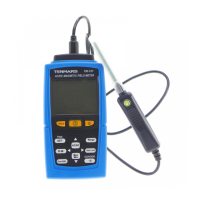
TM-191
1 Introduction
Safety precautions should be taken against electric appliances
in places including medical institutions, schools and residential
districts, where people usually stay for a long time, to prevent
patients, babies and senior citizens from exposure to high
electromagnetic waves.
An electromagnetic wave simply means the wave motion of the
electromagnetic field (EMF).
The change in electric fields produces magnetic fields, and the
change in magnetic fields can also generate electric fields. The
fluctuation of correlation between each other is known as
“electromagnetic waves", which is a form of energy similar to
light and heat that can be transmitted either by radiation in the
air or by an electric conductor.
It is suggested that rearrangements should be made in families
and work locations where electromagnetic fields are detected
the strongest in order to avoid prolonged exposure to excessive
lectromagnetic fields. e
2 Application
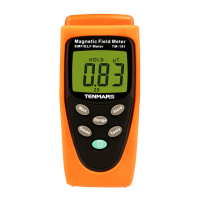
This meter is applied to measuring electromagnetic fields
of extremely low frequency (ELF) of 30 to 300Hz.
It is capable of measuring the electromagnetic field
radiation intensity that is produced from electric
transmission equipment, power line, microwave oven, air
conditioner, refrigerator, computer monitor, video/audio
device and so forth.
The magnetic field unit is Tesla (T), Gauss (G),
milli-Gauss (mG) or micro-Tesla (μT).
1 T=10,000 G 1 G=1,000 mG
1μT=10 mG
3 Features
Switch between the display of micro-Tesla and milli-Gauss
is available.
Data hold (HOLD)、maximum (MAX) Hold function.
Range display(20,200,2000).
Low battery detector “ ”.
Over load display “OL”.
EN-1


 To Next Page