Need help?
Do you have a question about the Texsport 01084 and is the answer not in the manual?
Lists and identifies all parts included with the Texsport shelter, such as leg poles, roof poles, shelter skin, and guy ropes.
Advises on preparing the campsite by removing sharp objects and ensuring a flat surface to prevent water collection.
Guides on inserting curved roof poles and standard roof poles into the shelter skin to form the roof structure.
Instructs on attaching the shelter skin to the frame using hook and loop fasteners and adjusting side tabs.
Details on assembling leg poles and pushing them through web straps, connecting to the roof frame.
Instructions on turning the shelter upright and adjusting the frame for a tight shelter skin.
Explains how to insert and tie guy ropes into the clew and frame, and how to secure them to stakes.
Describes adjusting guy rope tension using the clew for optimal shelter stability in windy conditions.
Confirms that the shelter is ready for use after all setup steps are completed.
Warns that while flame retardant treated, open flames should not be used in or near the shelter for safety.
Emphasizes staking down the shelter and placing it at a safe distance from campfires to prevent damage.
Recommends seam sealing new shelters to prevent leaks from needle perforations during sewing.
Provides guidance on different types of stakes suitable for various soil conditions.
Advises on lubricating zippers with silicone and avoiding forcing them to prevent damage.
Details on storing shelters dry and loosely, and hand-washing with mild soap to maintain waterproofing.
Suggests using rip-stop nylon patches for small tears and provides contact information for customer service.
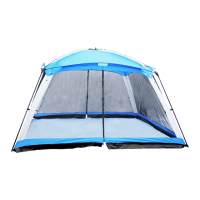
This document is an instruction manual for the Texsport #01084 Privacy Shelter, an authentic adventure gear product designed for outdoor use. The manual provides detailed steps for setting up, using, and maintaining the shelter, emphasizing safety and proper care.
The Texsport #01084 Privacy Shelter is a portable, lightweight shelter designed to provide privacy and protection from the elements during camping or other outdoor activities. It is constructed from flame-retardant, water-repellent fabrics, making it suitable for various weather conditions. The shelter's design allows for relatively easy assembly and disassembly, making it convenient for transport and storage. Its primary function is to offer a private space in an outdoor setting, whether for changing, showering, or simply as a secluded area.
The shelter's construction utilizes fabrics treated to be flame retardant, meeting C.P.A.I.-84 specifications. The materials are also coated for water repellency. However, the manual notes that due to the sewing process, seams may leak and require seam sealing for complete waterproofing. The shelter's frame consists of various pole types: 4 bottom leg poles (A), 4 center leg poles (B), 4 top leg poles (C), 4 roof poles (D), and 4 curved roof poles (F). The shelter skin (E) is the main fabric component, and it is secured using hook 'n' loop fasteners and web straps. Stability is provided by 4 guy ropes (G), clews, and stakes. The overall design is intended to be lightweight, facilitating portability.
The setup process for the privacy shelter is outlined in 15 steps, starting with spreading out the shelter skin and assembling the roof frame using the curved and straight roof poles. The leg poles are then assembled and inserted into the shelter skin's web straps, with pins securing them to the roof frame. Once the frame is upright, the shelter skin is adjusted for tightness. Crucially, the shelter must be secured with guy ropes and stakes, especially in windy conditions. The guy ropes are inserted into clews, tied to the top of the frame poles, and then wrapped around stakes. Tension can be adjusted by sliding the clews up or down. The manual advises preparing the campsite by removing sharp objects and ensuring a flat surface to prevent water collection. It also stresses the importance of staking down the shelter to prevent it from being blown away, particularly in relation to campfires. Specialized stakes are recommended for different ground conditions: sand stakes for loose sand, steel stakes for hard/rocky/frozen soil (with a note about potential rust and damage if stored with the shelter), skewer stakes for lighter holding power, and snow stakes (using the "dead man method" or securing to skis/poles) for snow. Zippers should be lubricated with silicone to prevent sticking and should not be forced if material is caught.
Proper maintenance is crucial for the longevity of the Texsport Privacy Shelter.


 To Next Page
 General