OPERATION ARC MASTER 175 SE
March 20, 2008 4-7 Manual 0-5054
this. The electrode needs to be moved along fast
enough to prevent the slag pool from getting ahead
of the arc. To complete the joint in thin plate, turn the
job over, clean the slag out of the back and deposit
a similar weld.
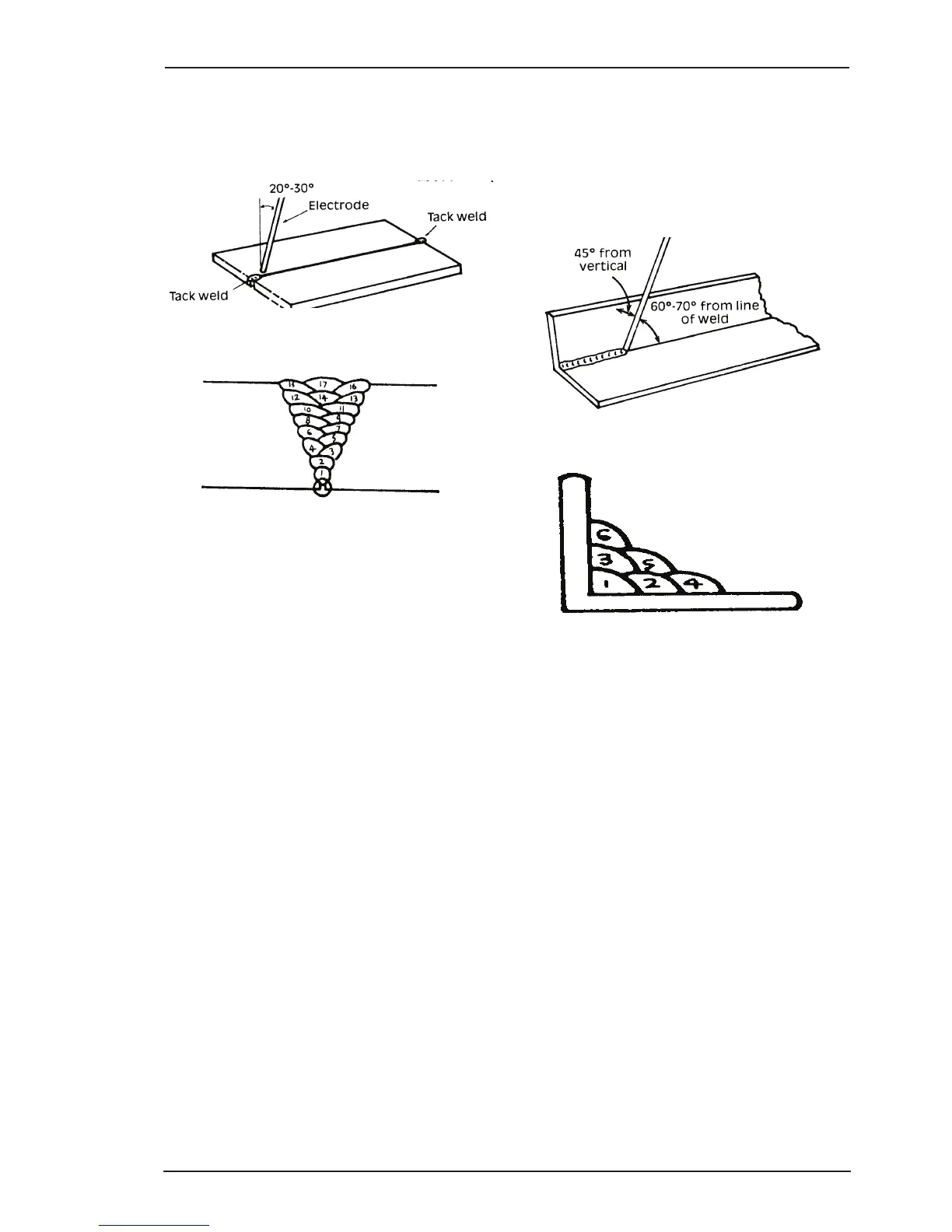
Figure 4-13: Weld build up sequence
Heavy plate will require several runs to complete the
joint. After completing the first run, chip the slag out
and clean the weld with a wire brush. It is important
to do this to prevent slag being trapped by the second
run. Subsequent runs are then deposited using either
a weave technique or single beads laid down in the
sequence shown in Figure 4-13. The width of weave
should not be more than three times the core wire
diameter of the electrode. When the joint is completely
filled, the back is either machined, ground or gouged
out to remove slag which may be trapped in the root,
and to prepare a suitable joint for depositing the
backing run. If a backing bar is used, it is not usually
necessary to remove this, since it serves a similar
purpose to the backing run in securing proper fusion
at the root of the weld.
B. Fillet Welds
These are welds of approximately triangular cross-
section made by depositing metal in the corner of two
faces meeting at right angles. Refer to Figure 4-5.
A piece of angle iron is a suitable specimen with
which to begin, or two lengths of strip steel may be
tacked together at right angles. Using a 1/8" (3.2mm)
E7014 electrode at 120 amps, position angle iron
with one leg horizontal and the other vertical. This is
known as a horizontal-vertical (HV) fillet. Strike the
arc and immediately bring the electrode to a position
perpendicular to the line of the fillet and about 45°
from the vertical. Some electrodes require to be sloped
about 20° away from the perpendicular position to
prevent slag from running ahead of the weld. Refer
to Figure 4-14. Do not attempt to build up much
larger than 1/4" (6.4mm) width with a 1/8" (3.2mm)
electrode, otherwise the weld metal tends to sag
towards the base, and undercut forms on the vertical
edge. Multi-runs can be made as shown in Figure 4-
15. Weaving in HV fillet welds is undesirable.
Figure 4-15: Multi-runs in HV fillet weld
C. Vertical Welds
1. Vertical Up
Tack weld a three feet length of angle iron
to your work bench in an upright position.
Use a 1/8" (3.2mm) E7014 electrode and
set the current at 120 amps. Make yourself
comfortable on a seat in front of the job and
strike the arc in the corner


 To Next Page