
 Need help?
Do you have a question about the THOMSON TX807 C and is the answer not in the manual?
Access the service menu by pressing the 'MENU' button on the remote control.
Use the 'V' buttons to navigate and 'OK' to confirm selections in the service menu.
Adjust settings using the 'Magenta' (menu) button and select sub-menus.
Leave the service mode by pressing the 'MENU' button or switching off the main switch.
Diagram of the power supply unit, including voltage regulation and distribution.
Illustrates connections and components on the main board for mono operation.
Details the video signal processing paths and associated components.
Diagrams signal flow for various inputs and outputs on the main board.
Shows stereo audio signal paths and related components for CS models.
Illustrates the distribution of system voltages across the stereo chassis.
Schematic for the TDA7263 audio amplifier integrated circuit.
Diagram of the MSP3415D-PO digital audio processing unit.
This document outlines the operational and maintenance procedures for the THOMSON TX807 C/CS television chassis, covering both its mono and stereo variants. It provides a comprehensive guide for technicians and users, detailing adjustments, service modes, and circuit diagrams for various components.
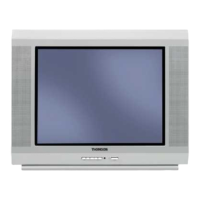
The THOMSON TX807 C/CS chassis is designed to provide television functionality, supporting both mono and stereo audio configurations depending on the specific model. It incorporates a range of features for video and audio processing, user interaction, and system control. The device includes a DCDC converter for power management, a VHF/UHF tuner for signal reception, and a CRT display for visual output. Audio processing is handled by dedicated ICs, ensuring clear sound reproduction. The chassis is equipped with various input and output ports to facilitate connectivity with external devices.
The television offers several user-accessible features and service modes for configuration and troubleshooting.
Service Mode Access: To enter the service mode, the user must first ensure the TV is in standby. A specific sequence of button presses on the remote control (e.g., "Mute," "9," "8," "7," "Power On") or a combination of front panel buttons (e.g., "Volume Down," "Program Down," "Power On") is required. Once in service mode, the TV displays "SERVICE" on the screen.
Navigation in Service Mode: Within the service mode, users can navigate through different menus and adjust parameters. The "Program Up/Down" buttons are typically used to select menu items, while "Volume Up/Down" buttons adjust the values of the selected parameters. The "Mute" button often serves to store the changes made.
Menu Items and Adjustments: The service mode provides access to various adjustment categories, including:
Exiting Service Mode: To exit the service mode and save all changes, the "Power Off" button on the remote control is usually pressed.
The manual emphasizes several key aspects for the maintenance and repair of the THOMSON TX807 C/CS chassis.
Safety Precautions: When performing any repairs, it is crucial to use only original replacement parts. This ensures the continued safety and proper functioning of the device. The document explicitly states this in multiple languages (English, French, German, Italian, Spanish), highlighting its importance.
Component Identification: Detailed circuit diagrams are provided for various sections of the chassis, including the DCDC converter, front connector, CRT, VHF/UHF tuner, and the main diagram for both mono and stereo versions. These diagrams are essential for identifying components, understanding their interconnections, and tracing signal paths during troubleshooting.
Component Replacement: The diagrams include part numbers and values for resistors, capacitors, diodes, transistors, and integrated circuits. This information is vital for ordering correct replacement parts. For instance, the DCDC converter diagram shows specific diode types (e.g., MUR160, RGP15G) and resistor values (e.g., 22K0, 10K0). Similarly, the CRT diagram details components related to the display, such as the TDA6107Q/N2 IC and associated resistors and capacitors.
Troubleshooting with Service Mode: The service mode, as described under "Usage Features," is a powerful diagnostic tool. Error codes displayed in service mode can pinpoint specific areas of failure, guiding technicians to the relevant sections of the circuit diagrams for further investigation. For example, an error related to the vertical deflection might lead a technician to examine the vertical output stage components.
Voltage Measurements: The main diagram often includes typical voltage values at various test points. These measurements are crucial for verifying the correct operation of different circuit blocks. Deviations from these expected voltages can indicate a fault.
Layout Diagrams: The "Locations Guide" provides a physical layout of components on the PCB, which helps technicians quickly locate specific parts identified in the circuit diagrams. This visual aid is invaluable during component replacement.
Specific CRT Information: The document provides specific information for different CRT types, including "tube mini neck" variants, detailing their connections and associated components. This ensures that the correct display settings and parts are used for the particular CRT installed in the TV.
Audio Circuitry: For stereo models, a dedicated audio diagram (TX807 CS Stereo) is provided, detailing the MSP3415D-PO audio processor and the TDA7263 audio amplifier. This allows for precise troubleshooting and repair of audio-related issues, including component identification for the audio input/output stages and power supply for the audio section.
Front Connector Details: The front connector diagrams (KDB.80001 and FCB.80001) illustrate the connections for user interface elements like buttons, IR receiver, and external audio/video inputs. This is helpful for diagnosing issues related to user input or external device connectivity.
In summary, the THOMSON TX807 C/CS manual serves as a comprehensive resource for understanding, operating, and maintaining the television chassis, providing detailed information for both end-users and service technicians.
 General
| Display Type | LED |
|---|---|
| Smart TV | No |
| HDMI Ports | 2 |
| USB Ports | 1 |
| Wi-Fi | No |
| Aspect Ratio | 16:9 |
| Resolution | 1366 x 768 |
| Audio Output | 10W |
| Display Technology | LED |
| Tuner | DVB-T2 |


 To Next Page