EasyManua.ls Logo

THORENS PC 650 - Page 11

THORENS PC 650
44 pages
Print Icon
To Next Page IconTo Next Page
To Previous Page IconTo Previous Page
Loading...
Logic
Elements
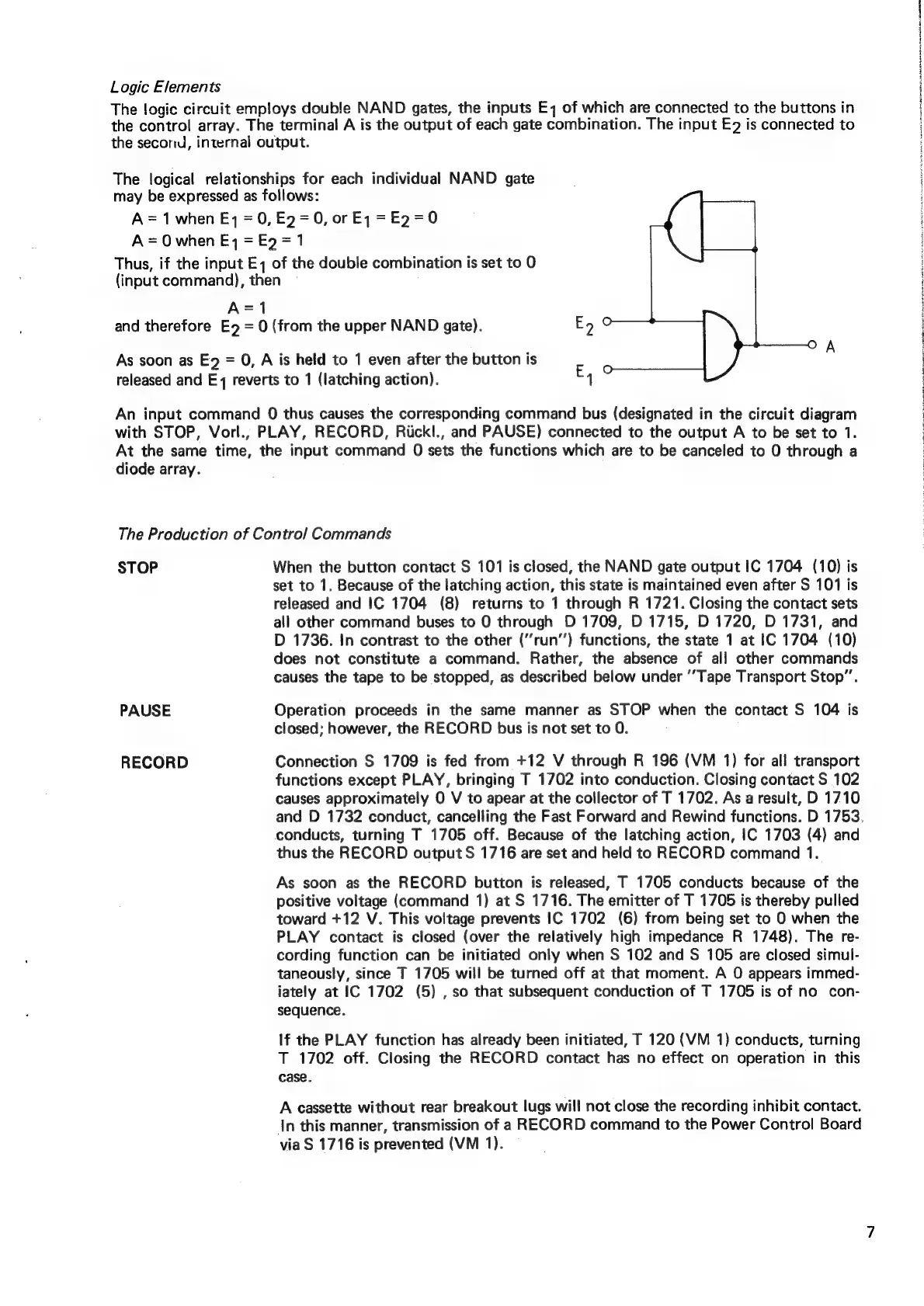
The
logic
circuit
employs
double
NAND
gates,
the
inputs
E14
of
which
are
connected
to
the
buttons
in
the
control
array.
The
terminal
A
is
the
output
of
each
gate
combination.
The
input
E2
is
connected
to
the
second,
internal
output.
The
logical
relationships
for
each
individual
NAND
gate
may
be
expressed
as
follows:
A=
1
when
E,
=0,
Eg
=0,
or
Ey
=
EQ
=
0
A=Owhen
Ej
=E9=1
Thus,
if
the
input
E4
of
the
double
combination
is
set
to
0
(input
command),
then
A=1
and
therefore
E9
=
0
(from
the
upper
NAND
gate).
Eo
As
soon
as
Eg
=
0,
A
is
held
to
1
even
after
the
button
is
released
and
E
7
reverts
to
1
(latching
action).
Ey
An
input
command
0
thus
causes
the
corresponding
command
bus
(designated
in
the
circuit
diagram
with
STOP,
Vorl.,
PLAY,
RECORD,
Riickl.,
and
PAUSE)
connected
to
the
output
A
to
be
set
to
1.
At
the
same
time,
the
input
command
0
sets
the
functions
which
are
to
be
canceled
to
0
through
a
diode
array.
The
Production
of
Control
Commands
STOP
PAUSE
RECORD
When
the
button
contact
S
101
is
closed,
the
NAND
gate
output
IC
1704
(10)
is
set
to
1.
Because
of
the
latching
action,
this
state
is
maintained
even
after
S
101
is
released
and
IC
1704
(8)
returns
to
1
through
R
1721.
Closing
the
contact
sets
all
other
command
buses
to
0
through
D
1709,
D
1715,
D
1720,
D
1731,
and
D
1736.
In
contrast
to
the
other
(run’’)
functions,
the
state
1
at
iC
1704
(10)
does
not
constitute
a
command.
Rather,
the
absence
of
all
other
commands
causes
the
tape
to
be
stopped,
as
described
below
under
’’Tape
Transport
Stop”.
Operation
proceeds
in
the
same
manner
as
STOP
when
the
contact
S
104
is
closed;
however,
the
RECORD
bus
is
not
set
to
0.
Connection
S
1709
is
fed
from
+12
V
through
R
196
(VM
1)
for
all
transport
functions
except
PLAY,
bringing
T
1702
into
conduction.
Closing
contact
S
102
causes
approximately
0
V
to
apear
at
the
collector
of
T
1702.
As
a
result,
D
1710
and
D
1732
conduct,
cancelling
the
Fast
Forward
and
Rewind
functions.
D
1753.
conducts,
turning
T
1705
off.
Because
of
the
latching
action,
IC
1703
(4)
and
thus
the
RECORD
output
S
1716
are
set
and
held
to
RECORD
command
1.
As
soon
as
the
RECORD
button
is
released,
T
1705
conducts
because
of
the
positive
voltage
(command
1)
at
S
1716.
The
emitter
of
T
1705
is
thereby
pulled
toward
+12
V.
This
voltage
prevents
IC
1702
(6)
from
being
set
to
0
when
the
PLAY
contact
is
closed
(over
the
relatively
high
impedance
R
1748).
The
re-
cording
function
can
be
initiated
only
when
S
102
and
S
105
are
closed
simul-
taneously,
since
T
1705
will
be
turned
off
at
that
moment.
A
O
appears
immed-
iately
at
IC
1702
(5)
,
so
that
subsequent
conduction
of
T
1705
is
of
no
con-
sequence.
If
the
PLAY
function
has
already
been
initiated,
T
120
(VM
1)
conducts,
turning
T
1702
off.
Closing
the
RECORD
contact
has
no
effect
on
operation
in
this
case.
A
cassette
without
rear
breakout
lugs
will
not
close
the
recording
inhibit
contact.
In
this
manner,
transmission
of
a
RECORD
command
to
the
Power
Control
Board
via
S
1716
is
prevented
(VM
1).
St
i
a
a
a