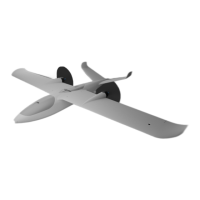
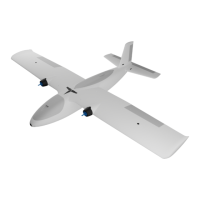
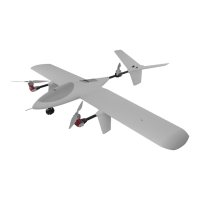
The Titan Eagle is a 1.6m twin-motor UAV designed for long-range flight and high payload capacity, holding several 3D-printed endurance records. It boasts a maximum distance from launch of 85km, a total distance traveled of 197km, and a flight time of 3 hours and 57 minutes on a 6S4P 21700 battery, making it one of the most capable 3D-printed UAVs available.
Important Technical Specifications:
- General Stats:
- Wingspan: 1596mm
- Wing area: 3799cm²
- Maximum take-off Weight: 4.5kg
- Efficiency: 1.72 Wh/km @ 3.54kg AUW
- Cruise speed: 50-75kph
- Recommended prop diameter: 10-12 inches
- Aerodynamic Properties:
- Root airfoil: NACA 4410
- Tip airfoil: NACA 3410
- Root chord: 300mm
- Tip chord: 83mm
- Average chord: 196mm
- Root incidence: 2°
- Tip incidence: 0°
- Aspect ratio: 6.71
- Dihedral: 0.5°
- Sweep: 2°
The manual provides detailed plots for drag, efficiency, power required for level flight, and fuselage angle of attack across different AUWs (2kg, 2.5kg, 3kg, 3.5kg, 4kg, 4.5kg). These plots help in understanding the aircraft's flight envelope, identifying the most efficient cruise speed, estimating loiter endurance, and setting the TRIM_PITCH_CD parameter in Arduplane. The stall speed is calculated assuming a CLmax of 1.3, with a minimum speed line 20% above stall speed for safety.
- 6S4P Samsung 50E (AUW = 3.54kg):
- 90% safe range = 226km
- Turn Rate and Bank Angle vs. Airspeed (Max load factor n = 2.5)
- Endurance vs. Airspeed
- Max Climb Rate vs. Airspeed (Total max motor wattage = 2000W)
- 6S6P Samsung 50E (AUW = 4.43kg):
- 90% safe range = 276km
- Turn Rate and Bank Angle vs. Airspeed (Max load factor n = 2.5)
- Endurance vs. Airspeed
- Max Climb Rate vs. Airspeed (Total max motor wattage = 2000W)
- 6S8P Panasonic NCR18650GA (AUW = 4.24kg):
- 90% safe range = 267km
- Turn Rate and Bank Angle vs. Airspeed (Max load factor n = 2.5)
- Endurance vs. Airspeed
- Max Climb Rate vs. Airspeed (Total max motor wattage = 2000W)
These plots offer an idea of expected performance but are not guarantees due to variables like draggy antennas, motor efficiency, and print quality.
Usage Features:
The Titan Eagle includes independent flaps, removable wings, removable stabilizers, and fully serviceable servos, all internally mounted. It features robust structural integrity with a double-reinforced floor and aileron/flap hinge. An optional FPV deck and support for most common mapping cameras are integrated into the fuselage.
Required Build Materials:
- Spars:
- (2) 8x1000mm tube (main wing spars)
- (2) 4x500mm solid (wing leading edge support)
- (2) 3x500mm solid (aileron and flap hinge)
- (1) 4x420mm solid (horizontal stabilizer support)
- (1) 3x420mm solid (elevator hinge)
- (1) 4x150mm solid (vertical stabilizer support)
- (1) 2x150mm solid (rudder hinge)
- Recommended Motor & Prop:
- 16-19mm mounting pattern
- BrotherHobby Tornado T5 640kv + APC 12x8E and 12x8EP
- Brotherhobby Avenger 2816 620kv + APC 11x8E and 11x8EP
- Gartt 3510 700kv + APC 12x8E and 12x8EP
- 10-12 inch propellers
- Recommended Electronics:
- ELRS / Dragonlink / Crossfire
- 5.8ghz / 1.2ghz analog or digital (19x19mm camera)
- Matek F405-WTE or similar flight controller running Arduplane (optional)
- Matek M8Q-5883 GPS/Compass or similar (optional)
- (2) 45A BLHeli ESC
- (6) Emax ES08MAII servos
- Battery: 6S4P 21700, 6S6P 21700, 4S10P 18650
- Misc:
- Polymaker Polylite prefoamed LWPLA
- Polycarbonate or other high-temp filament for the motor mount
- Medium CA glue
- 250x220x220 minimum size print bed
- Control horns
- M3 threaded inserts (max 6mm height)
- M3 bolts of various sizes
- 6x3mm magnets
Maintenance Features:
- 3D Printing:
- Titan Dynamics strongly recommends Polymaker Polylite prefoamed LWPLA for optimal results due to ease of tuning and less stringing.
- A well-maintained and calibrated printer is essential for good print quality.
- The provided guidance serves as a starting point; users should print test pieces to check retraction settings and carbon rod fitment.
- All fuselage, tail, and wing parts should be printed in LW-PLA unless specified otherwise.
- Recommended infill/wall settings for LWPLA parts:
- Maximum efficiency: 3% cubic subdivision, single wall (recommended for Eagle)
- Balanced efficiency and strength: 5% cubic subdivision, single wall
- Maximum strength: 8% cubic subdivision, single wall
- Higher infill (4%-8%) for fuselage sections can increase longevity without a significant weight penalty for the entire plane.
- Gyroid infill adds significant weight compared to cubic infill at the same percentage.
- Polycarbonate, PETG, or other high-temp filament should be used for motor mounts and wing bay covers (double wall, high infill 25%).
- Proper part orientation on the build plate is crucial to avoid disconnected overhangs, as the model is designed to be printed without supports.
- Tuning "hole horizontal expansion": Crucial for carbon rod fitment. Users should print a test part and adjust the "Hole Horizontal Expansion" setting in Cura (or equivalent slicer setting) to achieve a snug fit. A good starting point is 0.25mm.
- Bed Adhesion and Warping: Good print adhesion is necessary for tall parts. A full brim can be used, or a glue stick can improve adhesion. The Cura Marketplace "TabAntiWarping" plugin is recommended to add tabs to parts prone to warping, which can be moved and fine-tuned. Care must be taken when removing these tabs to avoid damaging the print.
- Assembly of 3D Printed Parts:
- Medium CA glue should be used for all fuselage parts.
- Wipe off excess glue before it sets. A kicker can speed up setting time but may result in a weaker joint.
- Careful alignment during gluing is important; minor mistakes can accumulate.
- Carbon rods should be used to ensure wing alignment during gluing but should not be glued in permanently.
- IMPORTANT: Do not glue the wing tips until the carbon rod and aileron/flap are installed, as the wing tip secures these components.
- Threaded inserts can be installed using a soldering iron at a low heat setting.
- Final Setup & Tuning Tips:
- Titan Dynamics strongly recommends using Arduplane for all models, as data logs are invaluable for troubleshooting.
- Give all control surfaces +/- 25 degrees or more throw.
- Flaps are highly effective; 35 degrees of downward travel is the maximum to avoid nose-down tendencies.
- The Center of Gravity (CG) is marked under the wing and should be adhered to within ±5mm.
- Add duct tape or other abrasion-resistant material to the bottom of the fuselage to increase durability during landings on rough surfaces.

 Need help?
 General

 To Next Page