4
9. WARNING: Some of the parts in this kit are made
of fi berglass, the fi bers of which may cause eye,
skin and respiratory tract irritation. Never blow into
one of these parts to remove fi berglass dust, as
the dust will blow back into your eyes. Always wear
safety goggles, a particle mask and rubber gloves
when grinding, drilling and sanding fi berglass parts.
Vacuum the parts and the work area thoroughly after
working with fi berglass parts.
We, as the kit manufacturer, provide you with a top
quality, thoroughly tested kit and instructions, but
ultimately the quality and fl yability of your fi nished
model depends on how you build it; therefore, we
cannot in any way guarantee the performance of
your completed model, and no representations
are expressed or implied as to the performance or
safety of your completed model.
Remember: Take your time and follow the
instructions to end up with a well-built model that
is straight and true.
DECISIONS YOU MUST MAKE
This is a partial list of items required to fi nish this
model that may require planning or decision making
before starting assembly. Order numbers are provided
in parentheses.
ENGINE RECOMMENDATIONS
As specifi ed on the front cover of this instruction manual,
the Top Flite B-25J ARF is intended for twin .70 four-
strokes or .46-.50 two-strokes. There isn’t much more
that can be said other than it is unnecessary (as well
as inadvisable) to overpower this model with larger
engines. Engines in the specifi ed range will provide
more than enough thrust to fl y this model in a scale-like
manner with plenty of extra power to perform evasive
maneuvers if the situation arises. Bottom line is with
two-stroke .46’s or four-stroke .70’s you’ll fi nd yourself
cruising around at half-throttle most of the time.
RETRACTABLE LANDING GEAR
Your B-25J Mitchell ARF may be assembled with the
included fi xed landing gear or retractable landing
gear. If fi xed landing gear is used, no additional items
will be needed to install the gear. If installing retracts,
this model is designed for Robart pneumatic retracts.
Following is the complete list of items required to
install the Robart retracts:
❏ Robart #TFB25 Top Flite B-25J ARF pneumatic
retractable main landing gear (ROBQ1624)
❏ Robart #157VRX Large-Scale Deluxe Air Control
Kit—includes pressure vessel, air line tubing,
variable-rate air valve, T-fi ttings (ROBQ2305)
❏ #190 Air Line Quick Disconnects (ROBQ2395)
❏ Standard size servo to operate air control valve
Additionally, a hobby can of compressed air such
as Hobbico Duster
™
(HCAR5500) will be helpful
for cycling the retracts during assembly and setup
without having to connect the gear to the air control
valve, fi ller and air tank before it is ready.
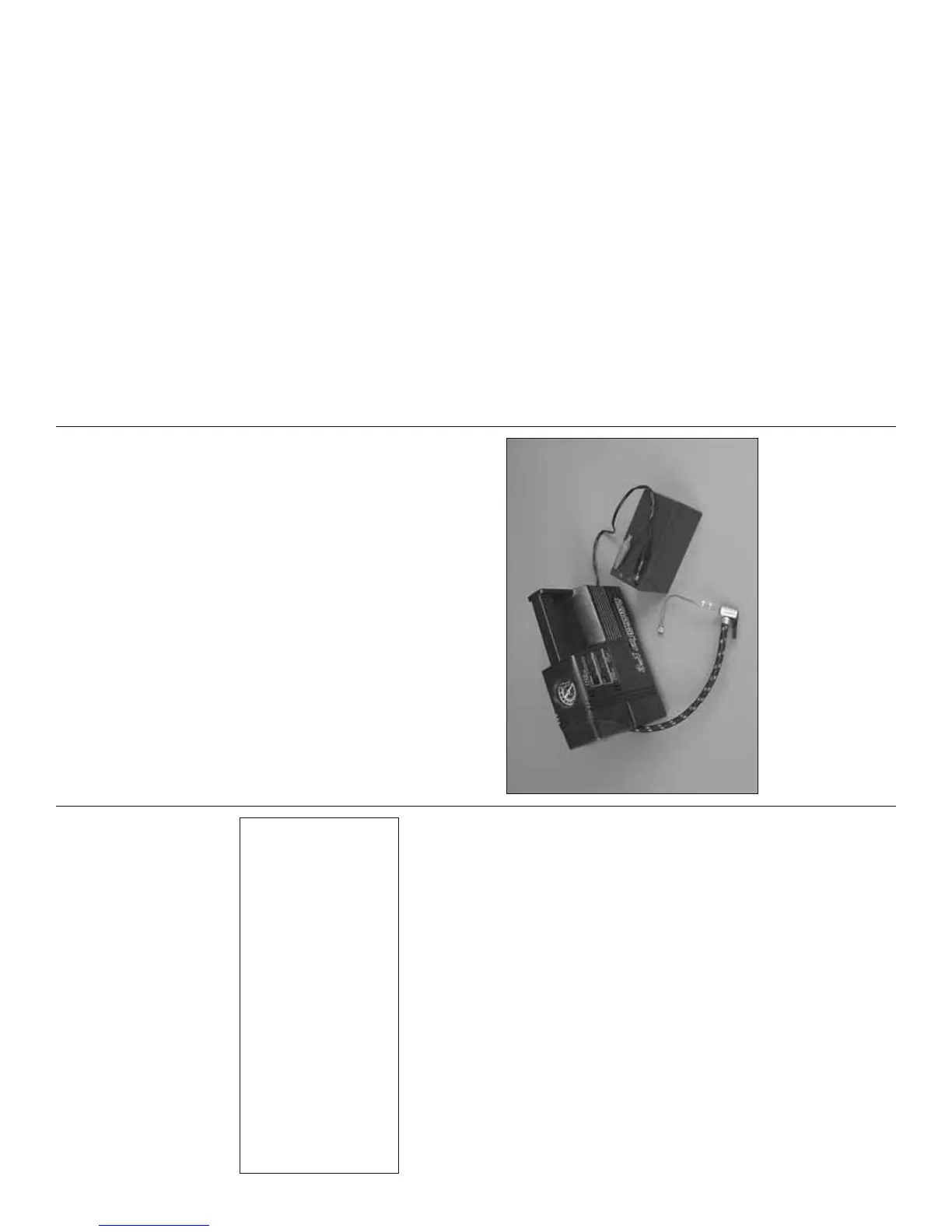
An air pump will also be required for fi lling the on-
board air tank when you get to the fi eld and it’s time
to fl y. The Robart Hand Pump & Gauge (ROBQ2363)
could be used, but will require considerable time (and
effort!) to fi ll the tank. Instead, we recommend an
electric hobby air compressor (with a pressure gauge).
What we use in our R&D shop is simply a small 12V
bicycle air compressor. The power cord may have to
be converted from a cigarette lighter connector to
alligator clips or something that can be connected
to your 12V battery. Connect Robart’s air fi ller to the
compressor with a length of Robart air line.
RADIO EQUIPMENT
If fl ying the B-25 with fi xed landing gear seven
channels will be required; one channel for the
ailerons, one for elevator, one for each engine, one
for the rudder, one for the fl aps and one channel for
the nose steering servo. The engines could be linked
with a Y-harness, but it is recommended to link the
throttles electronically via mixing in the transmitter.
Then, the throttles can be “decoupled” using a switch
on the transmitter for starting and tuning the engines
individually. It is also recommended to link the rudder
servos and nose steering servo electronically through
mixing in your transmitter so the nose steering servo
can be trimmed separately from the rudders.
If installing retractable landing gear eight channels
will be required, with an additional standard servo to
operate the air control valve.
Regarding servos, the ailerons, fl aps, nose steering
and air control valve may all be operated with standard
servos (such as Futaba S3003—FUTM0031). A
stronger ball bearing servo with no less than 50 oz.
in. of torque (such as the Futaba 9001—FUTM0075)
should be used on the elevator. Two mini servos with
a torque rating of at least 35 oz.-in. (such as Futaba
S3115—FUTM0415) are required on the rudders.
Note: Keep in mind that the standard servo
recommendations for the fl aps and ailerons are the
minimums. Higher-torque, ball bearing servos could
be used for more fl ight precision.
The following servo extensions and Y-harnesses were
also used in this model. See the diagrams on pages
48-49 that shows where all the extensions are used.


 To Next Page
 Loading...