45
4) I will operate my model using only radio control
frequencies currently allowed by the Federal
Communications Commission.
5) I will not knowingly operate my model within
three miles of any pre-existing fl ying site
except in accordance with the frequency
sharing agreement listed [in the complete AMA
Safety Code].
9) Under no circumstances may a pilot or other
person touch a powered model in fl ight; nor should
any part of the model other than the landing
gear, intentionally touch the ground, except
while landing.
CHECK LIST
During the last few moments of preparation
your mind may be elsewhere anticipating the
excitement of the fi rst fl ight. Because of this, you
may be more likely to overlook certain checks and
procedures that should be performed before the
model is fl own. To help avoid this, a check list is
provided to make sure these important areas are
not overlooked. Many are covered in the instruction
manual, so where appropriate, refer to the manual
for complete instructions. Be sure to check the
items off as they are completed.
❏ 1. Make sure you have checked the C.G. according
to the measurements and procedures provided.
❏ 2. Balance your model laterally as explained.
❏ 3. Be certain the battery and receiver are securely
mounted. Simply stuffi ng them into place with
foam rubber is not suffi cient.
❏ 4. Extend the receiver antenna all the way down
the antenna tube in the fuselage.
❏ 5. Use threadlocking compound to secure critical
fasteners such as the set screws on the retractable
landing gear struts and axles or wheel collars,
screw-lock pushrod connectors, etc.
❏ 6. Be certain the screws holding the horizontal
stabilizer and the vertical stabilizers have
been securely tightened with threadlocker on
the threads.
❏ 7. Add a drop of oil to the axles so the wheels will
turn freely.
❏ 8. Make sure all hinges are securely glued in place.
❏ 9. Reinforce holes for wood screws with thin CA
where appropriate (servo mounting screws,
canopy mounting screws, etc.).
❏ 10. Confi rm that all controls operate in the correct
direction and the throws are set up according
to the manual.
❏ 11. Make sure there are silicone retainers on all
the clevises.
❏ 12. Make sure all servo arms are secured to the
servos with the screws that came with them.
❏ 13. Where appropriate, secure connections between
servo wires and Y-connectors or servo extensions,
and the connection between your battery pack
and the on/off switch with vinyl tape, heat shrink
tubing or special clips suitable for that purpose.
❏ 14. Make sure any servo extension wires you may
have used do not interfere with other systems
(servo arms, pushrods, cables, etc.).
❏ 15. Make sure the fuel lines are connected and are
not kinked.
❏ 16. Balance the propellers (and spare propellers).
❏ 17. Securely tighten the propeller hubs. Be certain
to use threadlocker on the threads.
❏ 18. Place your name, address, AMA number and
telephone number on or inside your model.
❏ 19. Cycle your receiver battery pack (if necessary)
and make sure it is fully charged.
❏ 20. If you wish to photograph your model, do so
before your fi rst fl ight.
❏ 21. Range check your radio when you get to the
fl ying fi eld.
FLYING
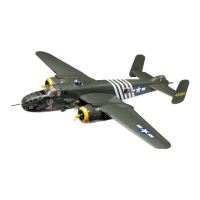
The Top Flite B-25J Mitchell ARF is a great-fl ying model
that fl ies smoothly and predictably. The B-25 does not,
however, possess the self-recovery characteristics
of a primary R/C trainer and should be fl own only by
experienced R/C pilots.
MOUNT THE WINGS
Assuming the outer panels and tail have been
mounted to the model at the work shop and you’ve
transported it in this confi guration, connect the aileron
and fl ap servo wires and mount the outboard panels
to the inboard panels.
FUEL MIXTURE ADJUSTMENTS
A fully cowled engine may run at a higher temperature
than an un-cowled engine. For this reason, the fuel
mixture should be richened slightly so the engine
runs at about 200 rpm below peak speed. By running
the engine slightly rich, you will help prevent dead-
stick landings caused by overheating.
CAUTION (THIS APPLIES TO ALL R/C
AIRPLANES): If, while fl ying, you notice an
alarming or unusual sound such as a low-pitched
“buzz,” this may indicate control surface fl utter.
Flutter occurs when a control surface (such as an
aileron or elevator) or a fl ying surface (such as a
wing or stab) rapidly vibrates up and down (thus
causing the noise). In extreme cases, if not detected
immediately, fl utter can actually cause the control
surface to detach or the fl ying surface to fail, thus
causing loss of control followed by an impending
crash. The best thing to do when fl utter is detected
is to slow the model immediately by reducing
power, then land as soon as safely possible. Identify
which surface fl uttered (so the problem may be
resolved) by checking all the servo grommets for
deterioration or signs of vibration. Make certain all
pushrod linkages are secure and free of play. If it
fl uttered once, under similar circumstances it will
probably fl utter again unless the problem is fi xed.
Some things which can cause fl utter are; Excessive
hinge gap; Not mounting control horns solidly; Poor
fi t of clevis pin in horn; Side-play of wire pushrods
caused by large bends; Excessive free play in
servo gears; Insecure servo mounting; and one of
the most prevalent causes of fl utter; fl ying an over-
powered model at excessive speeds.


 To Next Page
 Loading...