46
TAKEOFF
Before you get ready to takeoff, see how the model
handles on the ground by doing a few practice
runs at low speeds on the runway. If necessary,
hold a small amount of “down” elevator to keep the
nose wheel on the ground. If necessary, adjust the
nose wheel so the model will roll straight down the
runway—if your rudders and nose steering servos
are connected to different channels in your receiver
(and are electronically mixed), you should be able to
do this with one of the dials on your transmitter. If you
need to calm your nerves before the maiden fl ight,
shut the engines down and bring the model back into
the pits. Top off the fuel, and then check all fasteners
and control linkages for peace of mind.
Remember to takeoff into the wind. When ready,
point the model straight down the runway. Gradually
advance the throttle and use the rudders and nose
steering to keep the model tracking straight. Gain
as much speed as your runway and fl ying site will
practically allow before gently applying up elevator,
lifting the model into the air. At this moment you may
need to apply right rudder to counteract engine torque.
Be smooth on the elevator stick, allowing the model
to establish a gentle climb to a safe altitude before
turning into the traffi c pattern and retracting the gear
(should you choose to do so on your maiden fl ight).
FLIGHT
For reassurance and to keep an eye on other traffi c,
it is a good idea to have an assistant on the fl ight
line with you. Tell him to remind you to throttle back
once the plane gets to a comfortable altitude. While
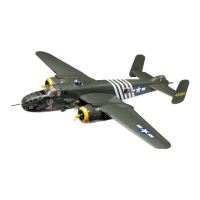
full throttle is usually desirable for takeoff, the B-25
should fl y well at approximately 1/2-throttle.
Take it easy with the B-25 for the fi rst few fl ights,
gradually getting acquainted with it as you gain
confi dence. Adjust the trims to maintain straight and
level fl ight. After fl ying around for a while, and while
still at a safe altitude with plenty of fuel, practice slow
fl ight and execute practice landing approaches by
reducing the throttle to see how the model handles at
slower speeds. Extend the fl aps at low throttle settings
to see how the model reacts. Add power to see how
she climbs as well. Continue to fl y around, executing
various maneuvers and making mental notes (or
having your assistant write them down) of what trim or
C.G. changes may be required to fi ne tune the model
so it fl ies the way you like. Mind your fuel level, but
use this fi rst fl ight to become familiar with your model
before landing.
B-25 ENGINE-OUT FLYING PROCEDURES
One of the primary concerns when fl ying a twin-
engine model is "what if one engine quits?" While
“engine-out” is never desirable, through experience
and testing we have developed a model that will not
react suddenly or unexpectedly and can be controlled
well enough to get it safely back to the ground if one
engine does quit.
There are two different approaches that can be taken
if an engine quits. “Plan A” is to follow the Single
Engine-Out Procedures to carefully fl y the model on
one engine allowing you to bring it closer to the landing
zone or runway. If, however, you become confused or
fi nd yourself not able to execute or understand the
procedures, it would be safer to go to “Plan B” which
is simply to cut the throttle on the remaining running
engine and perform a dead-stick landing same as
you would with any other model. Of course, you won’t
have the ability to fl y the model closer and will have to
land with the altitude and distance given. To execute
a single-engine landing follow the Single Engine-
Out Procedures below:
SINGLE ENGINE-OUT PROCEDURES
The fi rst thing to do is recognize that an engine has
quit. This may not be easy because the plane may not
react immediately or the single running engine may
be diffi cult to hear if other models are also in the air.
Once you’ve noticed that an engine has quit, the next
thing to do is decide! Decide whether to continue to
fl y on one engine until you can get the plane closer, or
to just kill the running engine and make a dead-stick
landing. The Top Flite B-25 has fl own both left and
right-hand turns on a single engine, turning both into
the dead and into the running engine. Both situations
will require the coordinated use of rudder and ailerons.
The key to making turns on one engine is to steer
the plane with the rudder and use the ailerons
only for keeping the wings level. Using the ailerons
to make banked turns may result in a stall or a spin,
so be certain to use the rudder for turning.
The other thing to keep in mind when fl ying on one
engine is that when turning toward the dead engine
(making a left-hand turn with the left engine not
running) turns may be tighter than you expect. And
when turning away from the dead engine (making
a right-hand turn with the left engine out) turns may
be wider than you expect. If using the ailerons for
turning away from the dead engine the nose will pitch
up the plane will slow until it stalls, so again, do your
turning with the rudder and use the ailerons to keep
the wings level.
In either scenario the other thing to remember is to
keep the airspeed up. Powered by one engine, there
will be enough thrust to extend the fl ight, but the
plane will slowly lose altitude. If too much airspeed
is lost, one engine will not be able to provide enough
power recover, so you will have to point the nose
down to gain airspeed. If the plane is already too
low this may not be an option, so fl at, large turns
are the key. When on the fi nal leg approaching the
runway, cut the running engine just the same as you
would if performing a normal approach. Flaps are not
recommended for a single-engine landing unless you
are surely going to overshoot.


 To Next Page
 Loading...