47
If not profi cient with the rudder or if anxious
about becoming confused with single engine-out
procedures, it may be safer just to cut the throttle
and perform a dead-stick landing the same as you
would any other single-engine plane. Of course, you
will have to land with the altitude and distance given.
Again, do not extend the fl aps on a single-engine or
engine-out landing (unless you are already over or
very near the runway).
Here’s a review of the Single
Engine-Out Procedures:
1. Recognize that an engine has quit.
2. Decide whether to continue fl ying on one engine or
to cut the other engine and dead-stick immediately.
3. Remember—use the rudder to do the turning and
use the ailerons to keep the wings level. Turns around
the dead engine will be tighter and turns away from
the dead engine will be wide.
4. Maintain your airspeed.
LANDING
The B-25 may be landed with or without fl aps. Flaps
increase lift and drag, so the plane may be landed
with less ground speed, thus shortening rollout
after touchdown (not as much of a factor on grass
runways). To initiate a landing approach, lower the
throttle while on the downwind leg (parallel with the
runway, but going the opposite direction). If using
fl aps, allow the model to slow, then extend the fl aps.
Continue to lose altitude, but maintain airspeed
by keeping the nose down as you turn onto the
crosswind leg. Make the fi nal turn toward the runway
(into the wind) keeping the nose down to maintain
airspeed and control. If landing with fl aps keep a
few additional “clicks” of power so the model doesn’t
slow too much. Level the attitude when the model
reaches the runway threshold and is approximately
ten feet [3 meters] above the ground, modulating the
throttle as necessary to maintain the glide path and
airspeed. If you are going to overshoot the runway,
smoothly advance the throttle (always ready on the
right rudder to counteract torque) and retract the fl aps
when enough airspeed is gained. Climb out to make
another attempt. When fi nally ready to land and the
model is a foot or so off the deck and you are ready to
make the landing fl are, smoothly increase up elevator
until the wheels gently touch down. Once the model
is on the runway and has lost fl ying speed, hold down
elevator to hold the nose on the ground. Note: If ever
the occasion arises when a dead-stick landing must
be performed, do not extend the fl aps until certain
the model will be able to reach the landing zone (on
dead-stick landings it is common to land with no fl aps
at all). Without engine power, fl aps can unexpectedly
reduce the model’s range, thus causing you to come
up short of the fi eld.
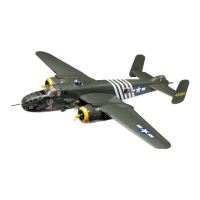
One fi nal note about fl ying your B-25 ARF. Have a
goal or fl ight plan in mind for every fl ight. The goal
could be learning a new maneuver, perfecting known
maneuvers, or learning how the model behaves in
certain conditions (such as on high or low rates). This
is not necessarily to improve your skills (though it is
never a bad idea!), but more importantly so you do
not surprise yourself by impulsively attempting a
maneuver without planning. Every maneuver should
be deliberate. For example, if performing a loop, plan
it out—check your altitude, mind the wind direction
(anticipating rudder corrections that will be required
to maintain heading), remember to throttle back on
the down side, and make certain you are on the
desired rates (high/low rates). A fl ight plan greatly
reduces the chances of crashing just because of poor
planning and impulsive moves. Remember to think!
Have a ball! But always stay in control
and fl y in a safe manner.
GOOD LUCK AND GREAT FLYING!


 To Next Page
 Loading...