12 Grinding Angle Adjustmentl
Adjustment of the length A between adjustable stop and knife-edge
for a grinding edge !
at a preset of the distance S between support-top and stone
Table 6. Stone diameter=200 mm
S= 65 70 75 80 85 90 95 100 105 110 115 120 125
!(°) Adjustable length A (mm)
10 121 127 133 139 145 151 157 163 168 174 180 185 191
11 120 126 132 138 144 150 155 161 167 173 178 184 189
12 118 124 130 136 142 148 154 160 165 171 177 182 188
13 117 123 129 135 141 147 152 158 164 170 175 181 186
14 115 121 127 133 139 145 151 157 162 168 174 179 185
15 114 120 126 132 138 144 150 155 161 167 172 178 183
16 113 119 125 131 137 142 148 154 160 165 171 176 182
17 111 117 123 129 135 141 147 152 158 164 169 175 180
18 110 116 122 128 134 140 145 151 157 162 168 173 179
19 109 115 121 127 132 138 144 150 155 161 167 172 178
20 107 113 119 125 131 137 143 148 154 160 165 171 176
21 106 112 118 124 130 136 141 147 153 158 164 169 175
22 105 111 117 123 129 134 140 146 151 157 163 168 174
23 104 110 116 122 127 133 139 144 150 156 161 167 172
24 103 109 115 120 126 132 138 143 149 154 160 165 171
25 102 108 113 119 125 131 136 142 148 153 159 164 170
26 101 106 112 118 124 130 135 141 146 152 157 163 168
27 99 105 111 117 123 128 134 140 145 151 156 162 167
28 98 104 110 116 122 127 133 139 144 150 155 161 166
29 97 103 109 115 121 126 132 137 143 148 154 159 165
30 96 102 108 114 119 125 131 136 142 147 153 158 164
© 2013 Ton Nillesen 5
5. Range of grinding angles
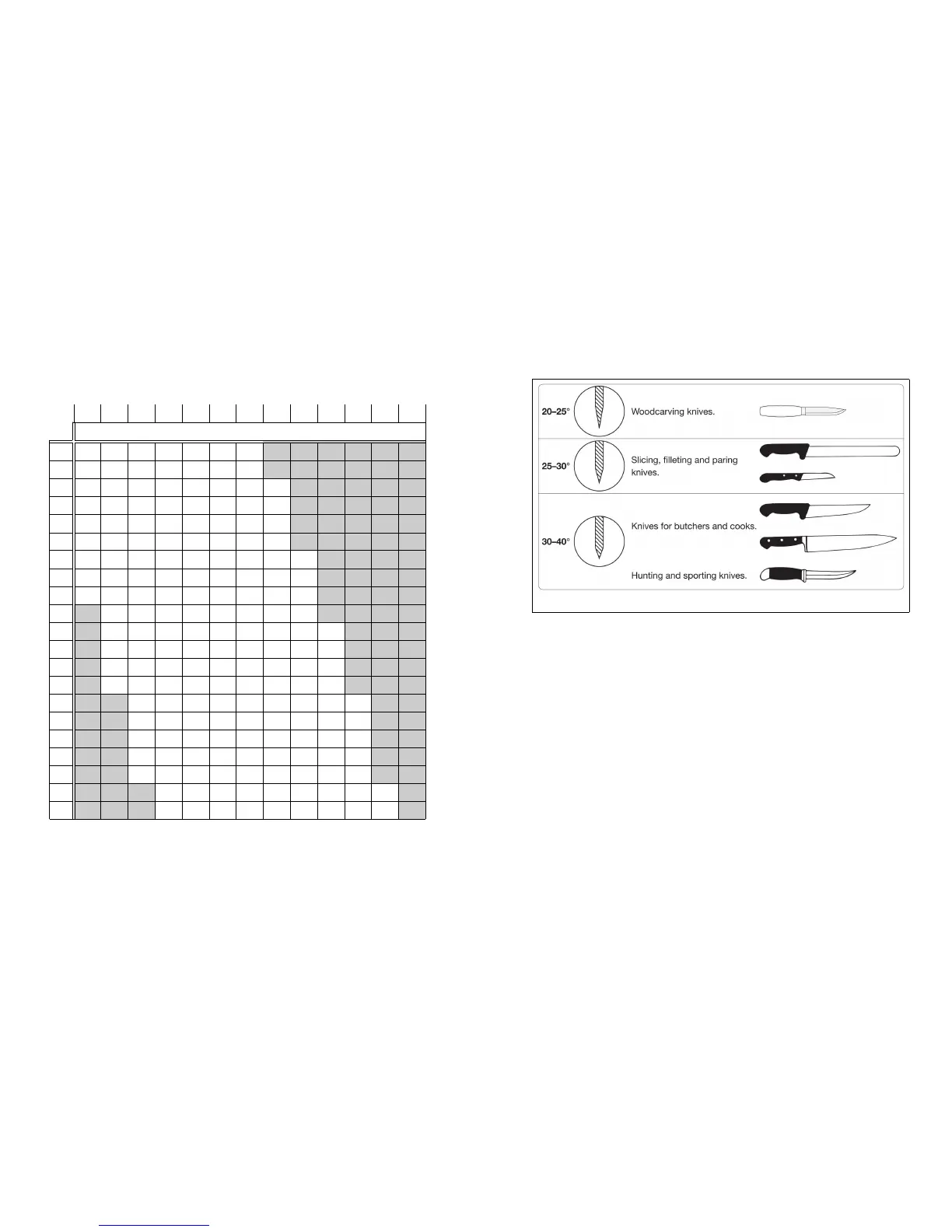
The handbook of the Tormek grinder gives recommended edge angles in the figure
copied in Fig. 5.1.
So the grinding angle adjustment should cover a range from 10°-20° if grinding is
done at both sides.
With respect to the recommended angle for kitchen knives, I found the following text
on a forum of “the Society for Culinary Arts & Letters”:
The Myth of Thick Edges
The theory is that thick edges (larger angles) last longer than thin
edges, and the majority of the knife buying public wants the edge to
last as long as possible. But it doesn’t work out that way in practice.
Thinner edges actually outlast thicker edges almost all the time.
The thinner edge starts out performing better than the thicker edge.
So even if it does degrade it has a lot of ground to lose before it falls
to the performance level of the thick edge.
Thinner edges cut more easily, putting less stress on the edge. If a
thin edge takes three slices to get through a big slab of raw meat, a
thicker edge might take six or seven. Or three with a lot more force.
The thicker edge is doing twice as much work, degrading twice as
quickly.
Thinner edges are easier to control. Lateral stresses are a significant
source of edge degradation. The more smoothly, accurately and eas-
ily you are able to cut, the less lateral stress you put on the edge.
Thin is good.
Fig. 5.1: Recommended Edge Angles (from the Handbook)


 To Next Page
 Loading...