6 Grinding Angle Adjustmentl
Furthermore the following recommendation was given:
The best compromise in the kitchen has proven to be a 15/20 double
bevel. That is a 15 degree back bevel with a 20 degree primary edge
face.
The “double bevel” refers to a second, more acute, angle be-
hind the edge bevel. This secondary bevel is sometimes
called a back bevel or relief angle. The back bevel solves
one of the great problems with V-edges, the fact that the
metal behind the edge gets progressively thicker as the knife
is sharpened over time. The knife doesn’t cut as well and be-
comes harder and harder to sharpen. The answer is to grind
the shoulders off the edge at an acute angle, i.e. add a back
bevel, then reestablish the primary bevel.
It’s purpose is to thin the metal behind the edge. The thinner
the edge, the greater the cutting ability. However, an edge
that is too thin is susceptible to damage. So you add a smal-
ler, more obtuse primary bevel to the very edge to give it the
strength to avoid damage from impaction, chipping or rolling.
Following the quoted text, I decided to adjust the grinding
angle of my knives to 10°, resulting in a cutting edge of 20°.
6. Adjustment tables
Formula [F6]:
is not a simple calcula-
tion. Therefore the required adjustments associated with several parameters have
been combined in tables on the following pages.
• Each table is made for a certain stone diameter, ranging from 250mm to the re-
commended minimum stone diameter of 180mm. The stone diameters in the
tables are reduced in steps of 10mm.
• The top row of each table gives the parameter S for which the underlying
column has been calculated.
• The left column of the table gives the grinding angle ! for which the associated
row has been calculated.
• The table cell in the column of a given S, in the row of the desired ! gives the
value at which the adjustable stop of the knife-jig should be adjusted.
Example:
Consider a cooks knife with a width of 45mm. The jig can grip the knife to a depth of
14mm. As a consequence the knife edge extends 31mm from the clamp.
Thus the distance A between the knife edge and the adjustable stop can be varied
between 108+31 and 125+31 mm, that is from 139mm to 156mm.
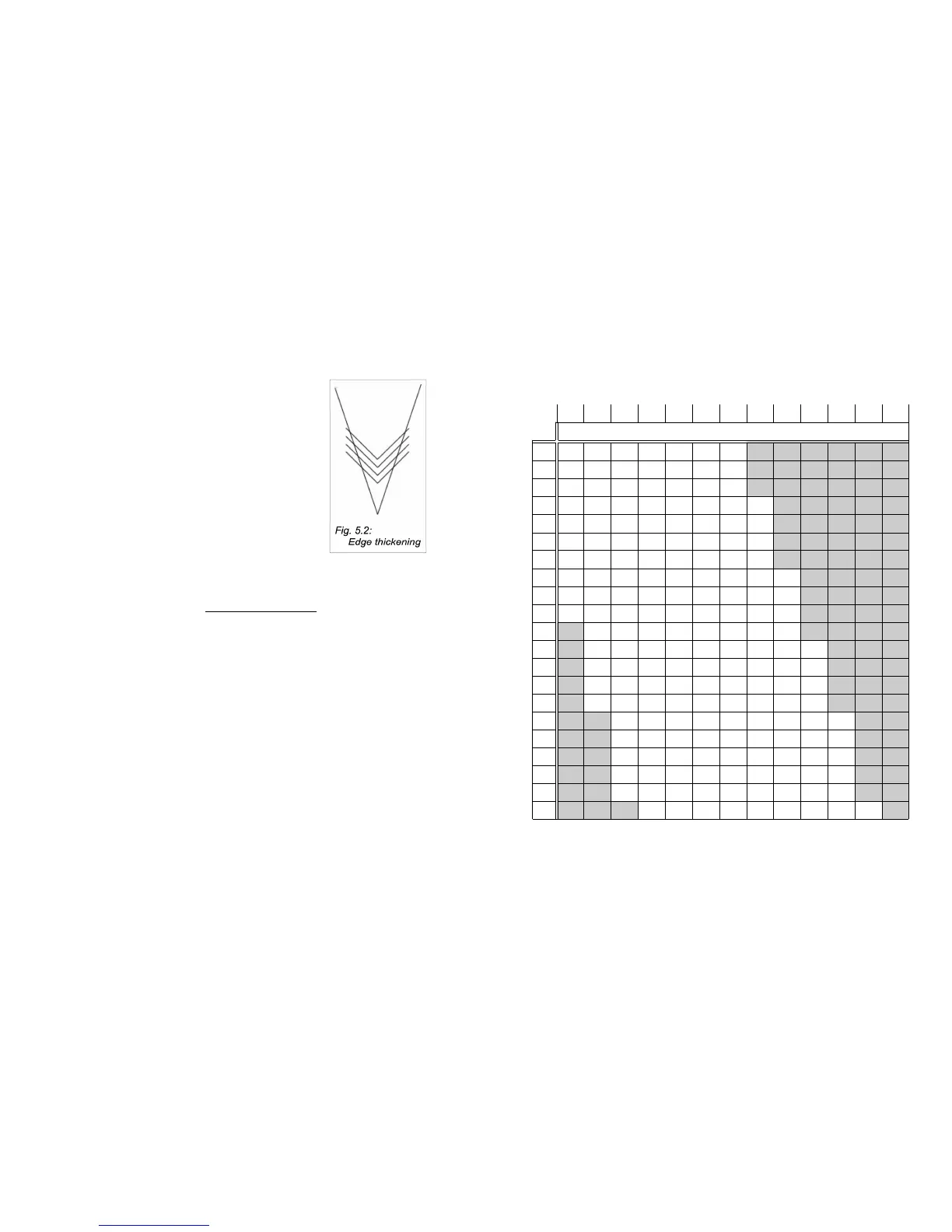
In Table 1. on the following page two column sections have been indicated in fat
lines. The included table cells cover the whole range of grinding angles from 10° to
30° within the adjustable range of 139-156mm. The distance S should then be set
to 85mm or 100mm or values in between.
In Table 9. on page 15 personal notes can be made on
grinding angles chosen for certain knifes
© 2013 Ton Nillesen 11
Adjustment of the length A between adjustable stop and knife-edge
for a grinding edge !
at a preset of the distance S between support-top and stone
Table 5. Stone diameter=210 mm
S= 65 70 75 80 85 90 95 100 105 110 115 120 125
!(°) Adjustable length A (mm)
10 123 129 135 141 147 153 159 165 171 176 182 188 193
11 121 127 134 140 146 151 157 163 169 175 180 186 192
12 120 126 132 138 144 150 156 162 167 173 179 184 190
13 118 124 130 137 142 148 154 160 166 171 177 183 188
14 117 123 129 135 141 147 153 158 164 170 176 181 187
15 115 121 128 134 139 145 151 157 163 168 174 180 185
16 114 120 126 132 138 144 150 155 161 167 173 178 184
17 112 119 125 131 137 142 148 154 160 165 171 177 182
18 111 117 123 129 135 141 147 153 158 164 170 175 181
19 110 116 122 128 134 140 145 151 157 163 168 174 179
20 109 115 121 127 132 138 144 150 155 161 167 172 178
21 107 113 119 125 131 137 143 148 154 160 165 171 176
22 106 112 118 124 130 136 141 147 153 158 164 170 175
23 105 111 117 123 129 134 140 146 151 157 163 168 174
24 104 110 116 121 127 133 139 144 150 156 161 167 172
25 102 108 114 120 126 132 138 143 149 154 160 166 171
26 101 107 113 119 125 131 136 142 148 153 159 164 170
27 100 106 112 118 124 129 135 141 146 152 157 163 168
28 99 105 111 117 123 128 134 140 145 151 156 162 167
29 98 104 110 116 121 127 133 138 144 149 155 161 166
30 97 103 109 115 120 126 132 137 143 148 154 159 165


 To Next Page
 Loading...