
 Need help?
Do you have a question about the Toro Recycler 21445 and is the answer not in the manual?
Signals hazards that may cause serious injury or death if precautions are not followed.
Informs about chemicals known to cause cancer or reproductive harm in California.
Essential safety rules for operating the lawn mower to prevent serious personal injury or death.
Explains the meaning of various safety and instructional decals found on the machine.
Procedure for correctly unfolding the mower's handle to prevent cable damage.
Steps to install the recoil-starter rope in its guide for safe engine starting.
Instructions for checking and adding engine oil to prevent engine damage.
Guide on how to assemble and attach the grass bag to the mower.
Technical specifications including weight, dimensions, and model number.
Information on approved attachments and accessories for enhancing mower capabilities.
Critical safety checks and precautions to take before starting the mower.
Proper procedures and safety guidelines for filling the fuel tank with gasoline.
Daily procedure to check the engine oil level and add if necessary.
How to adjust the handle to a comfortable position for the operator.
Instructions on how to set the mower's cutting height for different grass conditions.
Essential safety practices to follow while operating the lawn mower.
Guidelines for safely operating the mower on slopes and inclines.
Step-by-step guide on how to start the mower's engine.
Procedure for safely shutting down the mower's engine.
Instructions for engaging and disengaging the self-propel drive system.
How to use the grass bag to collect clippings from the lawn.
Steps for safely detaching and removing the grass bag from the mower.
General advice and tips for efficient and effective lawn mowing.
Guidance on proper mowing techniques for different grass heights and conditions.
Tips for using the mower to effectively cut and manage fallen leaves.
Safety precautions to follow after finishing mowing operations.
Instructions for cleaning the underside of the mower deck after use.
Procedure for folding the handle for storage or transport.
Guidelines for storing the mower vertically to save space, including safety warnings.
A schedule outlining routine maintenance tasks and their intervals.
Crucial safety precautions to observe before and during maintenance.
Steps to take before performing any maintenance procedures on the mower.
Procedure for inspecting and cleaning or replacing the air filter.
Detailed instructions on how to drain and refill the engine oil.
Steps and safety precautions for replacing the mower blade.
Safety guidelines for storing the mower properly in a cool, clean, dry place.
Steps to prepare the mower for long-term storage, including fuel treatment.
Instructions for preparing the mower after it has been stored for a period.
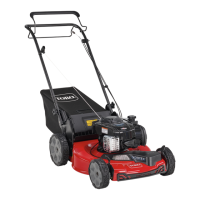
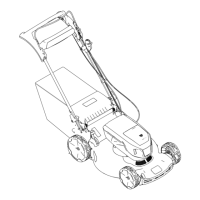
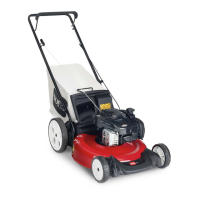
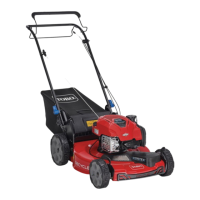
This document describes the 22in Recycler® Lawn Mower with SmartStow®, Model No. 21445, designed for residential homeowners to cut grass on well-maintained lawns. It is a rotary-blade, walk-behind lawn mower.
The primary function of this device is to cut grass using a rotary blade. It is designed for residential use on well-maintained lawns. The mower features a self-propel drive system, which assists the user in moving the machine across the lawn. The SmartStow® feature allows the machine to be stored in a vertical position, minimizing storage space, which is particularly useful during the mowing season or off-season. The machine is also capable of recycling grass and leaf clippings back into the lawn, or collecting them in a grass bag.
The lawn mower is designed for ease of use and safety. Before operation, users must ensure the handle is properly unfolded and the recoil-starter rope is installed in its guide. The handle height is adjustable to provide a comfortable operating position for the user. The cutting height can also be adjusted, allowing users to select the desired grass length. All wheels should be set to the same cutting height for an even cut.
To start the engine, the blade-control bar must be held against the handle while pulling the recoil-start handle. The engine should shut off within 3 seconds of releasing the blade-control bar, a safety feature that should be regularly checked. For models equipped with self-propel drive, engaging the self-propel-drive bar to the handle activates the drive system, making mowing less strenuous. Releasing the bar disengages the drive. The maximum self-propel-drive speed is fixed, but users can reduce the speed by increasing the space between the self-propel-drive bar and the handle.
The mower offers two primary modes for handling clippings: recycling and bagging. The machine comes factory-ready for recycling grass and leaf clippings back into the lawn. If bagging is desired, the grass bag can be easily installed by raising the rear deflector, placing the bag pins into the handle notches, and then lowering the deflector. Removing the grass bag follows the reverse procedure.
Operating tips include inspecting the mowing area for objects that could interfere with operation or be thrown by the blade. Users should avoid striking solid objects and never deliberately mow over any object. If the machine strikes an object or vibrates excessively, the engine should be shut off, and the machine inspected for damage. For optimal performance, a new blade should be installed at the beginning of the cutting season or as needed. When cutting grass, it is recommended to cut only about a third of the grass blade at a time, avoiding cuts below 51 mm (2 inches) unless the grass is sparse or growth has slowed. For tall grass, mowing at the highest setting first, then at a lower setting, is advised. Mowing in wet conditions should be avoided as wet grass and leaves can clump and stall the engine. Alternating mowing direction helps disperse clippings for even fertilization. For unsatisfactory lawn appearance, users can try replacing or sharpening the blade, walking slower, raising the cutting height, cutting more frequently, or overlapping cutting swaths. When cutting leaves, ensure half of the lawn shows through the cut leaf cover, possibly requiring multiple passes. For thick leaf cover, mow at a higher cutting height first, then at the desired height. Slowing down mowing speed can help cut leaves more finely.
Safety is paramount during operation. Users should wear appropriate clothing, including eye protection, long pants, slip-resistant footwear, and hearing protection. Loose clothing and jewelry should be avoided, and long hair tied back. Full attention is required during operation, and the machine should not be operated while ill, tired, or under the influence of alcohol or drugs. Bystanders and children must be kept out of the operating area. Before moving the machine in reverse, users should always look down and behind them. Operation should only occur in good visibility and appropriate weather conditions, avoiding lightning risks. Extreme care is needed near blind corners, shrubs, trees, or other objects that may block the view. Discharge material should not be directed toward anyone or against obstructions to prevent ricochet. The blade(s) should be stopped when crossing gravel surfaces. Users should watch for holes, ruts, bumps, rocks, or hidden objects to prevent loss of balance or footing. If the engine has been running, the muffler will be hot and can cause burns. The engine should only be operated in well-ventilated areas due to carbon monoxide in exhaust gases. Grass catcher components and the discharge chute should be frequently checked for wear.
Slope safety guidelines emphasize mowing across the face of slopes, never up and down, and exercising extreme caution when changing direction. Mowing on excessively steep slopes is discouraged due to slip-and-fall risks. Caution is advised near drop-offs, ditches, or embankments.
Regular maintenance is crucial for the machine's performance and longevity. Before each use or daily, the engine-oil level should be checked and oil added as needed. The engine should shut off within 3 seconds of releasing the blade-control bar. After each use, grass clippings and dirt should be cleaned from under the machine.
Yearly maintenance includes servicing the air filter more frequently in dusty conditions, changing the engine oil (if desired), and replacing or sharpening the blade. The engine should also be cleaned by removing dirt and debris from its top and sides, with more frequent cleaning in dusty conditions. Before yearly storage, the fuel tank should be emptied.
For engine oil, the machine should be on a level surface. The dipstick is removed by rotating the cap counterclockwise and pulling it out. To drain used oil, the machine is tipped onto its side with the air filter up, allowing oil to drain from the oil-fill tube. After draining, about 3/4 of the engine's oil capacity is carefully poured into the oil-fill tube, followed by a 3-minute wait for the oil to settle. The dipstick is then wiped clean, inserted, screwed in, and removed to check the oil level. If the level is too low, small amounts of oil are added until correct; if too high, excess oil is drained. The dipstick is then securely installed. Used oil should be recycled properly.
Blade replacement requires a torque wrench for proper installation. The blade should be examined whenever fuel runs out and replaced if damaged or cracked. Dull or nicked blades should be sharpened or replaced. When servicing the blade, gloves should be worn due to its sharpness. The machine should be tipped onto its side with the air filter up, and a block of wood used to hold the blade steady while removing it. The new blade is installed with all mounting hardware, ensuring the curved ends point toward the machine housing. The blade bolt is tightened to 82 N·m (60 ft-lb) with a torque wrench.
Before any maintenance procedure, the engine must be shut off, all moving parts stopped, and the machine allowed to cool. The spark-plug wire should be disconnected from the spark plug to prevent accidental starting. Gloves and eye protection should be worn. Safety devices should never be tampered with and their operation checked regularly. Tipping the machine can cause fuel leaks, so the engine should be run dry or fuel removed with a hand pump before tipping. Only genuine Toro replacement parts and accessories should be used to ensure optimum performance and safety certification.
For storage, the machine should be kept in a cool, clean, dry place. Before storing for the year, fuel stabilizer should be added to the fuel as directed. Any unused fuel should be disposed of properly. The machine should be run until the engine shuts off from lack of fuel, then started again and run until it completely shuts off to ensure it is sufficiently dry. The spark-plug wire should be disconnected and connected to its retaining post. The spark plug is removed, 30 ml (1 fl oz) of engine oil added through the spark-plug hole, and the starter rope slowly pulled several times to distribute oil, preventing cylinder corrosion. The spark plug is then loosely installed. All nuts, bolts, and screws should be tightened.
For vertical-stow storage, the fuel level in the tank must not exceed the recommended level to prevent leaks. The cutting-height setting should be 92 mm (3-5/8 inches) or lower. The handle locks are disengaged, and the handle is folded fully forward, ensuring cables are routed to the outside of the handle knobs. The handle locks are then engaged. The machine can then be lifted by the handle into a storage space, ensuring it is at a 90° angle. When transporting, the machine should be laid down.
To remove the machine from storage, all fasteners should be checked and tightened. The spark plug is removed, and the engine spun rapidly by pulling the recoil-start handle to blow excess oil from the cylinder. The spark plug is then installed and tightened to 20 N·m (15 ft-lb). Any remaining maintenance procedures are performed, the engine-oil level checked, the fuel tank filled with fresh fuel, and the spark-plug wire connected.
 General
| Cutting Width | 22 inches |
|---|---|
| Mulching Capability | Yes |
| Bagging Capability | Yes |
| Side Discharge | Yes |
| Deck Material | Steel |
| Starting System | Recoil |
| Engine | Briggs & Stratton |
| Cutting Height | 1.25 - 3.75 inches |
| Weight | 80 lbs |
| Wheel Size | 8 inches |
| Drive System | Personal Pace |




 To Next Page