
 Need help?
Do you have a question about the Toshiba e-STUDIO 2505 and is the answer not in the manual?
Instructions for when the toner cartridge is empty.
Instructions for handling paper misfeeds in various locations.
Overview of the machine's physical components and their locations.
Description of the control panel buttons, screen, and functions.
Instructions for turning the machine on and off.
Instructions for loading paper into the drawer and bypass tray.
Steps for installing the necessary software drivers for the equipment.
How to connect the equipment to a computer via USB cable.
Step-by-step guide for making copies using the machine.
Instructions for printing documents from a computer.
Instructions for scanning documents using the machine.
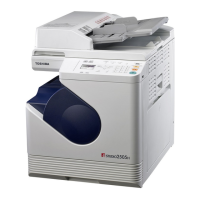
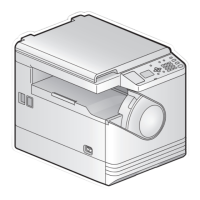
This document provides a quick guide for the TOSHIBA e-STUDIO2505, a multifunctional digital system designed for various office tasks. It covers the components, basic operations, and troubleshooting, ensuring users can effectively utilize the equipment.
The e-STUDIO2505 is a versatile multifunctional device capable of printing, copying, and scanning. It integrates these core office functions into a single unit, streamlining workflows and reducing the need for multiple specialized devices.
Copier Function: The device allows users to make copies of documents placed on the original glass or fed through the Automatic Document Feeder (ADF). Users can specify the number of copies using the digital keys and initiate the process with the [START] button. The copier supports various paper sizes and offers settings for reproduction ratio and exposure, including auto exposure and modes for text/photo. It also provides options to stop copying mid-process using [CLEAR/STOP] and to reset all settings with [FUNCTION CLEAR]. Shortcut keys are available for quick access to "ORIGINAL MODE" and "EXPOSURE" settings, as well as an "ID CARD" mode for specific regions.
Printer Function: The e-STUDIO2505 functions as a printer, allowing users to print documents from their computer applications. To print, users select the printer from their application's [File] menu, access [Preferences] to adjust print options, and then confirm with [OK] or [Print]. This integration with computer systems makes it a central printing hub for offices.
Scanner Function: The device is equipped with scanning capabilities, enabling users to digitize documents. Originals can be placed on the original glass or in the ADF. Users initiate the scan process through a TWAIN-compliant application on their computer, selecting the device from the application's [File] menu. After making the desired scan settings, the process is started by clicking [Scan]. This allows for easy conversion of physical documents into digital files.
Automatic Document Feeder (ADF): The ADF, an optional component for some regions, facilitates the scanning and copying of multiple-page documents automatically. This feature significantly enhances efficiency by eliminating the need to manually place each page on the original glass. When placing long originals (A3, B4, A4-R, LD, LG, COMP, or 8K) in the ADF, users should open the original holder to ensure correct size detection.
The e-STUDIO2505 is designed for ease of use, with a clear control panel and intuitive loading mechanisms.
Control Panel: The control panel features an LCD screen that displays current settings, messages (e.g., "READY," "MISFEED"), and copy quantity. It includes digital keys for input, directional arrows for navigation, and dedicated buttons for [SETTINGS], [ENERGY SAVER], [FUNCTION CLEAR], [CLEAR/STOP], [START], [CANCEL], and [OK]. An alert lamp provides visual notifications. The main screen for copying shows the reproduction ratio, paper size, exposure settings, and original mode.
Paper Loading:
Power Management: The device is turned on by pressing the power switch to the "I" (on) position and turned off by pressing it to the "O" (off) position. This simple mechanism ensures straightforward power control.
Connectivity: The equipment connects to a computer via a USB cable, enabling its printer and scanner functions. This standard connection method ensures compatibility with a wide range of computer systems.
Driver Installation: Installing the necessary drivers requires administrator authority. For Windows 7, Windows 8, Windows Server 2008 R2, or Windows Server 2012, an installer is provided. The installation process involves connecting the equipment to the computer, inserting the DVD, and following the on-screen instructions. The device also supports Plug and Play, where turning on the equipment after connecting it will prompt on-screen instructions for driver setup. Users are advised to close all running applications before installing from the installer.
The manual highlights basic troubleshooting steps and component identification that indirectly support maintenance.
Troubleshooting: The guide addresses common issues such as "Toner empty" and "Paper misfeed."
Component Identification: The detailed component description aids in understanding the device's structure, which is essential for basic maintenance and troubleshooting. Key components include:
Understanding these components helps users identify areas that might require attention during troubleshooting or routine checks. The quick guide emphasizes user-level maintenance by providing clear visual aids for common issues, empowering users to resolve minor problems without needing professional assistance.
 General
| Print Technology | Laser |
|---|---|
| Functions | Print, Copy, Scan |
| Print Speed | 25 ppm |
| Max Print Resolution | 2400 x 600 dpi |
| Copy Speed | 25 cpm |
| Max Paper Size | A3 |
| Duplex Printing | Manual |
| Paper Capacity | 250 sheets |
| Scan Resolution | 600 x 600 dpi |
| Copy Resolution | 600 x 600 dpi |
| Zoom | 25-400% |
| Dimensions | 575 x 540 x 402 mm |
| Memory | 128 MB |
| Connectivity | USB |
| Scan Speed | 25 spm |



 To Next Page