Need help?
Do you have a question about the Toyota RS3200 and is the answer not in the manual?
Explains the status monitor and LED indicators for system status.
Details the feature of auto-locking/unlocking doors with ignition key.
Details the 3-button remote, its buttons, and functions.
Explains methods for manually and remotely arming the system.
Explains methods for manually and remotely disarming the system.
Describes the system's automatic arming and disarming procedures.
Explains the process of the system automatically re-arming doors.
Describes how to temporarily suspend the system's armed state.
Details the warning sound for open doors during arming attempts.
Explains the automatic door locking/unlocking feature linked to the ignition.
Discusses the operating range of the remote and factors affecting it.
Explains how to activate and disarm the panic alarm for attention.
Lists various events or actions that will trigger the alarm system.
Details the characteristics of regular and warn-away alarms.
Provides instructions on how to disarm an active alarm.
Guides users on how to test the sensitivity and operation of the sensor.
Details programming for passive arming and entry delay settings.
Explains how to program the system for single or all-door unlocking.
Details programming to enable or disable the ignition-controlled door lock feature.
Step-by-step guide on safely removing the battery from the remote.
Step-by-step guide on safely installing a new battery into the remote.
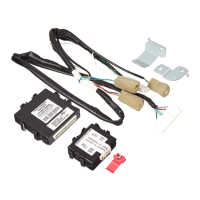
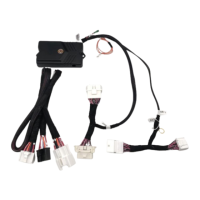
The Toyota RS3200 is a remote keyless security system designed specifically for Toyota vehicles, offering comprehensive protection through point-of-entry monitoring, glass breakage detection, and ignition switch monitoring. It provides the convenience of remote keyless operation, allowing users to arm and disarm the system while simultaneously locking and unlocking the vehicle's doors.
The core function of the RS3200 is to secure the vehicle against intrusion. When armed, the system will trigger an alarm if a door, trunk, or hatch is forcibly unlocked or opened, or if a window is tapped on or broken. During an alarm, the vehicle's horn sounds, and the headlights, tail lights, and front marker lights flash. Additionally, the vehicle's starter is disabled to prevent engine start.
The system offers multiple ways to arm and disarm. Users can arm the system by locking the doors with their key, using the central lock switch from inside the vehicle, or by pressing the LOCK button on the remote control. In each case, the STATUS MONITOR'S LED will illuminate for 30 seconds before flashing, indicating the system is armed. Disarming can be achieved by unlocking the doors with the key, pressing the UNLOCK button on the remote control, or by inserting the key into the ignition switch and turning it to "ON."
A key feature is the Passive (Automatic) Arming & Disarming mode, which can be programmed. When activated, the system will automatically arm 30 seconds after the ignition key is removed and all doors and the trunk/hatch are closed, without the need to manually lock the doors. In this mode, an Entry Delay (user-selectable at 0, 15, or 30 seconds) will begin when a door is opened before an alarm is triggered. If the doors are locked manually, regular arming overrides passive arming, and there will be no entry delay. The system can be disarmed in passive mode by inserting the key into the ignition switch and turning it to "ON" within the entry delay period, or by using the remote control's UNLOCK button.
The Automatic Rearming function ensures continued security. If the doors are unlocked using the remote control but no door, trunk, or hatch is opened within 30 seconds, the system will automatically relock the doors and rearm itself 30 seconds later.
The Arming Suspension mode allows temporary suspension of the armed state. This can be done by using the key to unlock and open the trunk. When arming is suspended, the STATUS MONITOR'S LED turns off until the trunk is closed again, at which point the system rearms. However, this feature is not applicable to Camry, Solara, and Corolla models from 2002 M.Y. onwards when using the key to unlock the trunk.
The Door Ajar Warning alerts the user if a door is open when attempting to remotely arm the system. A five-second warning tone will sound, which can be stopped by closing the open door or by pressing and releasing the UNLOCK button on the remote control. The system will not arm until all doors, the trunk, and the hatch are closed.
The Ignition-Controlled Automatic Door Locking/Unlocking feature automatically locks the vehicle's doors when the ignition key is turned to "ON" or "START" and unlocks them when the key is turned back to "ACC" or "LOCK." This feature can be disabled through programming.
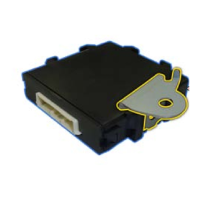
The Glass Breakage Sensor provides an additional layer of protection. It utilizes a microphone (usually mounted in the STATUS MONITOR) specifically tuned to detect the noise of tapping on or breaking window glass, while ignoring other sounds to prevent false alarms. Upon initial detection, it triggers a Warn-Away Alarm, where the horn sounds and lights flash for 20 seconds, but the starter remains enabled. If further glass tapping/breaking or unauthorized door/trunk opening occurs while armed, a regular alarm is triggered.
The Ignition Switch Monitoring function ensures that if an attempt is made to start the vehicle without a key while the system is armed, an alarm will be triggered.
The RS3200 features a Panic Mode Operation that can be activated by pressing the PANIC button on the back of the remote control. This mode causes the horn to sound and all lights (headlights, tail lights, marker lights, and interior lights) to flash for 60 seconds, drawing attention to the vehicle. The starter is not disabled in panic mode. If an alarm trigger is detected during panic mode, the regular alarm takes over.
Alarm Triggers include:
Alarm Descriptions differentiate between a Regular Alarm and a Warn-Away Alarm. A regular alarm, triggered by most intrusion events, causes the horn to sound, all lights to flash, and interior lights to turn on for 60 seconds. The starter is disabled until the system is disarmed, and the door lock will relock if an inside lock button is unlocked. After 60 seconds, the system rearms. A Warn-Away Alarm, specifically for initial glass breakage detection, sounds the horn and flashes lights for 20 seconds, with the starter remaining enabled.
Stopping an Alarm is straightforward, requiring only disarming the system using the remote control or the vehicle's key.
The remote controls are designed with separate LOCK and UNLOCK buttons on the front and a PANIC button on the back. The system can be controlled by up to four remote controls. The maximum operating range for the remote controls is approximately 50 feet, though this can be affected by battery strength, user position relative to the vehicle's antenna, objects in the path, surroundings (e.g., parking structures), and external electrical interference.
The system provides visual and auditory feedback for various operations. The vehicle's tail and marker lights flash once when arming and twice when disarming. The piezo buzzer chirps once for arming and twice for disarming. If an alarm was triggered while the user was away, the tail and marker lights will turn on and the buzzer will sound for 2 seconds upon disarming, indicating a "trigger memory."
Programming allows customization of several features:
The primary maintenance feature described is Remote Control Battery Replacement. The manual recommends replacing the batteries at least once a year or when the remote control's transmitting range diminishes. The specified battery type is a Lithium CR2025. The procedure involves carefully prying open the remote control with a coin, removing the old battery, and inserting a new one, taking care not to damage the rubber gasket or bend components. It is advised to handle the new battery with a cloth or tissue to prevent body oils and moisture from interfering with operation and reducing battery life.
The manual also includes important Warning and Caution Information regarding product usage and safety. It specifies that the product is for 12V DC, negative grounding vehicles only and warns against using it with 24V systems. It emphasizes keeping remote control batteries out of reach of children and consulting a physician if swallowed. Users are cautioned against disassembling or modifying the product, using incorrect fuses, or continuing to use the product if abnormal conditions (e.g., liquid spills, smoke, strange odors) occur. Proper battery insertion with attention to polarities is also highlighted to prevent explosion or electrolyte leakage. Finally, it advises against using the product for non-vehicle applications and to contact the dealer if the product is dropped or damaged.
 General
| Engine Start | Yes |
|---|---|
| Keyless Entry | Yes |
| Installation | Professional installation recommended |
| Compatibility | Toyota vehicles with compatible factory keyless entry systems |
| Security | Alarm system integration |

 To Next Page