SYS-APG001A-EN Dedicated Outdoor Air Systems: Trane DX Outdoor Air Unit 1
Defining the
Dehumidification Challenge
Building professionals expend much time and effort to design HVAC systems
that handle both ventilation and dehumidification. High-occupancy spaces,
such as classrooms, pose a particular challenge—especially when the system
of choice delivers a constant-volume mixture of outdoor and recirculated
return air. Why? The answer lies in the fact that the sensible- and latent-cooling
loads on the HVAC equipment do not peak at the same time.
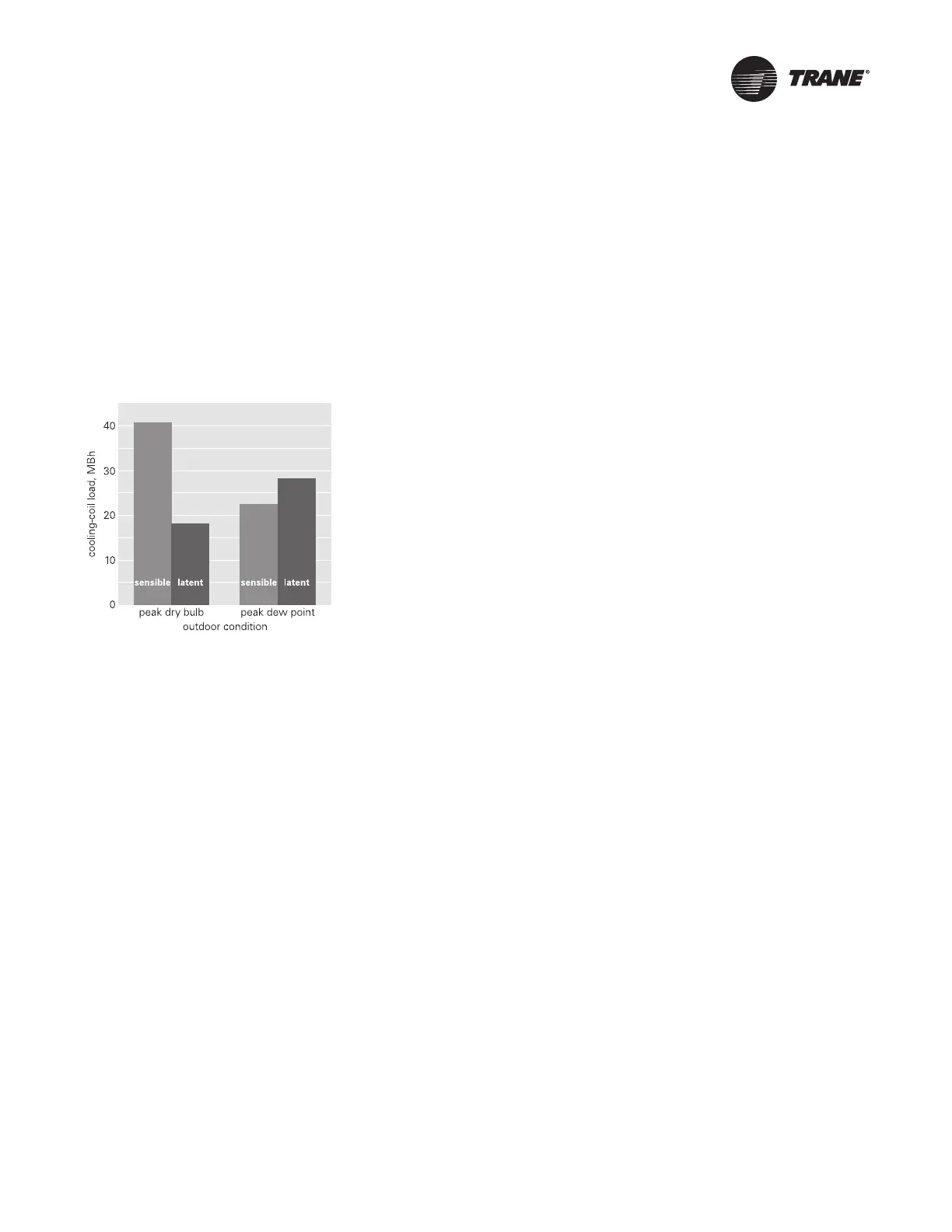
When it’s hot outside, the sensible-cooling load often far exceeds the latent-
cooling load (Figure 1). By contrast, when it’s cooler but humid outside, the
latent-cooling load can approach or even exceed the sensible-cooling load.
Conventional HVAC equipment traditionally is selected with sufficient cooling
capacity to handle the design load at the peak outdoor dry-bulb condition and
controlled by a thermostat that matches the sensible-cooling capacity of the
coil with the sensible-cooling load in the space. Therefore, as the sensible-
cooling load in the space decreases, the cooling capacity (both sensible and
latent) provided by the HVAC equipment also decreases. In most climates, the
combination of less latent-cooling capacity and a lower SHR (sensible-heat
ratio) in the space elevates the indoor humidity level at part-load conditions.
An “off-the-shelf,” packaged unitary air conditioner may further aggravate this
situation. Such equipment is designed to operate with a supply-airflow-to-
cooling-capacity ratio of 350 to 400 cfm/ton. In hot, humid climates, offsetting
the ventilation load for high-occupancy spaces may require that the unit
delivers no more than 200 to 250 cfm/ton in order to achieve the dew point
needed for adequate dehumidification.
Figure 1. Cooling loads at different
outdoor conditions*
* Based on an example classroom, which is
l
ocated in Jacksonville, Fla., and has a
target space condition of 74°F dry bulb and
50% relative humidity



 To Next Page