SYS-APG001A-EN Dedicated Outdoor Air Systems: Trane DX Outdoor Air Unit 5
Dedicated OA System Configurations
Cold or Neutral Air?
Regardless of where the conditioned outdoor air is delivered, the dedicated
OA unit should dehumidify the outdoor air so that it is drier than the zone.
This offsets the latent load associated with ventilation and, if the dew-point
temperature of the conditioned outdoor air is lower than the dew point in the
zone (Figure 6), also offsets some (or all) of the zone latent loads. This
approach can adequately limit indoor humidity levels, at both full- and part-
load conditions, without the need for additional dehumidification
enhancements in the local HVAC equipment.
Many dedicated OA systems are designed to dehumidify the outdoor air and
then reheat it to approximately zone temperature (neutral). Delivering the
dehumidified outdoor air at a neutral dry-bulb temperature can simplify
control because it has no impact on the zone sensible cooling or heating
loads.
However, when a chilled-water or DX cooling coil is used for
dehumidification, a by-product of that process is that the dry-bulb
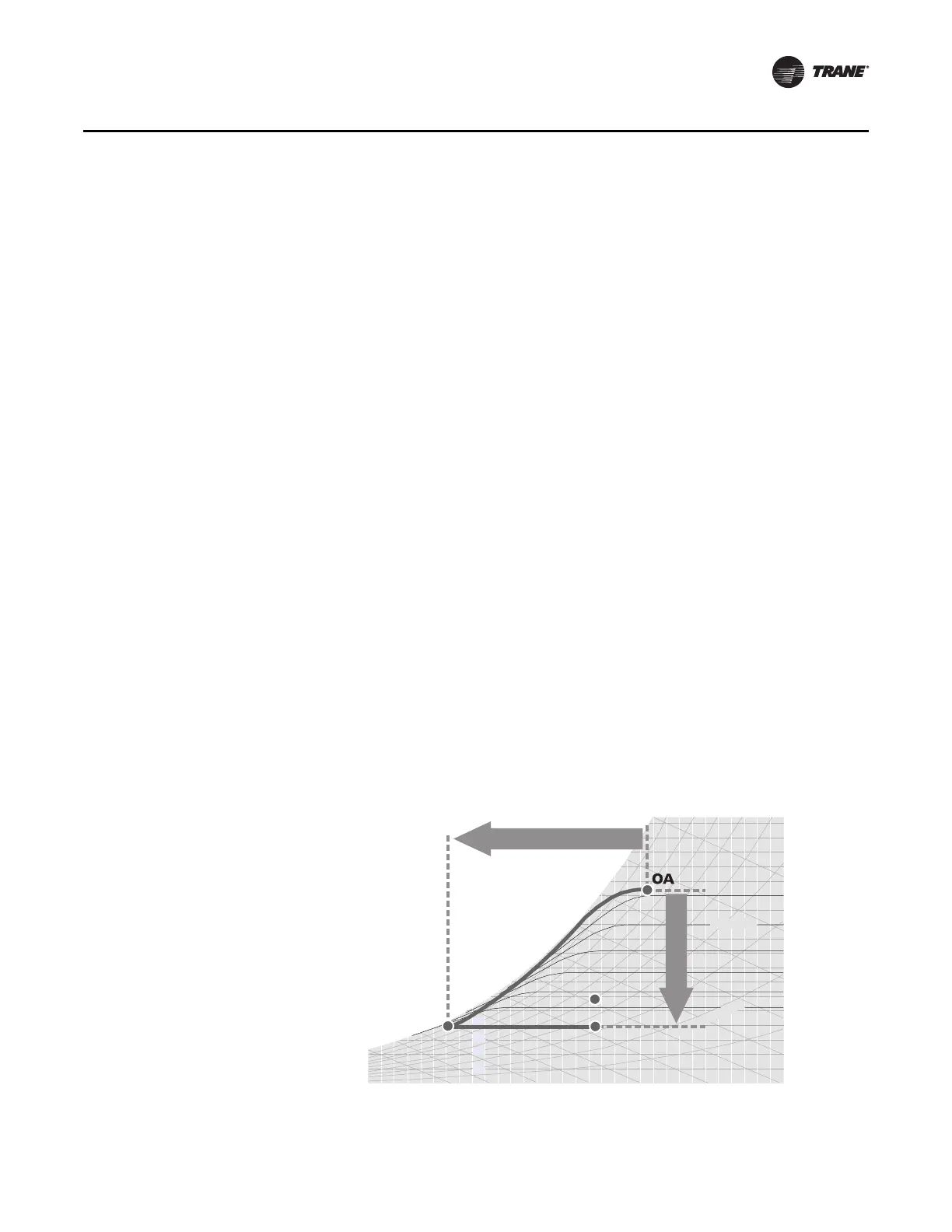
temperature of the air leaving the coil is colder than the zone (Figure 6). If the
dehumidified outdoor air (DH) is reheated to neutral (CA), most of the
sensible cooling performed by the dedicated OA unit is wasted.
If the dedicated OA system delivers air directly to each zone (see Figure 2,
p. 3) or to the supply-side of each local HVAC unit (see Figure 4, p. 4), the
dehumidified outdoor air (DH) can be delivered “cold,” rather than reheated
to neutral. The low dry-bulb temperature of the conditioned OA offsets part of
the sensible cooling load in the zone, reducing the energy used by the local
unit. At design conditions, this means that the local unit can be sized for less
airflow and less cooling capacity than in a neutral-air system.
Figure 6. Sensible cooling is a by-product of 'cold-coil' dehumidification
CA
DH
space
sensible cooling
dehumidification
30 35 40 45
50
55 65 70 80 90 100 11075 85 95 105
30
35
40
45
50
55
65
70
80
75
85
60
60
wet-bulb temperature, °F
dry-bulb temperature, °F
coil curves
relative humidity, %
humidity ratio, grains/lb of dry air
0
20
40
60
80
100
120
140
160
180
20
40
60
80



 To Next Page