4 Dedicated Outdoor Air Systems: Trane DX Outdoor Air Unit SYS-APG001A-EN
Dedicated OA System Configurations
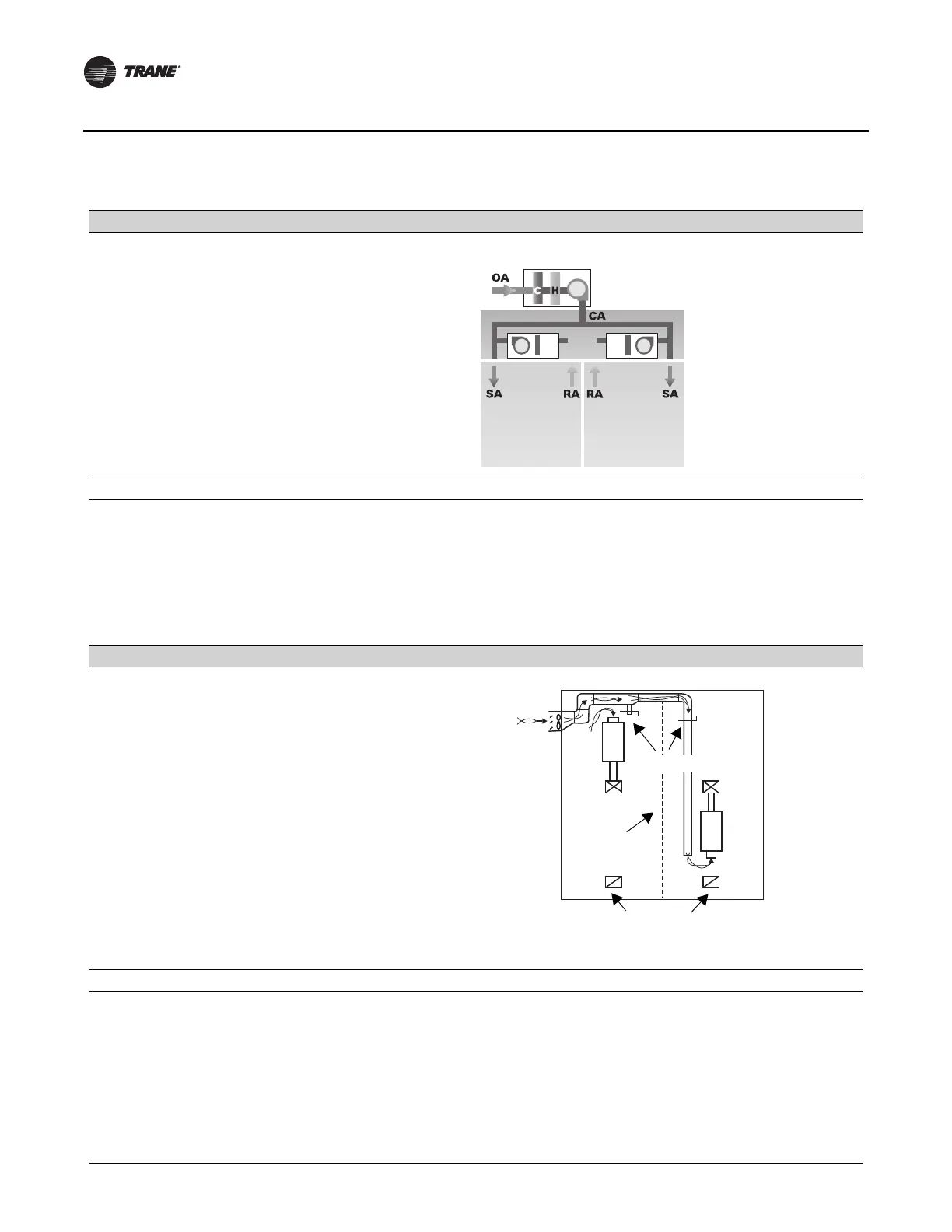
Conditioned OA delivered to the supply-side of each local HVAC unit
The DOAS in Figure 4 delivers the conditioned outdoor air (CA)
directly to the supply-side of each local HVAC terminal, where it
mixes with supply air from the local HVAC terminal before being
delivered to the occupied space. The local equipment conditions only
recirculated air (RA).
Figure 4.
Advantages: Disadvantages:
• Helps ensure the required amount of outdoor air reaches each unit,
because the OA is ducted directly to the supply-side of each unit
• Avoids the cost and space needed to install additional ductwork and
separate diffusers
• Affords the opportunity to downsize local units (reducing installed
cost and energy use) if the conditioned outdoor air is delivered
at
a cold temperature (rather than reheated to “neutral”)
• Easier to ensure that outdoor air is adequately dispersed
throughout the zone, because outdoor air is distributed by the
local fan
•
Measurement and balancing is more difficult than if the OA was
delivered directly to the zone via separate diffusers
• Fans inside the local units typically must operate continuously to
provide ventilation during scheduled occupancy, rather than
cycling off (unless a pressure-independent VAV terminal is used to
maintain outdoor airflow)
Conditioned OA delivered to the open ceiling plenum, near each local HVAC unit
The DOAS in Figure 5 delivers the conditioned outdoor air (CA) to the
ceiling plenum, near the intake of each local HVAC terminal. The
outdoor air mixes with recirculated air (RA) in the plenum before
being drawn in through the intake of the unit. The local unit
conditions this mixture of outdoor and recirculated air, and delivers
it to the occupied space through a shared duct system and diffusers.
Figure 5.
Advantages: Disadvantages:
• Avoids the cost and space needed to install additional ductwork,
separate diffusers, or field-fabricated mixing plenums
• More difficult to ensure the required amount of outdoor air reaches
each unit, since the OA is not ducted directly to each local unit
(refer to the ASHRAE 62.1 User's Manual for further guidance)
• Conditioned outdoor air may not be able to be delivered at a cold
temperature, due to concerns over condensation within the ceiling
plenum (rather, it must typically be reheated closer to a “neutral
”
temperature)
• Fans inside the local units must operate continuously to provide
ventilation during scheduled occupancy, rather than cycling off
• If the dedicated OA system operates during unoccupied periods
(for after-hours humidity control or preoccupancy purge, for
e
xample), the fans inside the local units typically must operate also
Table 1. Comparison of different dedicated OA system configurations
local HVAC
unit
dedicated
outdoor air unit
OA
SA
SA
top of
dividing wall
return air
inlet to ceiling plenum
WSHP
WSHP
air balancing means
Source: ASHRAE 62.1-2016 User’s Manual, Figure 5-D ©American Society of
Heating, Refrigerating and Air-Conditioning Engineers, Inc, www.ashrae.org.
(continued)



 To Next Page