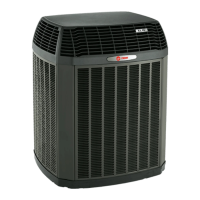
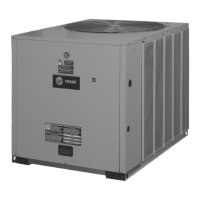
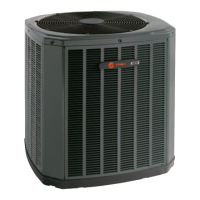
This document, "Application Guide SSC-APG002-EN," describes Trane XR Style Split Condensing Units and Heat Pumps, focusing on their application criteria, mounting, and minimum operating clearances.
Function Description:
Trane XR Style Split Condensing Units and Heat Pumps are designed for residential and light commercial HVAC applications, providing cooling and heating capabilities. These units are designed to operate effectively in various outdoor ambient temperatures, including low ambient conditions, with the aid of specific accessories. The application guide emphasizes the importance of proper installation, including unit mounting and maintaining adequate clearances, to ensure optimal performance, serviceability, and compliance with safety codes. The units are designed to be part of a matched indoor and outdoor system, and Trane recommends installing them with Trane-approved components. Systems with a nominal rating of 13 SEER and above are listed in the ARI Certified Directory with thermostatic expansion valves (TXV) only.
Important Technical Specifications:
-
Low Ambient Operation:
- Units can operate in cooling mode down to 45°F (7.2°C) as shipped from the factory when applied with an indoor TXV.
- With appropriate accessories, operation down to 30°F (-1.1°C) and even 0°F (-17.8°C) is possible.
- Compressor Crankcase Heater (CCHT): Required for low ambient cooling operation to prevent refrigerant migration during the compressor off cycle. Models include BAYCCHT300 (Reciprocating Compressor) and BAYCCHT301 (Scroll Compressor).
- Thermostatic Expansion Valve (TXV): A non-bleed TXV is required for low ambient cooling applications to maintain constant superheat. Bleed TXVs allow pressure equalization during the off cycle, while non-bleed TXVs do not.
- Head Pressure Controller (BAYLOAM103): Field-installed device that cycles the outdoor fan motor to maintain system head pressure, preventing indoor coil icing in colder ambients. Approved for heat pumps and cooling units.
- Evaporator Defrost Control: Field-installed device (AY28X079 for cooling only, AY28X084 for heat pumps) to prevent the system from running during cooling cycles when the indoor coil approaches freezing temperatures.
- Quick Start Component: May be factory installed or offered as an accessory (BAYKSKT***). Consists of a capacitor and a potential relay, wired in parallel with the compressor's run capacitor, to aid compressor startup. Required for single-phase units with reciprocating compressors when using non-bleed TXVs.
- Solenoid Valve: Required if the liquid line is one size larger than the factory connection (e.g., 3/8" factory connection with 1/2" existing liquid line) or if off-cycle time will be longer than 30 minutes during low ambient cooling operation.
- Wind Shields: Necessary for 0°F operation to block prevailing winds and maintain system performance. Designs are provided for highly directional and non-directional winds, with specific minimum clearances and free area requirements (e.g., 33% minimum free area for shadow box fences).
-
Unit Dimensions:
- The document provides detailed tables and diagrams for "Unit Dimensions 2TTR3 and 2TWR3" and "Unit dimensions 2TTR4 and 2TWR4," including cabinet sizes (Base 2, 3, and 4) and corresponding A, B, and C dimensions in both millimeters and inches. For example, a 2TTR3018A1000AA (Base 2) has dimensions of 651 mm (25 5/8") A, 724 mm (28 1/2") B, and 651 mm (25 5/8") C.
- Similar tables are provided for 4TTR3, 4TTR4, 4TWR3, and 4TWR4 models.
-
Airflow Performance:
- An "XR13 and XR14 Outdoor Unit Airflow Table" lists CFM (Cubic Feet per Minute) values for various 2TTR3/2TWR3, 2TTR4/2TWR4, 4TTR3/4TWR3, and 4TTR4/4TWR4 models. For example, a 2TTR3018A1 has an airflow of 1565 CFM, while a 4TTR3060A1 has 4610 CFM.
- Required opening for airflow is calculated as CFM / 300 FPM (Feet Per Minute).
Usage Features:
- Off-Season Cooling Operation: The guide details the necessary accessories and conditions for operating the units in cooling mode at outdoor temperatures below 45°F, including the use of CCHTs, TXVs, head pressure controllers, and evaporator defrost controls.
- Unit Mounting:
- Units should be supported from the edge, with supporting material extending a minimum of two inches beyond the basepan perimeter.
- Mounting holes are molded in the basepan and must be drilled through (5/16" drill size/bolt diameter).
- Trane recommends supporting the center of the unit with a cross member if not mounted on a plate.
- For regions with high winds, the Trane BAYECMT001 extreme conditions mounting kit is recommended. In seismic zones, local codes and a P.E.'s stamp may be required.
- Minimum Operating Clearances:
- System Operation: Adequate airflow (300 FPM maximum velocity) is crucial for heat transfer and maintaining head pressure.
- Serviceability: Sufficient working space is required for HVAC technicians to perform maintenance and component changes, adhering to Local, State, and National Codes (e.g., NEC Table 110.26).
- Space Maintenance: Adequate area around units to prevent debris accumulation and obstruction of airflow.
- Single Unit in a Corner: Clearances vary based on design ambient temperature (below or above 105°F). For example, below 105°F, 1.0 ft clearance on two sides and 3 ft on the service access side. If the service panel faces a wall, NEC requires a minimum 3 ft clearance. A 5 ft minimum unrestricted top clearance is always required.
- Multiple Units with Adjacent Walls: Clearances depend on unit base size and design ambient temperature. For example, below 105°F, a Base 2 unit requires 1.0 ft (A) and 1.0 ft (B) clearance, with a 36" service clearance. If service panels face each other, clearance may increase to 4 ft per NEC.
- Units Surrounded on Four Sides: If surrounded by walls and a solid fence, fence height should not exceed unit height. Openings providing 300 FPM air velocity must be provided in the fence, especially at the lower portion.
- Multiple Units on Pad/Rooftop: Similar clearance requirements as other multi-unit installations, with 3 ft minimum (4 ft if certain conditions) between service access panel and adjacent unit. Walls/fences should not be higher than the top of units. If ambient temperatures exceed 105°F, an additional 1.0 ft is added to all dimensions.
Maintenance Features:
- Service Access: The guide repeatedly emphasizes the importance of providing proper service access. Minimum clearances are specified to ensure technicians can easily access the unit for maintenance and repairs. For example, a 3-foot minimum clearance is required for the service access side, which may increase to 3.5 or 4 feet depending on specific conditions and NEC requirements.
- Electrical Code Compliance: The document includes excerpts from the National Electric Code (NEC) Article 110.26, detailing minimum working clearances for electrical equipment (e.g., 900 mm or 3 ft for 0-150V to ground) to ensure the safety of service personnel. Trane units require access to the side service panel for electrical controls.
- Debris Prevention: Maintaining appropriate space around the units helps prevent debris from collecting on panels, ensuring unobstructed airflow and reducing maintenance needs.

 Need help?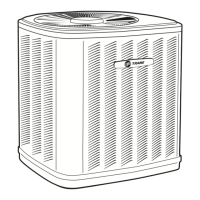

 To Next Page
 General