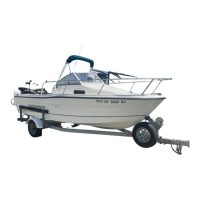
TROPHY Owner’s Manual Supplement
1901 Bay - 2101 Bay - 2401 Bay
36
The painted hull bottom will need to be inspected annually.
Any growth will affect the boats performance and overall
look. If it has been a while between inspections you might
notice algae or slime growth. This can be cleaned with
a coarse towel or soft bristle brush. The growth should
be cleaned immediately after the boat has been removed
from the water. If the growth is allowed to dry it will be
that much harder to remove. If the growth is more severe,
you may need to enlist the services of a professional hull
cleaning company. Fresh water, salt water and water
temperature can all affect the types of growth that you
will find on your boats hull.
Painted Hull Care (Bottom)
Vinyl Cushion Care
The cushions on your boat are made of a durable vinyl
material called OMNOVA and is protected by a finish
called PreFixx.
This protective finish is designed to be cleaned easily,
over and over without showing signs of wear. The PreFixx
finish gives you the freedom to remove stains with ease
that were not possible before.
The vinyl material and superior finish has been tested to
resist heavy abrasion. There is a 3 step cleaning process
recommended by the manufacturer; that if followed will
ease in cleaning the vinyl cushions.
Complete cleaning instructions are included in the
owner’s packet. Read all information provided by the
cushion manufacturer regarding the proper cleaning and
maintenance.
Notice: As the level of stain is increased; the likelihood
of using solvents may be necessary.
Read all information from the solvent manufacturer
regarding safety and handling of this material.
Wear proper protective equipment to insure your personal
safety. Only use solvents in a well ventilated area and test
the solvent in a conspicuous section of the affected vinyl.
Keep all solvents away from open flame and any other
forms of ignition.
Do not use bleach or solvents to clean the vinyl
cushions.
Storage or winter lay-up will require you to make sure
that your boat and its systems are properly conditioned
for extended periods of non-usage.
It is important that you follow all the recommendations
set by the engine owner’s operations manual. It will give
you a schedule of when these important functions need
to be done.
Engine:
Protecting your engine’s vital moving parts from corrosion
and rust caused by freezing of trapped water or excessive
condensation due to climatic changes is very important.
Internal engine parts can be effected by rust due to lack
of proper lubrication. Freezing water in the engine can
cause extensive damage to the internal moving parts.
Fuel System:
Tank(s), hoses, fuel pump and carburetor should be treated
to help prevent the formation of varnish and gum. Empty
gas tanks collect condensation which could lead to fuel
contamination and/or premature wear of your system.
Long periods of storage and/or non-use, common to boats,
create unique problems. When preparing to store a boat
for extended periods, of two months or more, it is best
to completely remove all fuel from the tank. If it is not
possible to remove the fuel, maintaining a full tank of
fuel with a fuel stabilizer added to provide fuel stability
and corrosion protection is recommended.
Trailer Storage:
If you will be storing the boat for an extended amount of
time on its trailer, you will need to lift the trailer off of
its wheels. Use care when raising the trailer. The surface
should be level and conditioned to accept the weight of the
boat and trailer and allow for adequate drainage. Covering
the wheels will protect them from harmful UV rays.
Repeatedly immersing the trailer in water during boat
launching can cause a variety of problems. Water seeping
into the wheel hubs will cause the grease to emulsify
and can prematurely corrode the bearings. Check with
the trailer manufacturer for scheduled maintenance of
your trailer.
Long Term Storage



 To Next Page