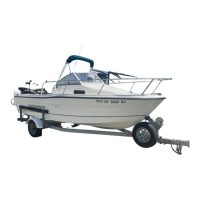
TROPHY Owner’s Manual Supplement
1901 Bay - 2101 Bay - 2401 Bay
6
Fire Avoidance & Safety
Fire and explosion can be avoided by:
• Checking for the odor of fuel in the bilge.
• Inspect the fuel tank, connections and
fuel vent for leaks, and proper fi t.
• Stow all flammable items away from
combustion source.
• Clean any fuel spillages immediately.
• Never smoke in the area where fuel is
stored or where the odor of fuel is present.
• Always carry or store fuel in approved
containers.
• Carry an approved fi re extinguisher, check
the charge bimonthly and have it readily
accessible.
• Know how to use the fi re extinguisher,
and inform passengers on the proper usage
of the fi re extinguishing equipment.
Fire Port
The deck plate located in the aft
cockpit, used to access the fuel
tank and valves, can be
removed to flood the area
with extinguishant in the event
of an emergency.
NOTICE
The law requires the operator to assist any
person or boat in distress as long as rendering
assistance does not endanger the operator, the
passengers or the boat
General Considerations
High performance boats require intimate knowledge
of their handling characteristics for safe high speed
operation.
On the water there are no marked traffic lanes, no traffic
signs or lights, and boats have no turn signals. The boat
operator must keep her or his attention focused not only
on what’s ahead but what’s on the left, right and behind
the boat.
The operator must always be alert to approaching boats
(from the rear, right and left sides, as well as those ahead).
There can be people in the water, partially submerged
debris, and other navigational hazards such as rocks, sand
bars, dangerous currents, to name a few.
Your passengers are relying on you to operate and
maneuver the boat safely so that they are not in danger
of going overboard. If you turn too quickly, increase or
decrease speed abruptly, your passengers are at risk of
being thrown overboard or thrown about the boat.
When visibility becomes impaired because of weather,
time of day or high bow angle you must slow down so
that you have sufficient time to react if an emergency
occurs. Nearby boats face similar risks in avoiding a
collision with you.
• Learn the effects of trim, steering and
throttle changes at gradually increasing levels
of speed.
• Approach full throttle while adjusting trim
for safe handling of the vessel.
• Know how your boat handles under
different conditions. Recognize your limitations
and the boat’s limitations. Modify speed in
keeping with weather, sea and traffi c
conditions.
• Instruct passengers on location and use
of safety equipment and procedures.
• Instruct passengers on the fundamentals of
operating your boat in case you are unable
to do so.
• You are responsible for passenger’s actions.
If they place themselves or the boat in
danger, immediately correct them.



 To Next Page