Need help?
Do you have a question about the Trotec TCH 2050 E and is the answer not in the manual?
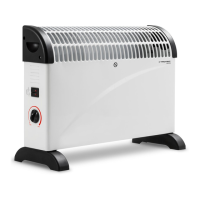
This document describes the TCH 2050 E convector, an electrical local space heater designed for generating warm air in interior spaces. It is suitable for well-insulated spaces or occasional use, including living spaces, storerooms, salesrooms, construction areas, containers, and basements. The device operates by heating air with an electric heating element, which then circulates through the air outlet to warm the room.
The TCH 2050 E convector is an electric heater that generates heat through an integrated heating element. The air surrounding this element is warmed and then released into the room through the top and side air outlets. It features an integrated temperature sensor that monitors the current room temperature and adjusts the heating level to reach a desired temperature, which can be set between 15 °C and 35 °C. The device offers two heating levels: a low heating level (1200 W) and a high heating level (2000 W).
Operation is possible via the control panel on the device itself or through the included infrared remote control. The convector also includes integrated castors on its feet for easy positioning within a room.
The device can be switched on by setting the on/off switch to 'I', which emits an acoustic signal and puts the device in standby mode, displaying the current room temperature. Pressing the power button activates the low heating level, indicated by an illuminated icon. A second press activates the high heating level, with both low and high heating level icons illuminated.
To set the desired room temperature, the MODE button is pressed repeatedly until the temperature symbol flashes. The desired temperature can then be adjusted using the increase or decrease value buttons (15 °C to 35 °C in 1 °C increments). The setting is saved after approximately 5 seconds, and the display reverts to the current room temperature. The desired room temperature should always be higher than the current room temperature for heating to occur.
The convector also features a timer function with two modes: automatic switch-on and automatic switch-off. The timer can be set for 1 to 24 hours in 1-hour increments. For automatic switch-on, the device must be in standby mode. Pressing the MODE button until the timer icon flashes allows setting the desired number of hours until switch-on. For automatic switch-off, the device must be running. Pressing the MODE button until the timer icon flashes allows setting the desired number of hours until switch-off. Setting the timer to 0 hours disables the timer function. Manually switching the device off also disables the automatic switch-off function.
Safety features include overheating protection via a safety thermostat. If the device overheats, it will automatically switch off and restart once it has cooled down sufficiently. If the safety thermostat fails, the overheating protection will trip, switching the device off completely, requiring customer service intervention.
Before any maintenance, the device must be switched off, unplugged from the mains socket (holding the plug, not the cable), and allowed to cool down completely.
Cleaning the housing should be done with a soft, damp, lint-free cloth. It is crucial to prevent moisture from entering the housing and to protect electrical components. Aggressive cleaning agents, solvents, alcohol-based, or abrasive cleaners should not be used. After cleaning, the housing should be wiped dry.
Tasks requiring the device to be opened or involving electrical components must only be carried out by authorized specialist companies or by Trotec to prevent electric shock and ensure safety.
For storage, the device should be dry, protected from frost and heat, stored in an upright position away from dust and direct sunlight, and covered if necessary. Batteries should be removed from the remote control before storage. No other devices or objects should be placed on top of the convector to prevent damage.
In case of malfunctions, initial checks include power connection, cable and plug integrity, on-site fusing, room temperature (thermostat may have switched off), and whether overheating protection has tripped. If the device does not start after 10 minutes, professional inspection is required. If the remote control is unresponsive, check distance, obstacles, battery charge, and polarity.


 To Next Page
 General