6
TRUE
tcgr
www
.truemfg.com
INSTALLATION OF CASTORS
TOOLS REQUIRED:
• Castor wrench (if not included contact TRUE)
• Adjustable wrench
NOTE: CASTORS NOT AVAILABLE FOR HARD WIRED
MODELS.
WARNING: MAKE SURE UNIT IS EMPTY OF
ALL ITS CONTENTS (SHELVING, SHELVING
LIGHTING). MAKE SURE POWER SUPPLY HAS BEEN
DISCONNECTED.
A. Curved glass can be damaged if you lay unit on its back, side,
or front. Use a 6" x 6" (15.2 cm x 15.2 cm) block of wood or
equivalent. Slide the block under the cabinet frame rail. This will
support the unit while installing castors.
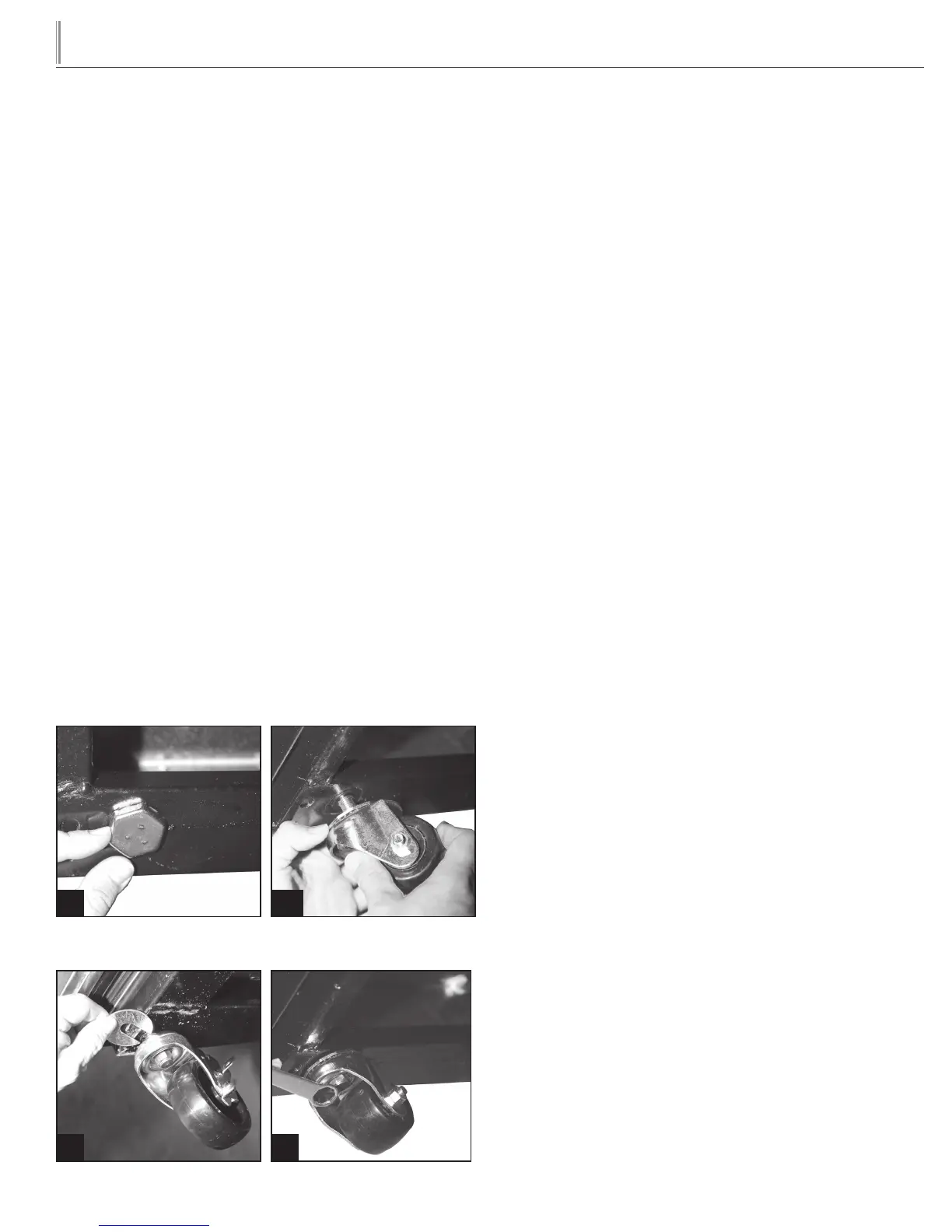
B. Leg levelers can be backed out by hand (Image 1).
C. Take two threaded castors and thread them into the existing
leg leveler holes. (Image 2). Shims can be used between castor
and cabinet frame rail for leveling (Image 3). Use the tool
provided to tighten the threaded castors (Image 4).
D. Repeat process for the other side of the cabinet.
WARNING: DISPLAY CASE MUST BE LEVELED
ACCURATELY TO ENSURE FRONT GLASS DOOR
SEALS PROPERLY.
E. The unit should be leveled front to back and side to side with
a level. Place the level in the interior floor of the unit and check
all four sides.
SEALING CABINET TO FLOOR
It may be necessary to seal the bakery case to the floor for local sani-
tary codes or if the customer so desires. TRUE recommends either
of the following methods.
A. Using a vinyl cove base trim as produced by Armstrong,
Johnson, or Kentile (available at floor covering suppliers) or
using mastics available at hardware stores.
B. When applying the cove base trim, thoroughly clean both the
cabinet and floor of dirt and grease. Apply a recommended
contact cement to the cove base trim. After cove base trim has
dried, fill in cracks and joints with a caulking material.
C. When applying a mastic, thoroughly clean both the cabinet
and floor of dirt and grease. Draw an outline of the cabinet on
the floor. Raise and block the front side of the cabinet. Apply
a bead of mastic to the floor 1/2" (1.3 cm) inside the outline
drawn. Lower the cabinet. Raise and block the rear side of the
cabinet. Apply the bead of mastic, lower the cabinet.
NOTE: Asphalt floors are very susceptible to chemical attack.
A layer of tape on the floor prior to applying the sealant will protect
the floor.
NSF APPROVED SEALANTS:
1. Minnesota Mining #ECU800 Caulk
2. Minnesota Mining #ECU2185 Caulk
3. Minnesota Mining #ECU1055 Bead
4. Minnesota Mining #ECU1202 Bead
5. Armstrong Cork - Rubber Caulk
6. Products Research Co. #5000 Rubber Caulk
7. G.E. Silicone Sealer
8. Dow Corning Silicone Sealer
Tighten castor in position with
castor wrench.
Use shims as necessary to level
cabinet.
43
Back out leg levelers by hand, or
with adjustable wrench.
Thread castors into existing leg
leveler holes.
21



 To Next Page