Need help?
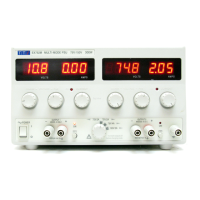
Do you have a question about the TTI EX752M and is the answer not in the manual?
Details voltage range, current, output settings, operating mode, terminals, impedance, protection, regulation, noise, response, temp coefficient, and status.
Describes selection, capabilities, and limitations of Modes A, B, and C.
Specifies meter types, resolutions, accuracies, and operating modes for output meters.
Covers AC input, power consumption, operating/storage range, environmental, safety, EMC, size, and weight.
Covers safety class, environmental conditions, proper usage, and basic warnings.
Emphasizes earthing, disconnection before opening, potential for charged capacitors, and qualified personnel for repair.
Explains common safety symbols used in the manual and on the instrument.
Advises on skilled engineers, proper tools, and handling of fine PCB tracks.
Provides step-by-step instructions for safely disassembling the instrument.
Describes the AC input stage, filtering components, and rectification.
Explains the primary control IC, start-up, voltage error amplifier, and current error amplifier functions.
Details the function of the boost stage, forward converter, and associated components.
Describes the rectification, filtering, linear regulation, and protection of the main outputs.
Explains how auxiliary power rails for control electronics are generated.
Details the generation of +15V, +5V, and -5V auxiliary rails.
Explains how voltage is set using potentiometers, error amplifiers, and gate drive.
Describes how current is limited and controlled using error amplifiers and lamps.
Details the microcontroller, A-to-D converter, multiplexer, and display drivers.
Explains the selection of isolated, parallel, and series modes using switches and opto-isolators.
Mentions referencing General section, component references, warm-up time, and required equipment.
Provides step-by-step instructions for voltage and current calibration in Mode A.
Details calibration steps for Modes B and C, focusing on current and voltage display accuracy.
Explains how to measure differential and common-mode noise using specific equipment.
Lists washers, nuts, screws, clips, inductors, and fuses for the main PCB.
Lists transformers, chokes, magamps, fuses, and receptables for the main PCB.
Lists main PCB resistors with part numbers, descriptions, and positions.
Continues listing main PCB resistors with part numbers, descriptions, and positions.
Lists main PCB capacitors with part numbers, descriptions, and positions.
Lists diodes, thyristors, and rectifier bridges for the main PCB.
Lists transistors (PNP, NPN, MOSFET) for the main PCB.
Lists integrated circuits and opto-couplers for the main PCB.
Lists switches, relays, headers, and ICs for the control PCB.
Lists resistors for the control PCB with part numbers, descriptions, and positions.
Continues listing resistors for the control PCB.
Lists capacitors for the control PCB with part numbers, descriptions, and positions.
Lists ICs, diodes, and thyristors for the control PCB.
Lists transistors and mechanical items for the control PCB.
Lists mechanical parts like nuts, screws, washers, sleeves, terminals, and knobs.
Lists PCB assemblies, instruction book, and associated mechanical items.
Diagram showing component placement on the Main PCB.
Diagram showing component placement on the Control PCB.
Detailed schematic diagram of the Main Printed Circuit Board.
Schematic diagram for the Control PCB, Channel A (slave).
Schematic diagram for the Control PCB, Channel B (master).
 General
| Model | EX752M |
|---|---|
| Manufacturer | TTI |
| Output Voltage Range | 0 - 75 V |
| Output Current Range | 0 - 2 A |
| Power Rating | 150 W |
| Voltage Resolution | 1 mV |
| Current Resolution | 0.1 mA |
| Programming Interface | USB, RS232, LAN |
| Protection Features | OVP (Over Voltage Protection), OCP (Over Current Protection), OTP (Over Temperature Protection) |
| Operating Temperature Range | 0°C to 40°C |
| Weight | 4.5kg |

 To Next Page