Need help?
Do you have a question about the TTI QL355 and is the answer not in the manual?
Specifies voltage/current ranges, setting resolution, output modes, terminals, and transient response times.
Details display type, voltage (CI mode), current (CV mode), and VxA measurement accuracy.
Outlines voltage, accuracy, current limit, protection, and terminal details for the auxiliary output.
Describes RS232, IEEE-488, and USB communication interface capabilities and specifications.
Details radiated, conducted, and harmonic emission test limits and compliance according to EN61326.
Covers electrostatic discharge, electromagnetic field, and transient immunity test methods, limits, and performance.
Precautions to ensure continued EMC compliance, including correct reassembly and part replacement.
Critical warning about mandatory earthing and hazards of interrupting the earth conductor for user safety.
Guidelines for skilled engineers on static sensitivity, proper tools, and PCB handling during maintenance.
Step-by-step instructions for safely disassembling the unit, including cover and PCB removal.
Explains the functionality of the Power PCB, including transformer windings, regulators, and microcontroller.
Details the Control PCB's role in voltage/current control, ADC/DAC functions, and protection circuits.
Lists the necessary test equipment, including a precision multimeter for accurate calibration procedures.
Step-by-step guide for calibrating the power supply outputs and settings using specific operational steps.
Comprehensive list of components for Power, Control, Interface, and other PCB assemblies with part numbers and positions.
Details mechanical parts, fasteners, chassis elements, and hardware for various QL models.
High-level overview of the instrument's functional blocks and data flow for understanding system architecture.
Visual representation of how different PSUs and PCBs connect internally for single and triple units.
Diagrams showing the physical placement of components on various PCBs for identification and assembly reference.
Detailed schematics for AC supply, control, power, interface, and auxiliary circuits for troubleshooting and analysis.
 General
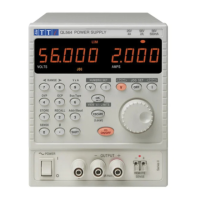
| Output Voltage | 0 - 35V |
|---|---|
| Output Current | 0 - 5A |
| Power | 175 W |
| Ripple & Noise | < 1 mV rms |
| Voltage Resolution | 10 mV |
| Current Resolution | 1 mA |
| Input Voltage | 100-240 V AC |
| Frequency | 50/60 Hz |
| Interface | RS232, USB |
| Display | 4 digit LED |

 To Next Page